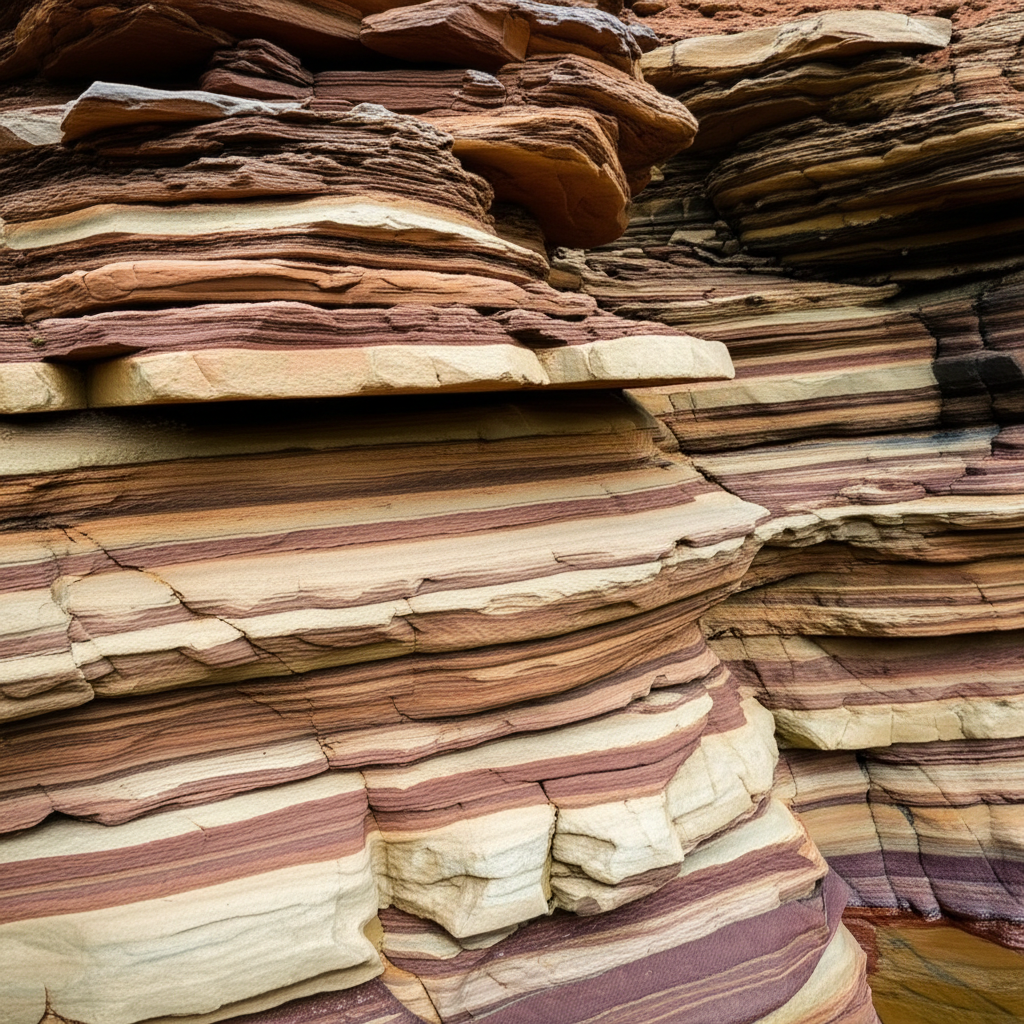
Why do rocks often display those distinctive, horizontally stacked layers? It’s a common observation that sparks curiosity, transforming what seems like a simple geological feature into a profound narrative of Earth’s ancient past. These stratified patterns, visible in everything from towering canyon walls to a single pebble, are not random occurrences but rather the product of relentless geological processes unfolding over millions of years. Unveiling the truth behind these layers offers a mesmerizing glimpse into the dynamic history of our planet, revealing stories of ancient seas, shifting continents, and vanished life forms.
At its core, the reason many rocks exhibit layers lies in the process of sedimentation. Imagine a landscape constantly being shaped by wind, water, and ice. Over vast spans of time, existing rocks are gradually weathered down into smaller fragments – sand, silt, clay, gravel, and dissolved minerals. This broken-down material, collectively known as sediment, is then transported from its origin by various natural forces. Rivers carry sediment downstream, depositing it along their banks or at their mouths; winds pick up dust and sand, scattering it across landscapes; glaciers grind and drag rocks, leaving behind unique deposits.
As these transportation agents lose energy, the sediment begins to settle. In bodies of water like oceans, lakes, and rivers, heavier, coarser particles settle first, followed by finer materials. This continuous deposition forms distinct layers, one on top of another. Crucially, environmental conditions are rarely static. A river might flood, carrying a different type of sediment, or sea levels might rise and fall, altering the types of materials deposited in a particular area. Each change in depositional conditions — whether it’s the size of the grains, the type of minerals, or the colour of the material — results in a new, discernible layer.
But these loose layers of sediment need to become rock. This transformation is known as lithification, a two-step process involving compaction and cementation. As more and more layers of sediment accumulate, the sheer weight of the overlying material presses down on the lower layers. This immense pressure expels water and air from between the particles, causing them to pack together tightly – a process called compaction. Following compaction, dissolved minerals in the groundwater (such as calcite, silica, or iron oxides) precipitate out and crystallize in the tiny spaces remaining between the sediment grains. These new minerals act like natural glue, binding the particles together to form solid sedimentary rock.
Why Different Layers Reflect Different Stories
The variations observed in rock layers are not merely aesthetic; they are invaluable geological records. Each layer, or “stratum,” tells a specific story about a particular moment in Earth’s history.
Changes in Sediment Type: A layer of sandstone forming above a layer of shale indicates a shift from a calmer, deeper water environment (where fine clay particles settle) to a more energetic, shallower environment (where sand is deposited, perhaps on a beach or delta). Limestone layers often signify clear, warm marine conditions, rich in marine life whose shells contribute to the rock.
Variations in Climate: Layers can reveal ancient climates. For instance, evaporite layers (like rock salt or gypsum) suggest arid conditions where large bodies of water evaporated, leaving behind minerals. Tillites (rock formed from glacial till) point to past ice ages.
Biological Activity: The presence of fossils within layers provides direct evidence of ancient life. Different fossil assemblages in successive layers demonstrate evolutionary changes and ecosystem shifts over time. Coal seams, for example, are distinct layers formed from vast accumulations of plant matter in ancient swamps.
Cyclical Changes: Many sedimentary rocks show rhythmic layering, or varves, which can represent annual cycles of deposition. For example, in glacial lakes, a thicker, coarser layer might be deposited during the summer melt, while a finer, darker layer settles during the winter freeze.
Beyond the predominant sedimentary processes, other geological mechanisms can also create layered appearances in rocks, though these layers form differently and convey different types of information.
Igneous Rocks: While typically massive and uniform, some igneous rocks exhibit layering. For instance, volcanic lava flows can display flow banding as viscous lava moves, arranging minerals and gas bubbles into parallel streaks. In large magma chambers, heavier minerals might settle at the bottom as the magma cools, creating distinct layers of different mineral compositions known as cumulate layers.
Metamorphic Rocks: Metamorphism involves the transformation of existing rocks under intense heat and pressure. In regional metamorphic settings, directed pressure can cause platy or elongated minerals (like micas) to align perpendicular to the stress. This alignment creates a planar fabric known as foliation, which appears as distinct bands or layers within the metamorphic rock (e.g., in slate, schist, or gneiss). These layers reflect the forces experienced during metamorphism rather than depositional history.
Why Are Rock Layers So Important for Understanding Earth’s History?
The layered structure of sedimentary rocks forms the bedrock of geology. The principle of superposition states that in an undisturbed sequence of sedimentary rocks, the oldest layers are at the bottom, and the youngest layers are at the top. This fundamental concept allows geologists to reconstruct a chronological timeline of Earth’s past. By studying the composition, texture, and fossil content of each layer, scientists piece together a detailed picture of ancient environments, climates, and the evolution of life.
These layers are like pages in Earth’s autobiography, each one chronicling a specific chapter. They reveal transitions from deserts to oceans, from forests to swamps, and from periods of intense volcanic activity to quiet sedimentary accumulation. Unconformities, which are gaps or erosional surfaces within the layered sequence, indicate periods where deposition ceased, and existing layers were eroded before new ones were laid down, signifying lost chapters in the geological record.
Finally, the layers we see exposed in mountainsides and canyons today have often undergone further geological modifications. Tectonic forces, driven by the slow movement of Earth’s crustal plates, can uplift, tilt, fold, and fault these once-horizontal layers. Erosion then sculpts these disturbed strata, revealing the intricate patterns and profound history contained within.
In conclusion, the visually stunning layers within rocks are far more than just pretty patterns. They are the cumulative result of countless cycles of weathering, erosion, deposition, and lithification, meticulously recording billions of years of Earth’s dynamic processes. Each stratum is a timestamp, a fossilized snapshot of ancient conditions and life, offering scientists—and anyone with a curious mind—an unparalleled opportunity to read the epic saga of our planet’s past.
0 Comments