Why does the Moon affect tides? This seemingly simple question unlocks one of the most elegant and accessible demonstrations of universal gravitation at play in our everyday lives. For millennia, humanity has observed the rhythmic ebb and flow of the oceans, intuiting a connection to our celestial companion. The amazing, simple cause lies in the fundamental laws of physics that govern every interaction in the cosmos, specifically the force of gravity and its varying strength across distance.
At its core, the Moon’s influence on Earth’s tides is a direct consequence of Isaac Newton’s Law of Universal Gravitation. This law states that every particle of matter in the universe attracts every other particle with a force that is directly proportional to the product of their masses and inversely proportional to the square of the distance between their centers. While the Moon is far smaller than the Sun, it is vastly closer to Earth, making its gravitational pull the primary driver of tidal forces.
The Gravitational Tug-of-War
Imagine the Earth and its surrounding oceans being pulled by the Moon’s gravity. It’s not a uniform pull across the entire planet. This is the crucial point: the strength of gravity diminishes with distance.
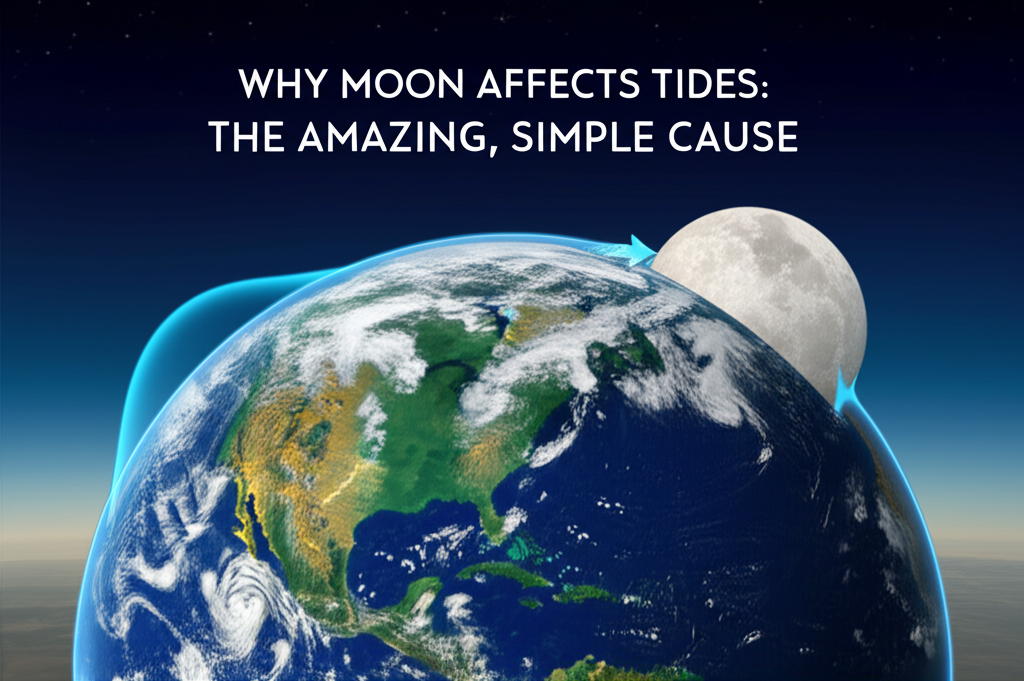
The Near-Side Bulge: On the side of Earth facing the Moon, the Moon’s gravitational pull is strongest. Water on this side is directly pulled towards the Moon with the greatest force. This pull causes the water to “pile up,” creating a high-tide bulge.
The Far-Side Bulge: A Counter-Intuitive Reality
This is where the concept of differential gravity becomes key, and it’s often the most confusing part of understanding tides. The Earth as a whole is pulled towards the Moon. However, the water on the side of Earth farthest from the Moon experiences a weaker gravitational pull than the solid body of the Earth, which is closer to the Moon’s center of mass.
Think of it this way: The Moon pulls on the solid Earth more strongly than it pulls on the distant water. This stronger pull on the Earth effectively pulls the Earth away from the water on the far side, leaving that water to “lag behind” or “bulge out” in the opposite direction. It’s not being pushed out, but rather the rest of the Earth (including the water on the near side) is being pulled more strongly away from it. This differential pull creates a second high-tide bulge on the side of Earth opposite the Moon.
Why Two High Tides? The Power of Differential Gravity
So, we have two high tides approximately opposite each other: one directly facing the Moon, and one on the far side. Between these two bulges, there are areas where the water level is lower. These correspond to the low tides, occurring roughly 90 degrees from the Moon’s alignment. As the Earth rotates on its axis approximately every 24 hours, different locations cycle through these bulges and troughs. This is why most coastal areas experience two high tides and two low tides each day.
The precise timing isn’t exactly every 12 hours, though. Because the Moon is also orbiting Earth, it moves slightly in its orbit during the 24 hours it takes for Earth to complete a rotation. This means Earth has to rotate for an additional 50 minutes or so to catch up with the Moon, resulting in the high-tide cycle being closer to 12 hours and 25 minutes.
Beyond the Moon: The Sun’s Supporting Role
While the Moon is the primary driver, the Sun also exerts a significant gravitational influence on Earth. Although the Sun is vastly more massive than the Moon, its much greater distance means its tidal effect is only about half that of the Moon’s. However, when the Sun and Moon align, their combined gravitational forces amplify the tidal effects.
Spring Tides: During New Moons and Full Moons, the Earth, Moon, and Sun are aligned in a straight line. Their gravitational pulls combine, resulting in stronger tidal forces. This leads to exceptionally high high tides and unusually low low tides, known as spring tides (no relation to the season, but derived from the word “spring” meaning to burst forth).
Neap Tides: When the Moon is in its first or third quarter phase, it is at a right angle to the Sun relative to Earth. In this configuration, the Sun’s gravity partially counteracts the Moon’s gravity. This results in weaker tidal forces, leading to lower high tides and higher low tides, known as neap tides.
Other Influences on Tides
While celestial mechanics explain the fundamental patterns, many other factors modify the tides we observe at specific locations:
Local Topography: The shape of coastlines, bays, and ocean basins can funnel or amplify tidal currents, creating dramatic differences in tidal ranges. For example, the Bay of Fundy in Canada experiences some of the highest tides in the world due to its unique funnel shape.
Ocean Depth: The depth of the ocean floor influences how tidal waves propagate.
Weather Conditions: Strong winds blowing in a particular direction can push water towards or away from a coast, altering local tide levels. Atmospheric pressure can also play a role, with lower pressure generally allowing water levels to rise slightly.
The Coriolis Effect: This force, caused by Earth’s rotation, deflects tidal currents, creating complex patterns in open oceans.
In conclusion, the question of why the Moon affects tides reveals a beautiful interplay of celestial mechanics. It’s not just the Moon’s overall gravitational pull that causes the oceans to rise and fall, but crucially, the difference in that pull across Earth’s expansive body. This differential gravity creates two bulges of water, and as our planet rotates through these bulges and the troughs between them, we experience the predictable, yet often astonishing, rhythm of the tides. From the simple elegance of Newton’s law to the complex dance of cosmic bodies, the tides serve as a constant reminder of the unseen physical forces shaping our world.
0 Comments