- The Invisible Hand: Gravity's Embrace
- Why the Moon Creates Two Bulges
- The Sun's Supporting Role: Spring and Neap Tides
- Other Factors Influencing Tides
- The Powerful Truth and Its Impact
Why do our oceans rise and fall with such predictable rhythm? The answer lies in one of the universe’s most fundamental forces: gravity. For centuries, humanity has observed the powerful dance between the Moon and Earth’s waters, noting how the lunar cycle dictates the ebb and flow of tides. While folklore often attributed this phenomenon to mysterious lunar powers, the powerful truth is a remarkable testament to Newtonian physics and the elegant mechanics of our solar system. Understanding this celestial ballet reveals not just the Moon’s influence, but the intricate web of forces that shape our planet.
The Invisible Hand: Gravity’s Embrace
At the heart of tidal dynamics is gravity. Sir Isaac Newton’s Law of Universal Gravitation states that every particle of matter in the universe attracts every other particle with a force directly proportional to the product of their masses and inversely proportional to the square of the distance between their centers. In simpler terms, big things pull on other big things, and the closer they are, the stronger that pull.
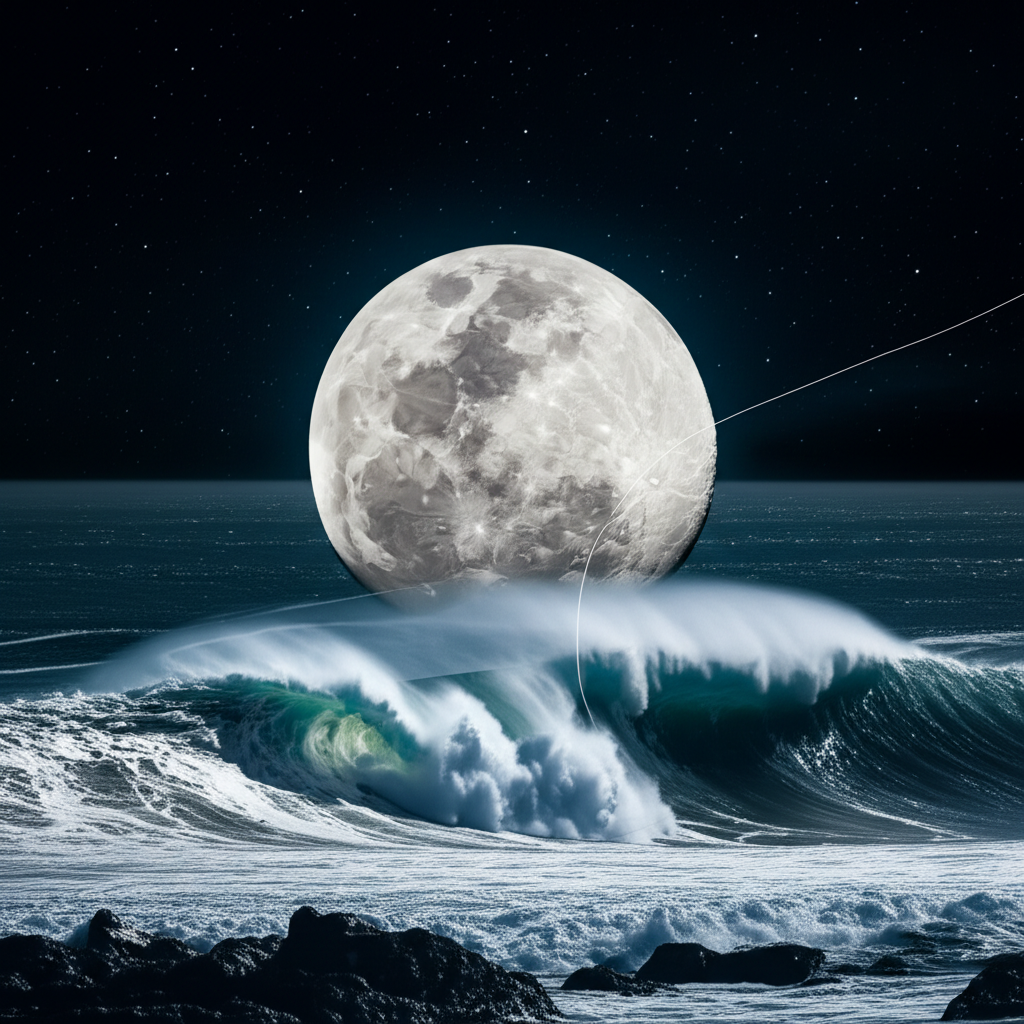
The Moon, despite being much smaller than the Sun, is significantly closer to Earth. This proximity makes its gravitational influence on our planet’s oceans far more potent than that of the distant Sun, acting as the primary conductor of the tidal orchestra. While Earth’s gravity holds us firmly to its surface, the Moon’s gravity subtly tugs at everything on Earth, including its vast bodies of water.
Why the Moon Creates Two Bulges
Here’s where the explanation truly reveals the genius of natural laws. It’s not just the Moon’s overall pull on Earth that matters, but the difference in its pull across Earth’s diameter. This differential gravitational force is the key to understanding why we experience two high tides a day.
Imagine the Earth and its oceans. The side of the Earth facing directly towards the Moon experiences the Moon’s strongest gravitational pull. This stronger tug literally pulls the ocean water on that side towards the Moon, creating a bulge – our first high tide.
But what about the opposite side of Earth, furthest from the Moon? Here, the Moon’s gravitational pull is weakest. The Moon is effectively pulling the solid Earth away from the water on this far side. Think of it like a tablecloth being pulled from beneath a setting of dishes: the dishes (ocean water) are left behind as the table (solid Earth) moves. This leaves a second bulge of water on the side of Earth opposite the Moon, creating our second high tide.
In essence, the Moon stretches the Earth ever so slightly, elongating its watery envelope into an elliptical shape with two bulges. As the Earth rotates on its axis approximately every 24 hours, any given point on the planet passes through these two bulges and two corresponding troughs (low tide areas), resulting in the familiar cycle of two high tides and two low tides each day. This is a crucial answer to why we experience this dual effect.
The Sun’s Supporting Role: Spring and Neap Tides
While the Moon is the primary driver, the Sun also exerts its own gravitational pull on Earth’s oceans. Although the Sun is massively larger than the Moon, its much greater distance means its tidal influence is about half that of the Moon’s. However, the Sun’s gravity isn’t negligible; it collaborates with or counteracts the Moon’s pull, leading to variations in tidal range.
Spring Tides: When the Moon, Earth, and Sun are aligned in a straight line (during New Moon and Full Moon phases), their gravitational forces combine. This synergistic pull creates exceptionally high high tides and very low low tides, known as spring tides. The term “spring” here does not refer to the season, but to the “springing forth” or “rising” of the tide.
Neap Tides: When the Moon and Sun are at right angles to each other relative to Earth (during the first and third quarter moon phases), their gravitational pulls partially cancel each other out. The Sun’s gravity works against the Moon’s, resulting in less extreme tides – lower high tides and higher low tides – known as neap tides.
Other Factors Influencing Tides
While celestial mechanics are the fundamental drivers, local geography plays a significant role in how tides manifest in specific locations.
Ocean Basin Shape: The size, depth, and shape of ocean basins, bays, and estuaries can profoundly modify tidal characteristics. Narrow inlets can amplify tides, creating spectacular tidal bores, while large, open oceans experience more modest ranges.
Landmasses: Continents obstruct the free flow of tidal bulges, reflecting and refracting tidal waves, further complicating predictable patterns.
Weather Conditions: Strong winds can push water towards or away from coastlines, affecting local water levels, while atmospheric pressure changes can also have minor effects.
Resonance: In some rare cases, the natural oscillation period of a particular body of water might perfectly match the tidal period, leading to extremely dramatic tidal ranges, such as those seen in the Bay of Fundy, Canada.
The Powerful Truth and Its Impact
The powerful truth of why the Moon affects tides extends beyond academic curiosity. Tides are vital to countless ecological processes and human activities. They create complex intertidal zones, unique ecosystems where marine life has adapted to survive periods of both submersion and exposure. Tides influence coastal erosion, sediment transport, and the flushing of estuaries. For humans, understanding tides is crucial for navigation, fishing, coastal engineering, and even the generation of renewable energy.
From the gentle lapping of waves on a beach to the dramatic rise and fall in a bustling harbor, the Moon’s unseen gravitational hand orchestrates a continuous, powerful dance with our planet’s oceans. It’s a reminder of the universe’s elegant design, where forces spanning millions of miles create a rhythm essential to life on Earth.
0 Comments