
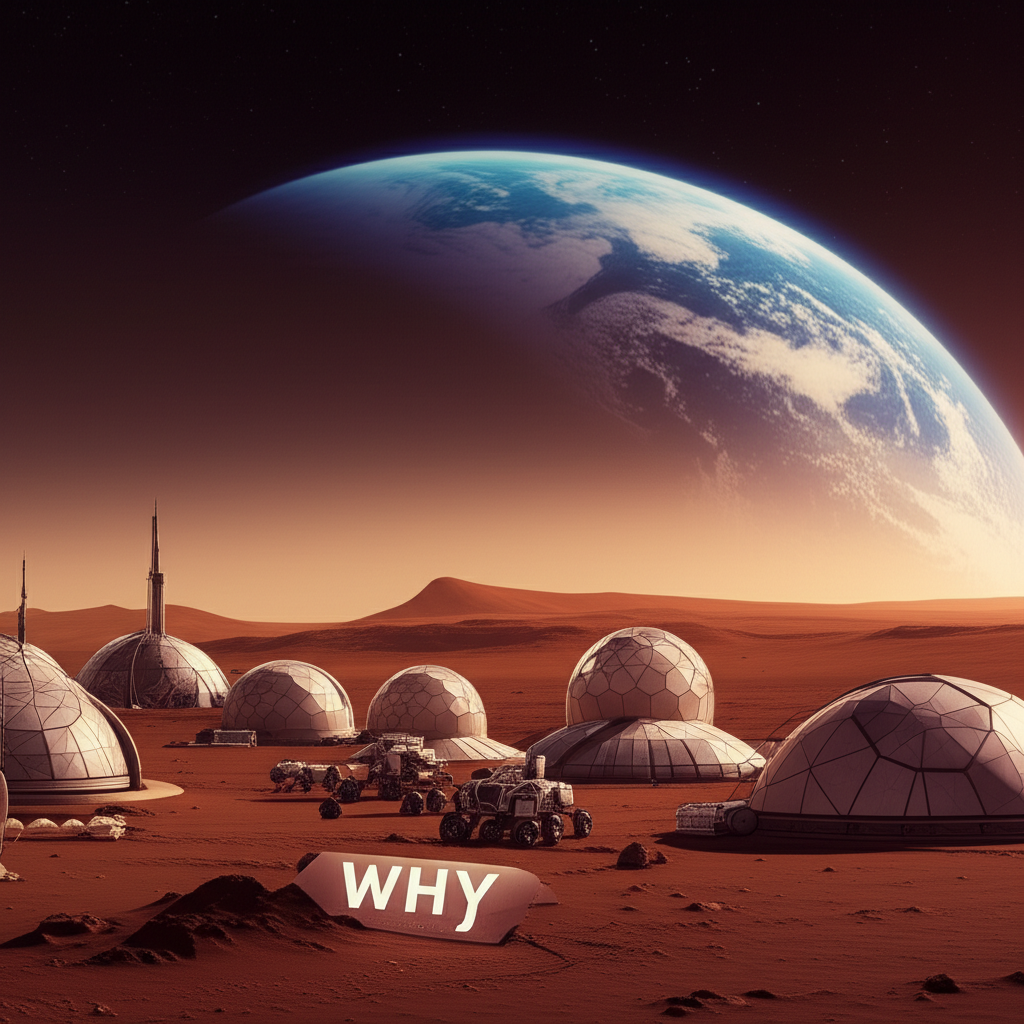
- The Imperative for a Multi-Planetary Future
- Why Mars Triumphs: A Closer Look at its Advantages
- Why Overcoming Martian Challenges is Within Reach
- The Next Great Leap for Humanity
Why do we look to the stars? Why do we dream of another world, another home, when our own Earth is so vibrant and alive? The answer lies not just in a romanticized vision of the future, but in a pragmatic understanding of humanity’s long-term survival and insatiable drive for exploration. As our technological capabilities grow, so too does our awareness of both the fragility of our planetary existence and the incredible opportunities that lie beyond it. Among the myriad celestial bodies in our solar system, one red orb consistently captures our imagination and our scientific focus: Mars. It stands as our most promising candidate for humanity’s ultimate next home, offering a blend of proximity, potential resources, and a curious similarity to Earth that makes the seemingly impossible, merely improbable.
The Imperative for a Multi-Planetary Future
The contemplation of leaving Earth is not a choice born of disdain for our current home, but rather a realization of an unavoidable truth: all eggs in one basket is a risky strategy. Earth faces a multitude of threats, both natural and anthropogenic. Climate change, resource depletion, overpopulation, and the potential for devastating asteroid impacts or supervolcanic eruptions all present existential challenges that could, individually or collectively, threaten human civilization. Establishing a self-sustaining presence on another planet isn’t about abandoning Earth; it’s about safeguarding humanity’s future, creating a “backup drive” for our species, our knowledge, and our culture. This multi-planetary existence would not only ensure our long-term survival but also inspire unprecedented levels of scientific inquiry and technological innovation.
Why Mars Triumphs: A Closer Look at its Advantages
When considering potential new homes, scientists evaluate several factors: proximity, resources, survivability, and the feasibility of terraforming (modifying a planet to make it more Earth-like). While the Moon offers extreme proximity, its lack of an atmosphere, volatile compounds, and deep-seated resources, coupled with short “days” (2 weeks of sun, 2 weeks of night), make sustained settlement challenging. Venus, while similar in size to Earth, is a hellish furnace with a runaway greenhouse effect and crushing atmospheric pressure. The icy moons of Jupiter and Saturn, like Europa or Enceladus, might harbor subsurface oceans with potential for life, but their extreme distance and radiation environment make them untenable for human settlement in the foreseeable future.
Mars, however, presents a compelling alternative for several key reasons:
Proximity: It’s relatively close, with transfer windows occurring every 26 months, allowing for missions lasting 6-9 months one-way. This makes it logistically more viable than outer solar system destinations.
Day Length: A Martian day (sol) is remarkably similar to Earth’s, lasting 24 hours and 37 minutes. This consistency is crucial for human circadian rhythms and daily operations.
Axial Tilt & Seasons: Mars’s axial tilt is 25.19 degrees, very close to Earth’s 23.5 degrees. This means Mars experiences distinct seasons, which, while more extreme than Earth’s, offer predictability and variation useful for long-term planning and resource management.
Water Ice: Abundant water ice has been confirmed at the poles and beneath the surface at various latitudes. This is a critical resource for drinking water, growing food, and producing rocket fuel (liquid hydrogen and oxygen) and breathable air through electrolysis.
Atmosphere: While thin (less than 1% of Earth’s), Mars’s atmosphere primarily consists of carbon dioxide. This CO2 can be harvested and used for plant growth in enclosed habitats or processed into methane fuel and oxygen.
Resources: Beyond water, the Martian regolith (soil) contains essential elements like iron, aluminum, silicon, and sulfur, which can be extracted and utilized for construction and manufacturing.
Why Overcoming Martian Challenges is Within Reach
Despite its advantages, Mars is not a ready-made paradise. It presents formidable challenges, including a harsh radiation environment due to its lack of a global magnetic field and thin atmosphere, extremely cold temperatures, pervasive dust storms, and a sterile, toxic soil. Yet, humanity’s ingenuity is geared towards overcoming such obstacles.
Radiation Shielding: Habitats can be constructed underground or covered with thick layers of Martian regolith to provide effective radiation shielding. Spacesuits are also being developed with improved radiation protection.
Temperature Control: Enclosed habitats with robust insulation and heating systems can maintain Earth-like temperatures.
Atmosphere & Pressure: Pressurized habitats are essential, and techniques like in-situ resource utilization (ISRU) can generate oxygen and nitrogen from Martian resources to create breathable air mixtures.
Resource Utilization: ISRU is key. Technologies are being developed to extract water from ice, produce oxygen from CO2, and synthesize fuel. The Martian surface itself can be used as a building material, perhaps through 3D printing, to construct durable shelters.
* Food Production: Hydroponics and aeroponics in controlled agricultural modules can grow fresh produce. Research into closed-loop biological systems is also advancing to create more self-sustaining food production.
Current and planned missions, like NASA’s Perseverance rover and various private endeavors, are not just about scientific discovery; they are actively testing technologies and gathering data vital for future human expeditions and settlement. This systematic approach suggests that the “how” of settling Mars is rapidly evolving from theoretical speculation to engineering challenge.
The Next Great Leap for Humanity
The journey to Mars is more than a scientific endeavor or a survival strategy; it is a profound testament to the human spirit of exploration and discovery. Establishing a foothold on Mars would propel our scientific understanding of planetary evolution and the potential for life beyond Earth. It would drive technological advancements in robotics, energy, propulsion, and life support systems, creating ripple effects that benefit life on Earth. Most importantly, it would unite humanity under a common, inspiring goal, fostering a sense of shared purpose and limitless potential.
Mars, with its intriguing blend of challenges and opportunities, beckons. It is not just another planet, but a beacon of hope for an expanded future, a blank canvas for human ingenuity, and the ultimate next step in our species’ extraordinary journey through the cosmos. Our ultimate destination awaits, promising not just a new home, but a new era for humankind.
0 Comments