
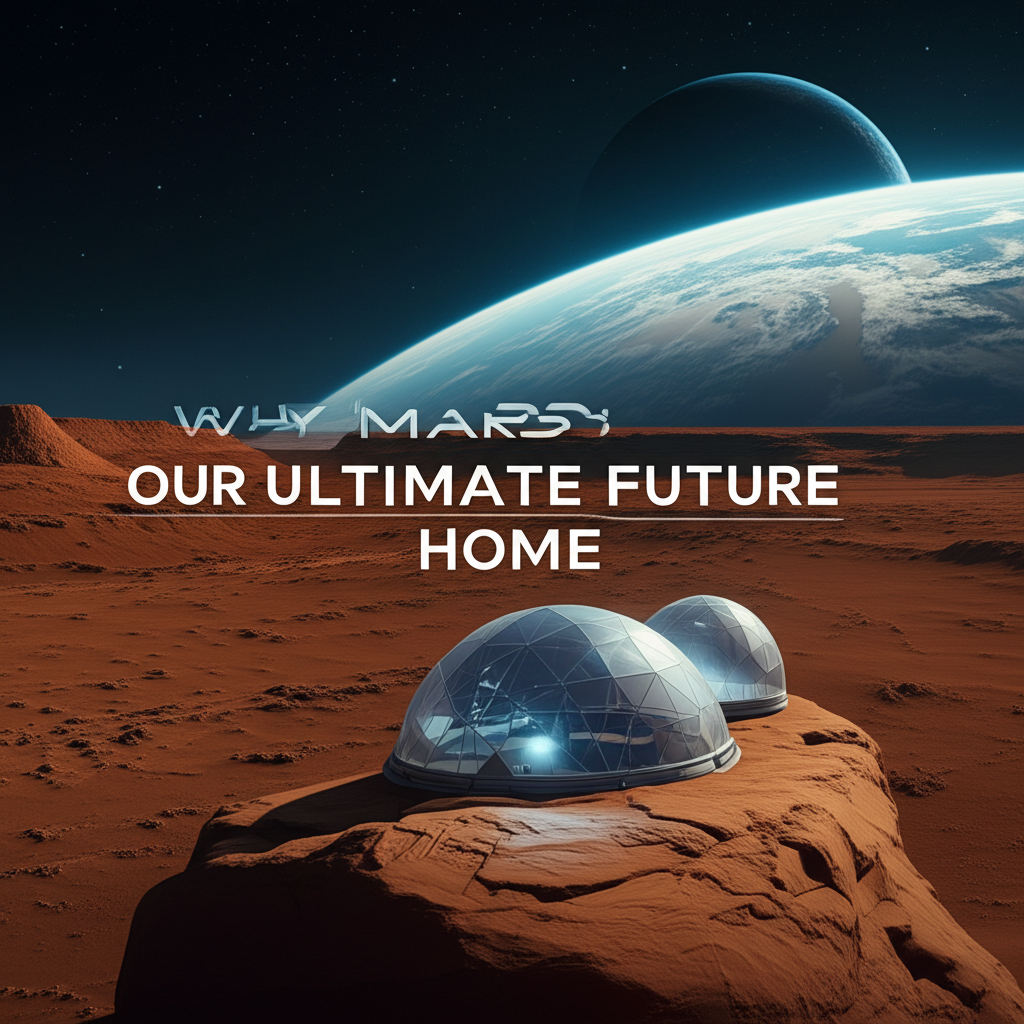
- Why Mars Stands Out: A Pragmatic Choice
- Overcoming the Red Planet's Challenges
- The Dawn of a Martian Civilization
Why do we look to the stars with such fervent hope, envisioning a future not bound by the familiar blue marble we call Earth? The answer lies in a complex interplay of existential necessity, scientific curiosity, and humanity’s inherent drive to explore and expand. While countless celestial bodies pepper our galaxy, one stands out as the most plausible and promising candidate for humanity’s future home: Mars. The Red Planet, once a distant dream, is steadily becoming the focus of concerted global efforts, not merely as a destination for scientific missions, but as the potential cradle of a multi-planetary civilization.
The concept of leaving Earth might seem like science fiction, yet the rationale underpinning this ambition is deeply rooted in our understanding of planetary dynamics and long-term species survival. Our home planet, beautiful and life-sustaining as it is, faces increasing pressures. Climate change, resource depletion, geopolitical instability, and the ever-present threat of cosmic events like asteroid impacts, all highlight the inherent vulnerability of having “all our eggs in one basket.” A multi-planetary existence isn’t just an escape route; it’s a strategic imperative for the endurance of human civilization. It represents the ultimate insurance policy, ensuring that even if catastrophe strikes Earth, humanity’s legacy and future can continue elsewhere.
Why Mars Stands Out: A Pragmatic Choice
Among the numerous planets and moons in our solar system, Mars holds a unique appeal. Its characteristics make it unparalleled as a candidate for human settlement:
1. Proximity and Accessibility: Mars is our closest planetary neighbor that is remotely habitable. While still a significant journey, advances in propulsion technology are constantly shortening transit times. Its relatively predictable orbits make mission planning feasible, and the journey is within the reach of current and near-future technologies, unlike gas giants or distant ice moons.
2. Striking Similarities to Earth: Mars boasts a 24.6-hour day, remarkably close to Earth’s 24-hour cycle, which is crucial for human circadian rhythms and daily operations. It also has an axial tilt similar to Earth’s, resulting in distinct seasons, albeit longer and more extreme. These parallels offer a degree of familiarity that would greatly assist human adaptation compared to other exotic environments.
3. Presence of Water Ice: One of the most significant discoveries on Mars is the widespread presence of water ice, particularly in its polar caps and beneath the surface. Water is indispensable for life support, but also for rocketry (through electrolysis, separating oxygen and hydrogen for fuel) and construction. The availability of local resources lessens the dependency on expensive, frequent resupply missions from Earth.
4. Atmosphere, Albeit Thin: While Mars’s atmosphere is extremely thin – less than 1% of Earth’s – it does exist and is composed primarily of carbon dioxide. This CO2 can be harvested and used for various purposes, including plant growth in enclosed habitats (photosynthesis) and potentially as a raw material for producing polymers and synthetic fuels. This minimal atmosphere also provides some protection from solar radiation compared to airless bodies like the Moon.
5. Scientific Bounty: Establishing a base on Mars would unlock unprecedented opportunities for scientific research. We could delve deeper into the planet’s geological history, searching for evidence of past or present microbial life, and gaining profound insights into planetary evolution, which in turn could teach us more about Earth’s past and future. Understanding how Mars lost its thicker atmosphere and surface water could inform our efforts to protect Earth.
Overcoming the Red Planet’s Challenges
Of course, colonizing Mars is not without its formidable challenges. The planet’s thin atmosphere and lack of a global magnetic field mean significant radiation exposure from solar flares and cosmic rays. Freezing temperatures (averaging -63 °C) and massive dust storms also pose threats. However, humanity’s ingenuity is already finding solutions. Pressurized habitats, radiation shielding (using regolith or water), advanced life support systems, and in situ resource utilization (ISRU) are all being actively researched and developed. Psychologically, extended isolation and living in an alien environment will be immense hurdles, requiring careful astronaut selection and robust support systems.
The Dawn of a Martian Civilization
Looking beyond the initial arduous settlement phase, imagine a future where Mars is dotted with bustling human settlements. These pioneering communities would not merely be research outposts but burgeoning societies with their own economies, cultures, and unique Martian identities. New industries would emerge – asteroid mining for precious resources, terraforming initiatives to gradually thicken the atmosphere and warm the planet (a centuries-long endeavor), and the development of advanced materials suited to the Martian environment.
The sheer act of transforming Mars would represent humanity’s greatest collaborative achievement, pushing the boundaries of engineering, science, and human resilience. It offers a new frontier for innovation, a place where the brightest minds can tackle grand challenges and inspire generations. Mars embodies the spirit of exploration that has driven humanity since its earliest days – the compulsion to journey beyond the horizon, to discover, and to build a better future.
In conclusion, Mars is far more than just a dusty red orb in the night sky. It represents our best chance for species survival beyond Earth, a fertile ground for scientific discovery, and the ultimate canvas for human ingenuity and aspiration. The reasons to make Mars our ultimate future home are compelling, rooted in both practical necessity and the enduring human spirit of exploration. The journey will be long and arduous, but the destination – a multi-planetary future for humanity – is a vision worth pursuing with every fiber of our being.
0 Comments