
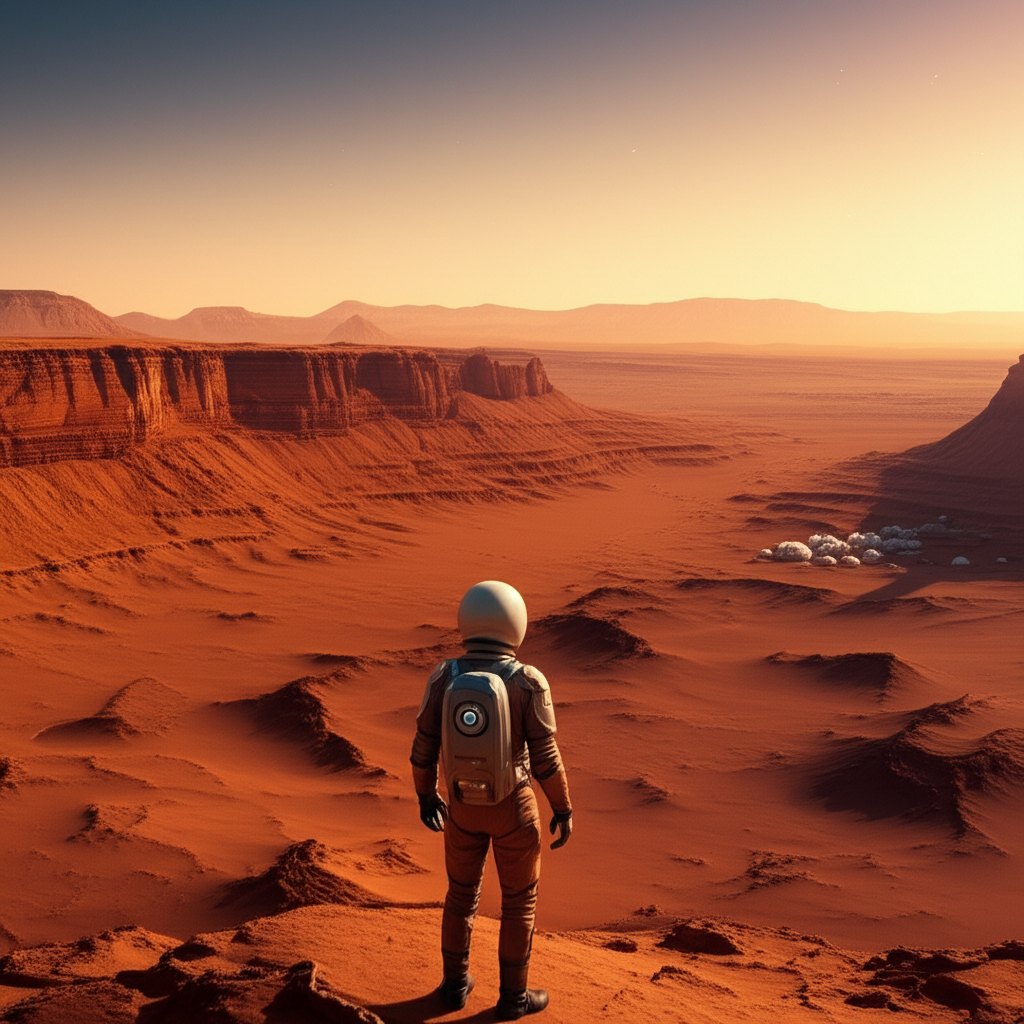
- The Fundamental Why: Beyond Earth's Horizon
- Why Mars: Our Nearest, Most Viable Solution
- The Scientific Why: Unlocking Cosmic Secrets
- Overcoming the Challenges: A Question of How, and Why It Matters
Why do we look to the stars with such persistent longing, and why, specifically, has Mars captured our collective imagination as humanity’s next potential home? The answer lies in a complex tapestry of survival instincts, scientific curiosity, and an inherent drive for exploration that has defined our species since its earliest days. While Earth remains our beloved cradle, the red planet beckons as both an insurance policy for our future and an unparalleled frontier for discovery.
The Fundamental Why: Beyond Earth’s Horizon
The primary motivation for venturing beyond Earth is simple: survival. Our home planet, while teeming with life, is a single point of failure for the human race. A catastrophic asteroid impact, a supervolcano eruption, an uncontrollable global pandemic, or even irreversible climate change could render Earth uninhabitable, or at least severely diminish human civilization. Becoming a multi-planetary species mitigates this existential risk, ensuring that humanity’s story continues, even if one world faces disaster.
Beyond safeguarding our existence, there’s the pressing issue of resource depletion and overcrowding on Earth. While space colonization is not a direct solution to current terrestrial problems, it opens up new avenues for resource acquisition (e.g., asteroid mining) and provides a long-term pressure release valve for a growing population. More profoundly, the sheer act of striving for such a monumental goal fosters innovation, driving technological advancements that benefit life on Earth in countless unforeseen ways. From medical breakthroughs to energy solutions and advanced materials, the pursuit of Mars colonization is a powerful catalyst for human ingenuity.
Why Mars: Our Nearest, Most Viable Solution
Among the accessible celestial bodies in our solar system, Mars stands out as the most promising candidate for future human settlement.
Proximity: Mars is our closest planetary neighbor, making missions logistically more feasible than venturing to the gas giants’ moons like Europa or Titan, which are also compelling but significantly further and present different, perhaps even greater, technological hurdles. A trip to Mars takes months, not years, a crucial factor for human missions.
Similarities to Earth: Mars shares several characteristics with Earth, albeit in a weaker form. It has a similar axial tilt, leading to seasons. Its day-night cycle (sol) is remarkably close to Earth’s: 24 hours and 37 minutes. Crucially, evidence strongly suggests Mars once possessed a warmer, wetter climate with a thicker atmosphere and liquid water on its surface, hints of a past that might be recoverable.
Presence of Water Ice: Orbital and rover missions have confirmed the widespread presence of water ice just beneath the Martian surface, particularly at the poles. Water is an indispensable resource—for drinking, for growing food, and for producing rocket fuel (by splitting H2O into hydrogen and oxygen). This in-situ resource utilization (ISRU) capability is vital for sustainable colonization.
Geological and Atmospheric Potential: While Mars’s atmosphere is currently thin and mostly carbon dioxide, it’s not a complete vacuum like the Moon. This thin atmosphere offers a small degree of protection from solar radiation and allows for aerobreaking and aerobraking techniques for spacecraft. The presence of significant amounts of CO2 is also key for life support systems and potential terraforming efforts in the distant future. Unlike the Moon, Mars also has tantalizing geological diversity, suggesting a dynamic history that could yield insights into planetary evolution.
While the Moon is closer, its lack of a substantial atmosphere, extreme temperature swings, and limited water availability (primarily at poles) make long-term, widespread human settlement more challenging than on Mars, at least for now. Mars offers a more robust foundation upon which to build a self-sustaining civilization.
The Scientific Why: Unlocking Cosmic Secrets
Beyond practical considerations, the scientific imperative to explore Mars is immense. What if life, even microbial life, once existed or still exists beneath the surface of Mars? Discovering evidence of past or present extraterrestrial life would fundamentally alter humanity’s understanding of its place in the universe. Mars provides a unique laboratory to study planetary evolution, the origins of life, and the potential for life elsewhere.
By sending humans to Mars, we can perform experiments, collect samples, and conduct observations with a level of dexterity, intuition, and adaptability that no robot, however sophisticated, can yet match. Martian geology, meteorology, and astrobiology hold secrets that could redefine our understanding of the cosmos and perhaps even our own origins. The rigorous scientific investigations conducted by astronauts would drive breakthroughs in fields ranging from biology and geology to engineering and astrophysics.
Overcoming the Challenges: A Question of How, and Why It Matters
Certainly, Mars is not a hospitable paradise. Its thin atmosphere offers little protection from cosmic and solar radiation. The average temperature is a frigid -63 degrees Celsius, and global dust storms can engulf the planet for months. Colonists would face psychological challenges of extreme isolation and confinement.
However, none of these challenges are insurmountable. Scientists and engineers are actively developing solutions:
Radiation Shielding: Advanced materials, underground habitats, and even water can act as radiation shields.
Life Support: Closed-loop systems for air, water, and waste recycling are being perfected on Earth and on the International Space Station.
Food Production: Hydroponics and aeroponics in controlled environments will allow for farming on Mars.
Atmospheric Pressure and Temperature: Long-term visions include terraforming, a multi-century endeavor to gradually warm the planet and thicken its atmosphere.
* Mental Health: Robust training, psychological support, and careful crew selection are critical.
The effort required to make Mars habitable isn’t just about building a new home; it’s about pushing the boundaries of human achievement. It forces us to innovate, to collaborate on an unprecedented global scale, and to rethink our relationship with our own planet. The lessons we learn in sustaining life on Mars will undoubtedly provide invaluable insights into better managing Earth’s fragile ecosystems.
Mars represents more than just a destination; it’s a testament to human potential. It embodies our innate drive to explore, to expand our horizons, and to secure a future for generations yet to come. The question is not just “Can we go to Mars?” but “Why wouldn’t we?” For the sake of our species’ long-term survival, for the advancement of science, and for the sheer inspiring grandeur of such an undertaking, Mars is not just an option—it is an incredible and crucial future home.
0 Comments