
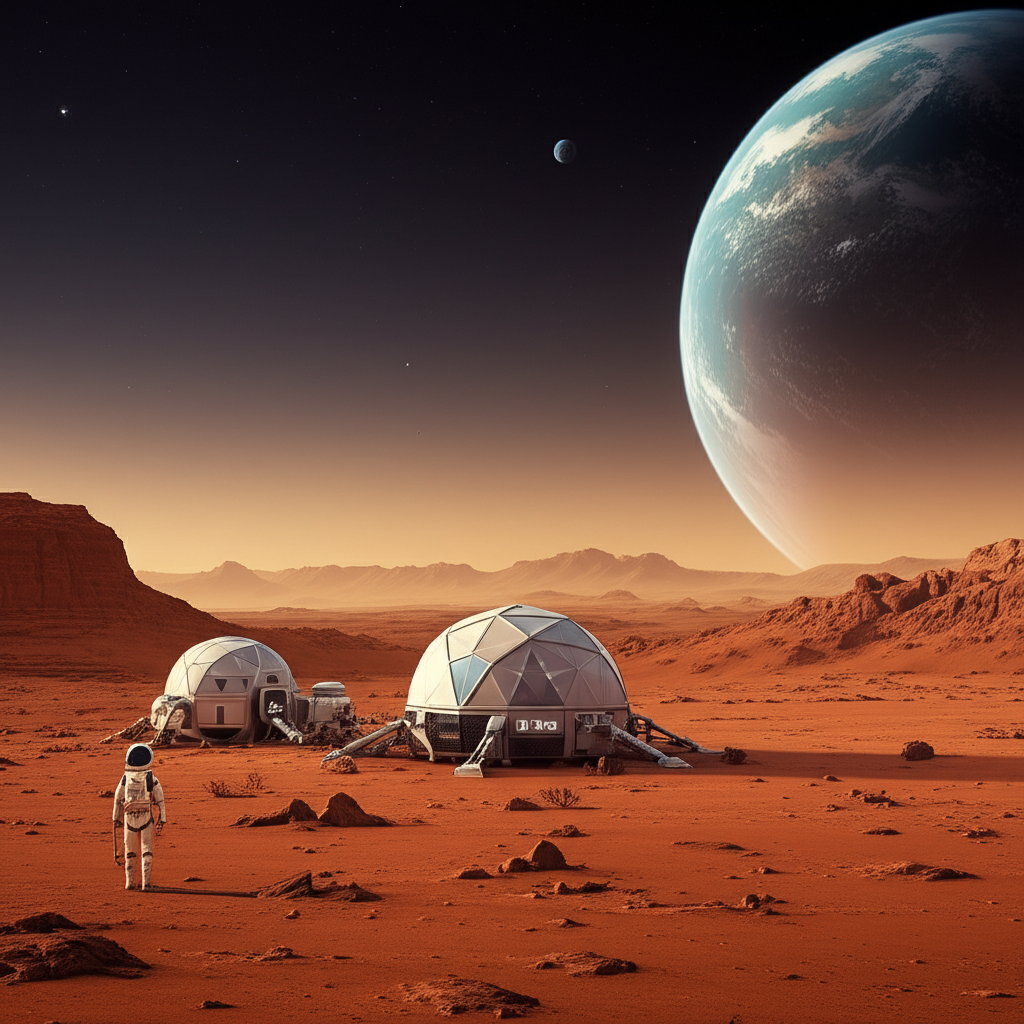
Why do we look to the stars with such fervent hope and ambition, particularly towards the rust-colored orb of Mars? The prospect of establishing humanity’s next home on the Red Planet is no longer confined to the realms of science fiction; it has become a central pillar of long-term strategic thinking for the survival and evolution of our species. As our civilization faces unprecedented challenges on Earth—from climate change and resource depletion to the ever-present threat of existential cosmic events—the imperative to become a multi-planetary species has sharpened into a crucial necessity rather than a distant dream.
The Imperative for a Multi-Planetary Future
Our beautiful blue planet, Earth, has been a nurturing cradle for life for billions of years. However, history teaches us that no cradle lasts forever, especially when faced with myriad internal and external pressures. From potentially devastating asteroid impacts to supervolcanic eruptions, and increasingly, human-induced crises like severe environmental degradation and global conflicts, Earth’s long-term habitability for advanced civilization faces numerous vulnerabilities. Placing all our evolutionary eggs in one planetary basket is, quite simply, an unacceptable risk for a species with the foresight and technological capability to expand its reach.
The drive to establish off-world colonies isn’t about abandoning Earth but rather safeguarding humanity’s future. It’s about building redundancies, creating new frontiers for innovation, and ensuring that should an unthinkable catastrophe render Earth uninhabitable, or significantly curtail advanced life, humanity would endure. This visionary leap ensures that our accumulated knowledge, culture, and very existence wouldn’t be wiped out in a single stroke.
Why Mars? The Red Planet’s Unique Advantages
Among the celestial bodies within our solar system, Mars stands out as the most compelling candidate for human colonization. Its selection isn’t arbitrary; it’s based on a confluence of scientific, logistical, and inspirational factors that make it uniquely suited for this grand endeavor.
Proximity and Accessibility: Mars is Earth’s closest planetary neighbor that isn’t scorching hot or atmospherically impenetrable. While still millions of kilometers away, a journey to Mars is feasible within a six-to-nine-month window every two years when the planets align favorably. This relative proximity makes it logistically manageable compared to the decades-long voyages required for targets further out, reducing travel time, fuel requirements, and the psychological impact on crews.
Presence of Water Ice: Perhaps the single most critical discovery that bolsters Mars’s candidacy is the widespread presence of water ice. Found beneath its surface, particularly at the poles, this frozen water is an invaluable resource. It can be melted for drinking, split into hydrogen and oxygen for breathable air, and used as rocket fuel (oxygen and hydrogen) for return journeys or further exploration, making self-sufficiency a more attainable goal.
Atmosphere and Geology: Although Mars’s atmosphere is thin (less than 1% of Earth’s) and predominantly carbon dioxide, it provides some shielding from solar radiation and presents a pressure environment that, while requiring pressurized habitats, is not a complete vacuum. Its geological history also fascinates scientists, with evidence of ancient riverbeds, lakebeds, and even oceans, suggesting a warmer, wetter past that could potentially be reactivated. The planet’s tilt and day/night cycle are remarkably similar to Earth’s, offering a degree of familiarity.
Abundant Resources for Construction and Shielding: The Martian regolith (soil) is a valuable resource. It can be used for building materials, either by directly packing it or processing it into bricks, offering durable structures for habitats. Crucially, the regolith also provides effective shielding against harmful cosmic and solar radiation, a major challenge for long-term human habitation.
Overcoming Challenges and Building a Martian Future
Establishing a permanent presence on Mars demands overcoming significant hurdles, but these challenges are increasingly met with innovative solutions and accelerating technological progress.
Radiation Shielding: Living on the surface directly exposed to solar and cosmic radiation is hazardous. Solutions include building habitats underground, constructing igloos from water ice, or utilizing Mars’s pervasive regolith as shielding material. This necessitates robotic precursors to prepare sites even before human arrival.
Breathable Atmosphere and Pressure: Humans cannot survive in Mars’s thin, carbon-dioxide-rich atmosphere. Future Martian settlers will live in highly pressurized habitats, complete with closed-loop life support systems that recycle air, water, and waste. The long-term vision of terraforming – gradually altering Mars’s atmosphere to make it more Earth-like – remains a generational goal, driven by concepts like releasing greenhouse gases from polar ice caps or importing volatile compounds.
Logistics and Self-Sufficiency: The sheer scale of transporting people and equipment to Mars is immense. Advanced heavy-lift rockets, such as SpaceX’s Starship, are designed to make this economically viable. Crucially, early Martian colonies must prioritize self-sufficiency, employing Martian resources to produce food (hydroponics, aeroponics), water, oxygen, and even manufacturing spare parts using 3D printing. This reduces reliance on costly resupply missions from Earth.
Psychological and Physiological Well-being: The isolation, confined living spaces, and extreme environment pose distinct psychological challenges. Robust crew selection protocols, advanced psychological support, varied work assignments, and recreational facilities will be vital. Physiologically, the lower gravity (about one-third of Earth’s) will require countermeasures to maintain bone density and muscle mass, and radiation effects will need careful monitoring and mitigation.
The Scientific and Inspirational Imperative
Beyond the survival argument, establishing a foothold on Mars ignites humanity’s innate drive for exploration and discovery. A permanent Martian presence would dramatically accelerate our understanding of planetary evolution, the potential for extraterrestrial life (past or present), and the fundamental origins of our solar system. The scientific returns from having human geologists, biologists, and engineers on site, directly conducting research and making real-time decisions, are immeasurable compared to robotic missions alone.
Moreover, the sheer audacity of settling Mars serves as a powerful inspiration for future generations. It fosters a renewed sense of purpose, encourages unprecedented technological innovation, and pushes the boundaries of what we believe is possible. The spin-off technologies developed for Martian exploration and habitation will undoubtedly find applications on Earth, improving life here in ways we can only begin to imagine.
In conclusion, Mars represents more than just a distant planet; it embodies our species’ resilience, ingenuity, and future. It’s a beacon of hope and a profound challenge that, when met, will redefine what it means to be human. The journey to make Mars our next home is not merely an option, but an essential step in securing humanity’s enduring legacy among the stars.
0 Comments