
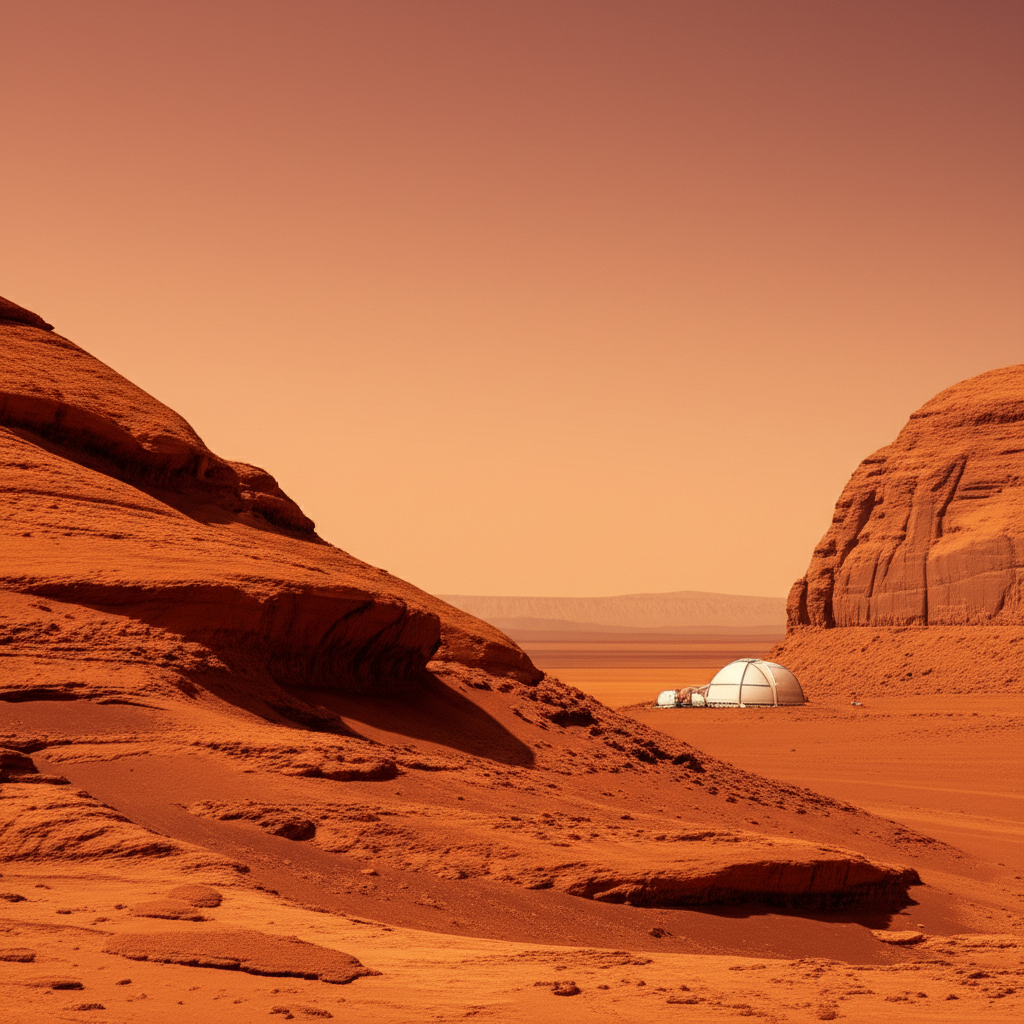
- The Allure of the Red Planet: Why Mars?
- Earth's Imperatives: Why We Need a Backup Plan
- Overcoming Martian Challenges: Engineering Humanity's Future
- The Human Spirit: Why Exploration Defines Us
Why Mars beckons as humanity’s prospective next home is a question steeped in both necessity and an unyielding spirit of exploration. For generations, the Red Planet has captured our imagination, appearing as a distant, dusty cousin to Earth. Today, however, that fascination has matured into a focused ambition, driven by compelling scientific insights, technological advancements, and a growing recognition of our inherent vulnerability as a single-planet species. Moving beyond science fiction, the establishment of a sustained human presence on Mars is no longer a matter of “if,” but “when,” and the reasons behind this monumental undertaking are as profound as they are practical.
The Allure of the Red Planet: Why Mars?
Among the myriad celestial bodies in our solar system, Mars stands out as the most compelling candidate for human expansion for several critical reasons. Its relative proximity, compared to gas giants or distant moons, makes it an achievable target for current and near-future propulsion technologies. A journey to Mars typically takes between six to twelve months, depending on the orbital alignments, a significant but manageable duration for human crews.
Beyond its accessibility, Mars holds the promise of vital resources. Extensive geological surveys and orbital data have confirmed the presence of vast quantities of water ice, particularly at its poles and beneath the surface in various latitudes. This water is not just crucial for drinking and growing food; it can also be split into hydrogen and oxygen. Oxygen is vital for breathing, of course, but both elements are potent rocket propellants, meaning future missions could refuel on Mars for return journeys or further exploration, significantly reducing the cost and complexity of space travel. The Martian regolith (soil) itself is a treasure trove, offering minerals for construction and a potential source of shielding against harmful radiation. The planet’s thin atmosphere, primarily carbon dioxide, can also be processed to create oxygen and fuel precursors.
Furthermore, Mars exhibits intriguing similarities to Earth, particularly in its ancient past. Evidence suggests that billions of years ago, Mars was a warmer, wetter world with a thicker atmosphere and liquid water flowing freely across its surface. While it has since undergone dramatic climate change, its geological history offers clues about planetary evolution and the potential for life beyond Earth. Its day-night cycle is remarkably close to Earth’s, at just over 24 hours, making adaptation for human settlers more feasible than on many other worlds.
Earth’s Imperatives: Why We Need a Backup Plan
While the allure of Mars is undeniable, the imperative to establish a multi-planetary civilization is also rooted in a clear-eyed assessment of Earth’s long-term future. Humanity faces a series of existential threats, both natural and self-inflicted, that underscore the wisdom of having a “backup plan.”
Our planet’s resources, though vast, are finite. Growing global populations and increasing consumption rates place immense strain on ecosystems, leading to resource depletion, habitat loss, and biodiversity crises. Climate change, driven by human activity, presents an escalating challenge, threatening sea-level rise, more frequent and intense extreme weather events, and disruptions to global food systems. While efforts to mitigate these issues on Earth are paramount, the long-term prognosis highlights the prudence of expanding our horizons.
Beyond these anthropogenic challenges, Earth remains vulnerable to catastrophic natural events. Asteroid impacts, supervolcano eruptions, coronal mass ejections from the sun, and even unforeseen global pandemics pose threats that could decimate or even extinguish human civilization if confined to a single planet. Spreading humanity to another world, even in small numbers initially, significantly mitigates this risk, ensuring the survival of our species and its accumulated knowledge and culture in the face of an unpredictable cosmos. Martian colonies would serve as a vital insurance policy, a safeguard against worst-case scenarios back home.
Overcoming Martian Challenges: Engineering Humanity’s Future
Establishing a permanent presence on Mars is not without its formidable challenges. The Martian environment is harsh: extreme cold, a thin carbon dioxide atmosphere offering minimal protection from solar and cosmic radiation, and frequent planet-wide dust storms. Humans would require sophisticated habitats, closed-loop life support systems, and robust protection against radiation.
However, scientific and technological advancements are rapidly bridging these gaps. In-Situ Resource Utilization (ISRU) is a key strategy, focusing on using local Martian resources—like water ice for oxygen and fuel, and regolith for construction materials—to reduce dependence on supplies from Earth. Robotics will play a crucial role in initial construction and hazardous exploration. Advanced propulsion systems, such as nuclear thermal or electric propulsion, could significantly reduce travel times. Innovations in medical technology, psychological support, and agricultural systems designed for extraterrestrial environments are also progressing. The long-term vision even includes the audacious concept of terraforming Mars, slowly altering its atmosphere and climate to become more Earth-like, though this remains centuries, if not millennia, away.
The Human Spirit: Why Exploration Defines Us
Ultimately, the drive to make Mars our next home transcends mere survival; it speaks to the very core of the human spirit. Throughout history, humanity has been defined by its insatiable curiosity and its urge to explore the unknown, to push boundaries, and to discover what lies beyond the horizon. From ancient mariners charting new seas to pioneers venturing into uncharted continents, exploration has been a catalyst for innovation, intellectual growth, and societal advancement.
Exploring Mars offers unparalleled opportunities for scientific discovery. It could answer fundamental questions about the origins of life, the evolution of planets, and the potential for life beyond Earth. The challenges of colonizing Mars will undoubtedly spark groundbreaking innovations in energy, materials science, artificial intelligence, and biotechnology, with countless spin-off benefits for life here on Earth. Moreover, a grand, unifying goal like interplanetary colonization has the power to inspire generations, fostering collaboration across nations and cultures, and encouraging young people to pursue careers in science, technology, engineering, and mathematics. It represents the ultimate expression of human ingenuity and collective aspiration.
In conclusion, the proposition of Mars as humanity’s stunning, crucial next home is not merely a romantic notion but a rational, forward-thinking strategy. It is driven by the planet’s intrinsic potential for sustaining life, the pressing need to secure our species’ long-term survival, and humanity’s inherent, defining urge to explore and expand. As we continue to push the frontiers of technology and knowledge, the Red Planet stands as a beacon, inviting us to take the next evolutionary step—to become a multi-planetary species, safeguarding our future while fulfilling our deepest exploratory instincts.
0 Comments