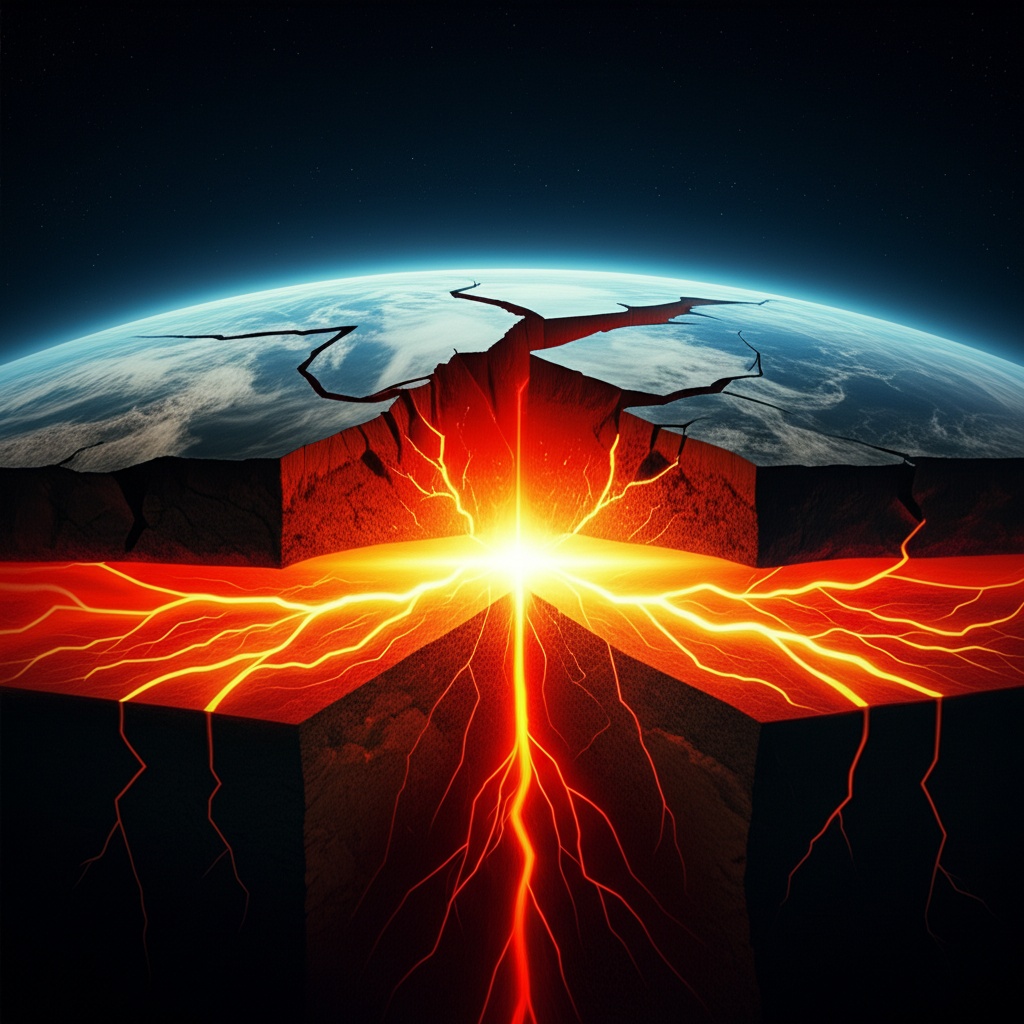
Why do earthquakes happen? This question has fascinated and mystified humanity for millennia, inspiring myths of world-carrying titans and angry gods. Today, thanks to advancements in geology and seismology, we understand that the shaking of our planet is not the wrath of a deity, but rather a profound manifestation of Earth’s dynamic, ever-changing nature. Earthquakes are a stark reminder that we live on a planet that is anything but static, a vibrant world where immense forces are constantly at play beneath our feet. Unveiling the mechanisms behind these powerful tremors reveals a shocking truth: our planet’s very crust is a shifting, restless puzzle, perpetually rearranging itself in a grand geological dance.
The Earth’s Restless Crust: A Tectonic Ballet
At the heart of almost all significant earthquakes lies the theory of plate tectonics. Imagine the Earth’s outermost layer, the lithosphere, not as a single, solid shell, but as a giant jigsaw puzzle composed of several enormous pieces called tectonic plates. These plates, which include both continental and oceanic crust, are not stationary. Instead, they are in constant, albeit slow, motion, gliding across the semi-fluid asthenosphere beneath them. This movement is incredibly slow – typically a few centimeters per year, about the same rate your fingernails grow – but over geological timescales, it leads to dramatic transformations of the Earth’s surface, from the formation of mountain ranges to the opening of ocean basins.
Why Do Earth’s Plates Move? The Engine Below
The underlying reason why these massive plates are in perpetual motion is the Earth’s internal heat. Deep within our planet, residual heat from its formation and ongoing radioactive decay creates immense convection currents in the mantle, the layer of molten rock beneath the crust. Think of it like water boiling in a pot: hot material rises, cools, and then sinks, creating a continuous circulatory pattern. This convection drives the plates in various ways:
Ridge Push: At mid-ocean ridges, where new oceanic crust is formed, the uplifted lithosphere pushes the oceanic plate away from the ridge.
Slab Pull: This is considered the strongest force. As an oceanic plate cools, it becomes denser and heavier. When it meets another plate and is forced downwards into the mantle (a process called subduction), its sheer weight pulls the rest of the plate along behind it.
Mantle Drag: While not as dominant as slab pull, the viscous flow of the asthenosphere can also exert a dragging force on the underside of the plates.
These combined forces ensure that the plates are never truly at rest, forever inching, sliding, and colliding.
The Moment of Rupture: How Earthquakes Manifest
Earthquakes primarily occur at the boundaries where these tectonic plates meet. As plates move, they don’t always slide past each other smoothly. Friction between the rough edges of the plates causes them to lock together. Despite being “stuck,” the immense forces driving the plates continue to build up stress and strain in the rocks along the fault lines (fractures in the Earth’s crust).
This accumulation of elastic energy can continue for decades, centuries, or even millennia. Eventually, the stress exceeds the strength of the rocks, and they suddenly rupture and slip, releasing the stored energy in the form of seismic waves. This sudden jolt is what we experience as an earthquake. The point within the Earth where the rupture originates is called the hypocenter, and the point directly above it on the Earth’s surface is the epicenter.
The seismic waves radiate outwards from the hypocenter, much like ripples in a pond. There are different types of seismic waves: P-waves (compressional, travel fastest), S-waves (shear, slower), and surface waves (which cause the most damage). The intensity and destructive power of an earthquake depend on factors like its magnitude (the amount of energy released), the depth of the hypocenter, and the local geology.
Understanding Why Earthquakes Vary: Plate Boundary Dynamics
The nature of an earthquake – its depth, magnitude, and specific characteristics – often depends on the type of plate boundary where it occurs:
Divergent Boundaries: Here, plates pull apart, like at mid-ocean ridges. Earthquakes are generally shallow and relatively mild, as magma rises to fill the gap, creating new crust.
Convergent Boundaries: These are sites of collision.
Oceanic-Oceanic or Oceanic-Continental: When one plate slides beneath another (subduction zones), deep and powerful earthquakes can occur, especially in the subducting slab. These are often associated with volcanic arcs and deep ocean trenches. The world’s most powerful earthquakes, including the 2004 Sumatra-Andaman earthquake, occur in these zones.
Continental-Continental: When two continental plates collide, neither can easily subduct. Instead, they crumple and uplift, forming massive mountain ranges like the Himalayas. Earthquakes in these regions can be very strong but tend to be shallower.
Transform Boundaries: Plates slide horizontally past each other, neither creating nor destroying crust. The San Andreas Fault in California is a famous example. These boundaries are prone to frequent, often powerful, shallow earthquakes.
Beyond Tectonics: Other Shakes and Tremors
While plate tectonics accounts for the vast majority of earthquakes, there are other, less common reasons why the ground might shake:
Volcanic Activity: The movement of magma beneath a volcano can induce seismic activity, often as precursors to an eruption.
Human-Induced Earthquakes (Induced Seismicity): Certain human activities can trigger earthquakes. These include:
Fracking (Hydraulic Fracturing): Injecting high-pressure fluid into the ground to extract oil and gas can activate dormant fault lines.
Reservoir Impoundment: The immense weight of water behind large dams can sometimes create stress on underlying geological structures.
Mining and Geothermal Energy Projects: Removing vast amounts of rock or injecting fluids for geothermal energy can also lead to minor tremors.
Landslides and Meteorite Impacts: Violent landslides or exceptionally large meteorite impacts can also generate localized seismic waves, although these are typically not classified as tectonic earthquakes.
Living with a Dynamic Planet: Prediction and Preparedness
Despite our advanced understanding of why earthquakes occur, accurately predicting the exact time, location, and magnitude of a future earthquake remains an elusive goal. This is due to the complex, non-linear nature of geological processes and the immense depths at which these forces operate. However, scientists can identify earthquake-prone regions and assess long-term seismic hazards.
For societies living on dynamic plate boundaries, preparedness is paramount. This includes implementing stringent building codes, developing early warning systems (which provide precious seconds or minutes of notice), educating the public on safety protocols (like “drop, cover, and hold on”), and securing infrastructure.
In conclusion, the shocking truth behind why earthquakes happen is a story of immense geological power, driven by the Earth’s internal heat and expressed through the slow, relentless dance of tectonic plates. These natural phenomena, while destructive, are an integral part of our planet’s ongoing evolution, a powerful reminder of the deep, unseen forces that continue to shape the world beneath our feet. Understanding these mechanisms not only satisfies our scientific curiosity but also empowers us to live more safely and resiliently on our ever-changing home.
0 Comments