- The Cosmic Culprit: Why an Asteroid Changed Everything
- Environmental Stressors: Why Some Dinosaurs Were Already Struggling
- The Aftermath and a New Beginning
Why did the magnificent dinosaurs, rulers of Earth for over 165 million years, suddenly vanish? For decades, this question has captivated scientists and the public alike, fueling countless theories from alien invasions to widespread disease. While the full picture is undoubtedly complex, modern science has presented some shocking truths, converging on a cataclysmic event that reshaped life on our planet forever. The disappearance of dinosaurs wasn’t a slow fade, but rather a dramatic and swift extinction known as the Cretaceous-Paleogene (K-Pg) event, approximately 66 million years ago.
The Cosmic Culprit: Why an Asteroid Changed Everything
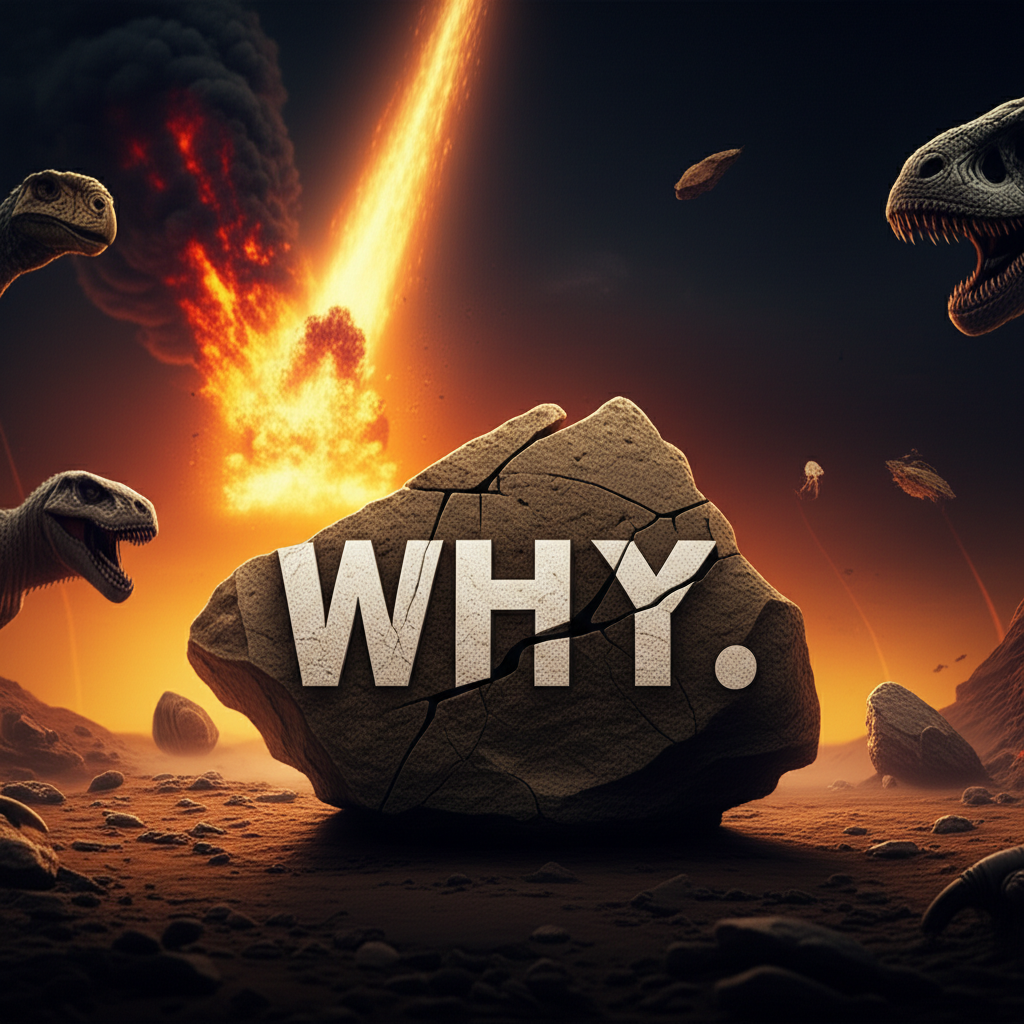
The most widely accepted and scientifically supported explanation for the dinosaurs’ disappearance centers around a colossal asteroid impact. This theory, famously put forward by father-son duo Luis and Walter Alvarez in 1980, proposed that a gigantic extraterrestrial object slammed into Earth, triggering a chain of events that led to a global catastrophe. The crucial piece of evidence supporting this theory was the discovery of an unusually high concentration of iridium – a rare metal on Earth but common in asteroids – in a geological layer coinciding with the K-Pg boundary worldwide.
Further research solidified this hypothesis with the identification of the Chicxulub crater, a massive underground impact structure roughly 180 kilometers (110 miles) in diameter, located beneath the Yucatán Peninsula in Mexico. Analysis of rocks from this crater confirmed it was formed exactly 66 million years ago. Imagine an object roughly 10-15 kilometers (6-9 miles) wide hurtling through space at cosmic speeds, then colliding with Earth. The immediate aftermath would have been unimaginable: an explosion thousands of times more powerful than all nuclear weapons combined, generating immense earthquakes, continent-wide tsunamis, and superheated dust clouds that incinerated everything in their path for hundreds of miles.
Yet, the true devastation came in the long term. The impact propelled billions of tons of dust, ash, and soot into the atmosphere, encircling the globe. This massive atmospheric veil blocked out the sun, plunging the Earth into an extended period of darkness and freezing cold, often referred to as an “impact winter.” Photosynthesis, the basis of almost all food chains, ground to a halt. Plants died, leading to the collapse of herbivore populations, and subsequently, the carnivores that preyed upon them. The mighty non-avian dinosaurs, dependent on vast amounts of vegetation or large prey, stood little chance against such a sudden and profound environmental collapse.
Environmental Stressors: Why Some Dinosaurs Were Already Struggling
While the Chicxulub impact is widely considered the primary trigger for the K-Pg extinction, many scientists believe that its effects were exacerbated by pre-existing environmental stressors. Earth was already undergoing significant changes, and these factors may have made life more precarious for dinosaurs and other species, leaving them more vulnerable to a sudden, catastrophic blow.
One major contributing factor was extensive volcanic activity. The Deccan Traps, a vast volcanic province in what is now India, experienced millions of years of intense eruptions leading up to and during the K-Pg event. These eruptions spewed enormous quantities of greenhouse gases, like carbon dioxide and sulfur dioxide, into the atmosphere. This led to periods of global warming, ocean acidification, and acid rain, which would have put significant stress on ecosystems worldwide. Some researchers argue that this gradual environmental degradation had already weakened food webs and biodiversity, making it easier for the asteroid impact to deliver a fatal blow. While volcanic activity alone might not have been enough to cause such a widespread extinction, it likely primed the planet for disaster.
Other, more gradual environmental shifts also played a role. Fluctuations in sea levels, changes in ocean currents, and variations in global temperatures over millions of years could have fragmented dinosaur habitats, altered food sources, and stressed populations. While dinosaurs had certainly adapted to major climate shifts throughout their long reign, a combination of these long-term trends alongside massive volcanic activity could have pushed many species to their ecological limits. When the asteroid struck, it wasn’t a hit on a perfectly healthy ecosystem, but rather one that was already showing signs of strain.
The Aftermath and a New Beginning
The K-Pg extinction event was devastatingly effective, wiping out approximately 75% of all species on Earth. Every non-avian dinosaur lineage perished. However, life found a way to rebound. Crucially, a few clades of dinosaurs survived: the birds. Modern birds are the direct descendants of avian dinosaurs, evolving and diversifying in the aftermath. Alongside birds, many mammals, crocodilians, turtles, insects, and some marine life managed to weather the storm.
The extinction of the dominant non-avian dinosaurs created vast ecological niches, allowing surviving groups to diversify and thrive. Mammals, previously confined to smaller, nocturnal roles beneath the shadow of the dinosaurs, rapidly evolved and expanded, ushering in the Cenozoic Era – the “Age of Mammals” – which continues to this day.
The disappearance of the dinosaurs remains one of the Earth’s most dramatic natural experiments, revealing profound truths about planetary resilience and vulnerability. While the question “why did dinosaurs disappear” once puzzled generations, scientific advancements now paint a clear, albeit terrifying, picture: a furious combination of cosmic impact and pre-existing environmental stress that fundamentally changed the trajectory of life on Earth. It’s a powerful reminder of the delicate balance within our planet’s ecosystems and the colossal forces that have, and continue to, shape our world.
0 Comments