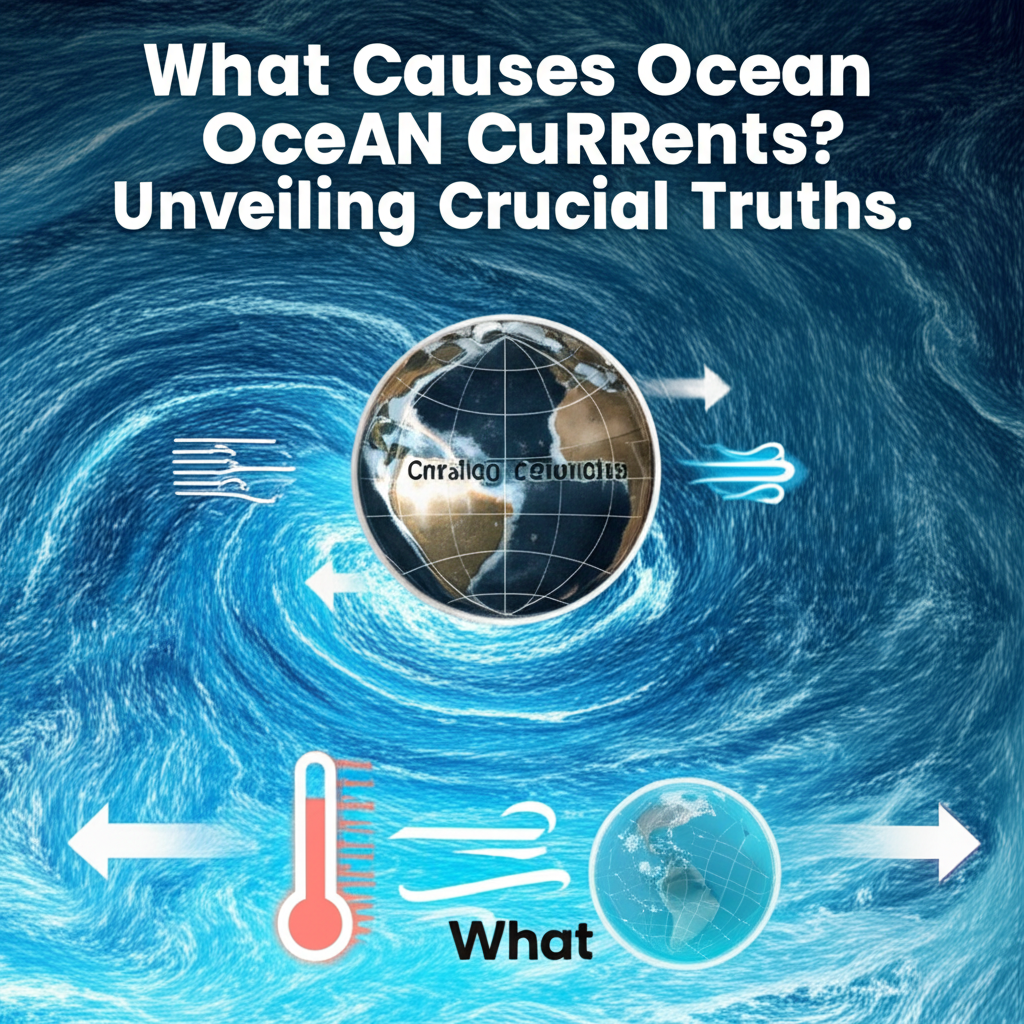
What causes ocean currents is a fundamental question that unveils the intricate workings of our planet’s vast aquatic systems. Far from being stagnant bodies of water, the world’s oceans are in constant motion, driven by a complex interplay of forces that originate from both above and within the water itself. These colossal rivers within the ocean are vital for regulating global climate, distributing heat, nutrients, and marine life across the globe, and understanding them is key to comprehending Earth’s dynamic environmental balance.
Understanding What Initiates Surface Currents: Wind and Solar Energy
The most visible and often talked-about ocean currents are those found at the surface, and their primary drivers can be traced back to the sun’s energy and the atmosphere it energizes.
Solar Radiation and Unequal Heating: The sun warms the Earth’s surface unevenly. Equatorial regions receive direct, intense sunlight, heating both the land and the ocean surface more effectively than the poles. This differential heating creates temperature gradients in the atmosphere, leading to variations in air pressure.
Wind as the Primary Mover: Air moves from areas of high pressure to areas of low pressure, generating winds. These prevailing winds, such as the trade winds, westerlies, and polar easterlies, then drag on the ocean’s surface. As wind energy is transferred to the water, it sets the top layer of the ocean in motion, initiating surface currents. The stronger and more consistent the wind, the more pronounced its effect on the currents below. Over vast stretches of ocean, sustained winds build up significant momentum, creating powerful systems like the equatorial currents.
The Coriolis Effect and Gyres: As these wind-driven surface currents move, they don’t flow in a straight line. Earth’s rotation introduces a powerful deflective force known as the Coriolis Effect. In the Northern Hemisphere, currents are deflected to the right, and in the Southern Hemisphere, they are deflected to the left. This effect, combined with the presence of continents that block and redirect water flow, leads to the formation of massive circular current systems called gyres. Prominent examples include the North Atlantic Gyre, which includes the Gulf Stream, and the North Pacific Gyre. These gyres are critical for heat distribution, moving warm water from the tropics towards the poles and cooler water back towards the equator.
What Drives Deep Ocean Circulation: Thermohaline Forces
While wind primarily drives surface currents, a completely different, yet equally powerful, mechanism drives the slower, deeper currents that traverse the ocean basins: thermohaline circulation. The term “thermohaline” literally means “heat-salt,” pointing to the key factors involved: temperature and salinity.
Density Differences: Water density is the crucial factor here. Colder water is denser than warmer water, and saltier water is denser than fresher water. When surface waters in certain regions become extremely cold (e.g., near the poles) and/or lose freshwater through evaporation or ice formation, their salinity increases, making them exceptionally dense.
The Global Conveyor Belt: This dense, heavy water then sinks to the bottom of the ocean. This sinking action initiates a powerful, slow-moving current that travels thousands of kilometers across the ocean floor. As this deep water moves, it displaces other water, setting off a continuous cycle often referred to as the “global conveyor belt.” A prime example occurs in the North Atlantic, where cold, salty water sinks to form the North Atlantic Deep Water (NADW), which then flows southwards, eventually spreading into other ocean basins. This deep circulation is incredibly slow, sometimes taking centuries to complete a full circuit. It’s vital for redistributing heat, oxygenating the deep ocean, and carrying nutrients from various regions.
Earth’s Rotation: The Invisible Hand Shaping Currents
Beyond its role in forming gyres, the Earth’s rotation, through the Coriolis Effect, exerts a profound influence on the entire ocean system, from surface to abyssal depths. It’s not a force that causes motion, but rather one that modifies its direction.
Ekman Transport: The Coriolis effect also leads to a phenomenon called Ekman transport. Because wind acts on the very surface layer, and the Coriolis effect deflects it, each subsequent layer of water below is also dragged and deflected, but slightly less so, creating a spiral effect. The net transport of water due to wind stress and the Coriolis Effect is typically 90 degrees to the right of the wind direction in the Northern Hemisphere and 90 degrees to the left in the Southern Hemisphere. This upwelling and downwelling of water plays a significant role in nutrient distribution and marine productivity.
Boundaries and Basins: The Role of Continents and Seafloor
The physical geography of our planet also heavily influences ocean currents.
Continental Barriers: Continents act as immense barriers, forcing currents to turn and flow along their coastlines. For instance, the Gulf Stream, after flowing north along the North American coast, is deflected eastward by the landmass, eventually contributing to the moderation of Europe’s climate.
Seafloor Topography: Even the unseen topography of the ocean floor – features like mid-ocean ridges, seamounts, and abyssal plains – steers and modifies deep-ocean currents. Trenches can channel deep flows, while underwater mountain ranges can block or deflect them, creating complex patterns of circulation in the abyssal depths.
The Moon’s Pull: Tidal Currents
While not contributing to the large-scale, continuous ocean currents discussed above, the gravitational pull of the Moon and, to a lesser extent, the Sun, creates predictable, oscillatory movements known as tidal currents. These are periodic, localized currents that change direction with the ebb and flow of tides, particularly noticeable in coastal areas, estuaries, and narrow straits. Though their influence is more regional and temporary, they are powerful forces shaping coastal environments and marine ecosystems.
In conclusion, the ocean’s vast currents are a testament to the interconnectedness of Earth’s systems. From the sun’s distant warmth driving winds, to the subtle gravitational pull of celestial bodies, to the density differences born of temperature and salinity changes, and the planet’s own rotation and geography – multiple forces converge to create these dynamic oceanic rivers. Understanding their genesis and behavior is not merely an academic exercise; it is crucial for predicting climate patterns, managing marine resources, and navigating our ever-changing world.
0 Comments