- Unveiling the Rainbow: What Exactly Are We Seeing?
- The Essential Ingredients: Sunlight and Water Droplets
- The Physics in Action: Refraction, Reflection, and Dispersion
- The Crucial 42-Degree Angle
- Why the Arch Shape?
- Beyond The Primary: Secondary Rainbows and Other Phenomena
- Your Personal Rainbow
- In Conclusion
The phenomenon of rainbows, those breathtaking arches of color painted across the sky, is one of nature’s most captivating spectacles. While their ethereal beauty might seem magical, the science behind them is a fascinating interplay of light, water, and geometry. Understanding the physics of rainbows transforms them from a mere visual delight into a profound testament to the natural laws that govern our world. This guide aims to demystify the stunning physics involved, offering an effortless journey into why and how these vibrant displays occur.
Unveiling the Rainbow: What Exactly Are We Seeing?
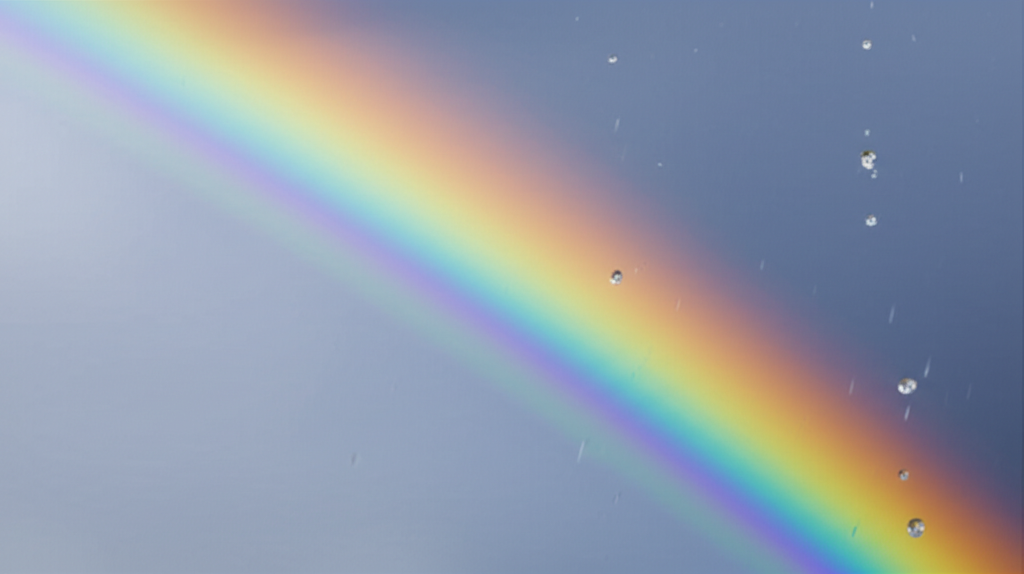
At its core, a rainbow is an optical and meteorological phenomenon caused by the reflection, refraction, and dispersion of light in water droplets, resulting in a spectrum of light appearing in the sky. It always appears opposite the sun and takes the form of a multicoloured arc. Crucially, a rainbow is not a physical object located at a specific point in the sky; rather, it’s an optical illusion whose apparent position depends on the viewer’s angle relative to the sun and the water droplets.
The Essential Ingredients: Sunlight and Water Droplets
For a rainbow to form, two primary ingredients are absolutely necessary: sunlight and water droplets suspended in the air. This is why rainbows are typically seen after rainfall, or near waterfalls or fountains, when the sun is relatively low in the sky, either in the morning or late afternoon.
Sunlight, which appears white to our eyes, is actually composed of a spectrum of colors—red, orange, yellow, green, blue, indigo, and violet (ROYGBIV). Water droplets, whether from rain, mist, or spray, act like tiny prisms, each bending and reflecting this sunlight in a specific way.
The Physics in Action: Refraction, Reflection, and Dispersion
The formation of a rainbow involves a precise sequence of optical events within each tiny water droplet:
1. Refraction (Entry): When a ray of sunlight strikes a water droplet, it doesn’t pass straight through. Instead, it bends as it enters the denser medium of the water. This bending is called refraction. As white light enters the droplet, it begins to separate into its individual colors because different wavelengths (colors) of light refract at slightly different angles. Violet light bends the most, and red light bends the least.
2. Internal Reflection: Once inside the water droplet, the light travels to the opposite side of the droplet. Here, instead of exiting, the light ray reflects off the inner surface of the droplet, bouncing back towards the direction it came from, but still inside the droplet. This is total internal reflection, a critical step that redirects the light back towards the observer.
3. Refraction (Exit) & Dispersion: After reflecting, the light travels back across the droplet and exits from the front surface, refracting once more as it passes from the water back into the air. This second refraction further separates the colors, making the spectrum even more distinct. It’s this combination of refractions and internal reflection that disperses the white light into the vibrant band of colors we associate with a rainbow.
The Crucial 42-Degree Angle
The vivid colors of a primary rainbow are always seen at a precise angle of approximately 42 degrees from the observer’s anti-solar point (the point directly opposite the sun). This specific angle is a result of the optimal combination of refraction and reflection within the spherical water droplets. For red light, this angle is around 42 degrees, while for violet light, it’s closer to 40 degrees. Because each color exits the droplet at a slightly different angle, we see them as distinct bands. Our eyes perceive a continuous arc of color rather than individual points because countless droplets are simultaneously reflecting and refracting light towards us, each contributing a specific color at the correct angle.
Why the Arch Shape?
The rainbow’s characteristic arc shape is due to the geometry of how we perceive the light. Each water droplet sending light to your eye produces one specific color at a particular angle. Since every droplet in a large area of sky is doing this, and your eye is at the center of a cone of light, you see a circular arc. The center of this circle is the anti-solar point. Since the ground blocks the lower half of this cone, we typically see only the top half of the circle as an arc. If you were viewing a rainbow from an airplane, you might see a full circle.
Beyond The Primary: Secondary Rainbows and Other Phenomena
Occasionally, you might spot a fainter, larger secondary rainbow above the primary one. This occurs when sunlight undergoes two internal reflections within the water droplets before exiting. The extra reflection causes the colors of the secondary rainbow to be reversed compared to the primary one (violet on the outside, red on the inside), and it appears at an angle of roughly 50-53 degrees. Due to the extra reflection, more light is lost, making it noticeably dimmer.
Beyond these common rainbows, the atmosphere can produce other dazzling displays:
Fogbows: Broad, white arcs formed by tiny fog droplets.
Moonbows: Faint, nocturnal rainbows produced by moonlight, often appearing white to the naked eye but sometimes revealing color in long-exposure photographs.
* Supernumerary bows: Faint, colored fringes found just inside the primary rainbow, caused by the wave nature of light (diffraction) intersecting with the droplet’s size.
Your Personal Rainbow
One of the most remarkable aspects of rainbows is their personal nature. Because the rainbow’s appearance depends on the unique perspective of the observer relative to the sun and the droplets, no two people ever see exactly the same rainbow. Even if you’re standing right next to someone, the millions of light rays entering your eyes are coming from a different set of water droplets than those entering your friend’s eyes. Your rainbow is truly yours alone.
In Conclusion
The mesmerizing beauty of a rainbow is a magnificent demonstration of fundamental physics principles at work. From the initial bending and separation of light as it enters a water droplet to its internal reflection and final exit, each step contributes to the brilliant spectrum we behold. Far from diminishing its wonder, understanding the stunning physics of rainbows only deepens our appreciation for these fleeting moments of natural artistry, reminding us of the intricate and elegant laws that continually paint our world in glorious color.
0 Comments