
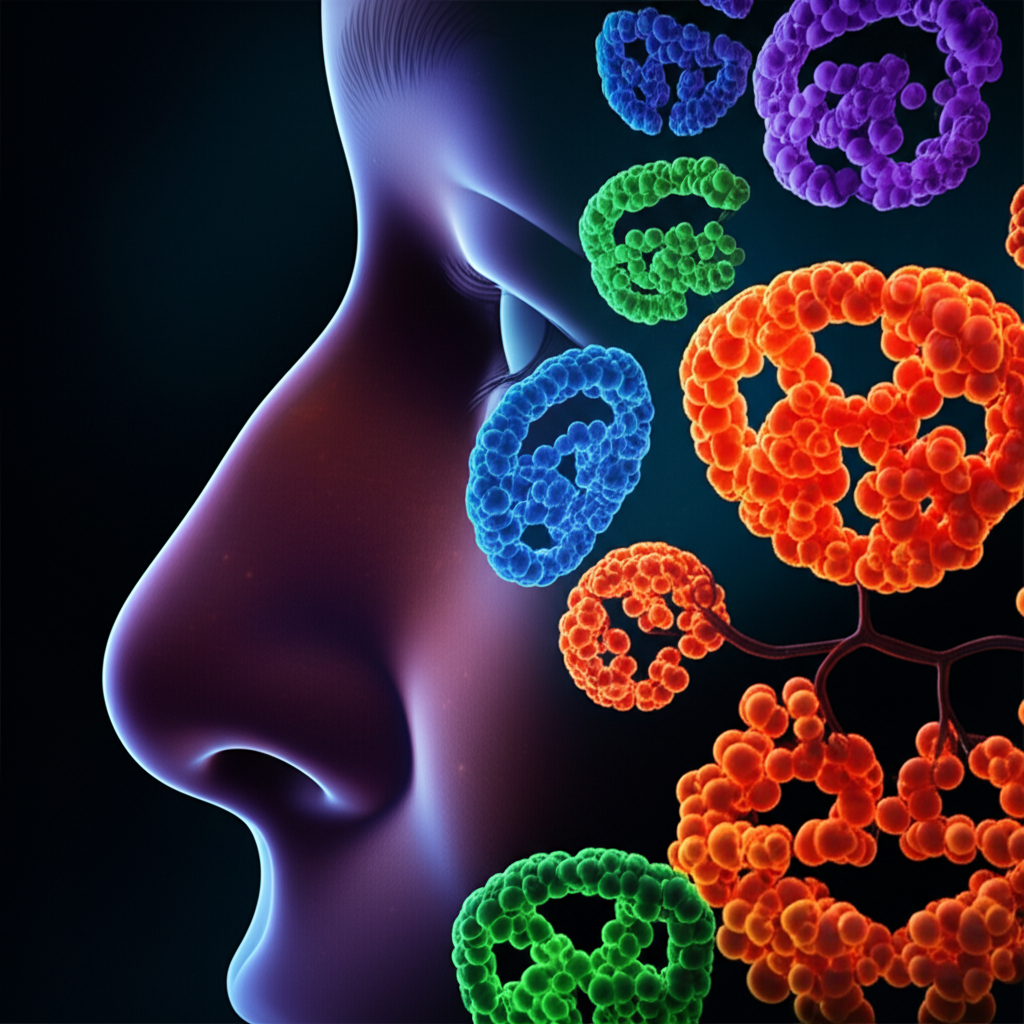
- Odorants: The Invisible Messengers
- The Olfactory Epithelium: Where Scent Recognition Begins
- Unraveling The Molecular Dance: Olfactory Receptors
- From Molecule to Message: Signal Transduction
- The Olfactory Bulb: Decoding The Scent Blueprint
- Beyond the Bulb: Perception, Memory, and Emotion
- The Future of Olfactory Science
The sense of smell, often considered one of our most primal and evocative sensory experiences, is far more complex and intricately wired than many realize. It possesses an astonishing ability to conjure memories, warn us of danger, and enhance the pleasure of food, all through the detection of microscopic airborne molecules. For centuries, the precise mechanisms underlying this ability remained shrouded in mystery. Only in recent decades, thanks to groundbreaking scientific discoveries, have we begun to unravel the stunning molecular secrets that allow us to perceive the vast tapestry of odors around us.
Odorants: The Invisible Messengers
At the heart of our ability to smell are odorants – chemical compounds typically characterized by their volatility (meaning they easily vaporize and reach our nose) and their ability to interact with our olfactory system. From the delicate floral notes of a rose to the pungent aroma of garlic or the comforting scent of freshly baked bread, each odorant possesses a unique molecular structure. The sheer diversity of these molecules is staggering, and our olfactory system is equipped to differentiate between potentially trillions of distinct odors. The challenge lies in how the body translates these varied molecular shapes and sizes into a recognizable neural signal.
The Olfactory Epithelium: Where Scent Recognition Begins
Our journey into the molecular mechanics of smell begins deep within the nasal cavity, in a specialized patch of tissue known as the olfactory epithelium. This remarkable tissue, roughly the size of a postage stamp, is home to millions of highly specialized sensory neurons – the olfactory receptor neurons (ORNs). Unlike most neurons in the body, ORNs are unique in their direct exposure to the external environment, extending their dendrites, covered in tiny hair-like cilia, into the mucus layer that lines the nasal cavity. It is within this mucus, brimming with odorant-binding proteins, that the initial interaction between odorant molecules and our nervous system takes place.
Unraveling The Molecular Dance: Olfactory Receptors
The true marvel of olfaction lies in the nature of these ORNs themselves. Each ORN expresses only one specific type of olfactory receptor gene from a very large family of genes. In humans, this family comprises approximately 400 functional olfactory receptor genes – an extraordinary number that accounts for roughly 3-5% of our entire genome. These olfactory receptors belong to a class of proteins called G-protein coupled receptors (GPCRs), known for their role in transmitting signals across cell membranes.
The groundbreaking work of Richard Axel and Linda Buck, for which they were awarded the Nobel Prize in Physiology or Medicine in 2004, illuminated how this vast array of receptors functions. They discovered that each olfactory receptor is exquisitely designed to recognize a specific range of odorant molecules, or specific features within those molecules. This isn’t a simple lock-and-key mechanism where one receptor fits one odorant perfectly. Instead, it’s more like a complex barcode scanner. A single odorant molecule might activate several different olfactory receptors to varying degrees, and conversely, a single receptor can be activated by multiple different odorants. It’s the unique combination and pattern of activated receptors that the brain interprets as a particular smell.
From Molecule to Message: Signal Transduction
Once an odorant molecule binds to its specific olfactory receptor on an ORN, a cascade of molecular events is triggered. This process, known as signal transduction, converts the chemical signal into an electrical one.
1. Binding: An odorant molecule attaches to the binding site on the olfactory receptor.
2. GPCR Activation: This binding causes a conformational change in the GPCR, activating an associated G-protein.
3. Second Messenger Production: The activated G-protein then stimulates an enzyme called adenylyl cyclase. Adenylyl cyclase converts ATP into cyclic AMP (cAMP), which acts as a “second messenger” within the cell.
4. Ion Channel Opening: cAMP directly binds to and opens specific ion channels (cyclic nucleotide-gated ion channels) in the ORN membrane. These channels allow positively charged ions (like sodium and calcium) to rush into the cell.
5. Depolarization and Action Potential: The influx of positive ions causes the ORN’s membrane potential to become less negative (depolarization). If this depolarization reaches a certain threshold, it generates an action potential – an electrical signal that races down the ORN’s axon.
This electrical signal is the brain’s first direct “message” about the detected odor.
The Olfactory Bulb: Decoding The Scent Blueprint
The axons of the millions of ORNs coalesce and project upwards through tiny holes in the skull, converging on a remarkable structure at the base of the brain called the olfactory bulb. Within the olfactory bulb are specialized spherical structures called glomeruli. In one of the most elegant examples of neural organization, all ORNs expressing the same type of olfactory receptor converge onto just one or two specific glomeruli. This means that each glomerulus essentially represents a single “feature detector” for a particular aspect of an odorant molecule.
Inside each glomerulus, the ORN axons synapse with mitral and tufted cells, which are the main output neurons of the olfactory bulb. Here, the raw sensory data is processed, filtered, and refined. The pattern of activated glomeruli creates a unique “odor map” or “scent blueprint” for each distinct smell. This pattern is then relayed via the mitral and tufted cells to various higher brain regions.
Beyond the Bulb: Perception, Memory, and Emotion
From the olfactory bulb, the signals travel along the olfactory tract to several brain areas, notably the piriform cortex, which is the primary olfactory cortex. Unlike other sensory systems where signals pass through the thalamus before reaching the cortex, olfaction has a more direct route, often bypassing the thalamus initially. This direct projection to the piriform cortex allows for rapid integration and recognition of smells.
Further processing occurs in areas like the amygdala and hippocampus, brain regions critically involved in emotion and memory, respectively. This direct link explains why smells are so potent in triggering vivid memories and strong emotional responses, often bypassing conscious thought entirely. The intricate molecular dance on the cilia of an ORN ultimately culminates in the subjective experience of recognizing the aroma of freshly brewed coffee, recalling a childhood memory, or sensing an impending danger.
The Future of Olfactory Science
Our understanding of smell continues to evolve. Scientists are exploring how individual differences in olfactory receptor genes might explain why some people perceive certain smells differently, or why some experiences “olfactory blindness” to specific odorants. The implications of this research are vast, from developing more effective artificial noses for security or industrial applications to understanding the role of smell in diagnosing neurodegenerative diseases like Parkinson’s, and even improving the quality of life for those who have lost their sense of smell due to trauma or illness.
In conclusion, the journey from an airborne molecule to a perceived scent is a breathtaking saga of molecular recognition, signal transduction, and neuroanatomical elegance. The stunning molecular secrets of smell, once an enigma, are now gradually being revealed, offering profound insights into one of the most ancient and powerful senses that shapes our experience of the world.
0 Comments