
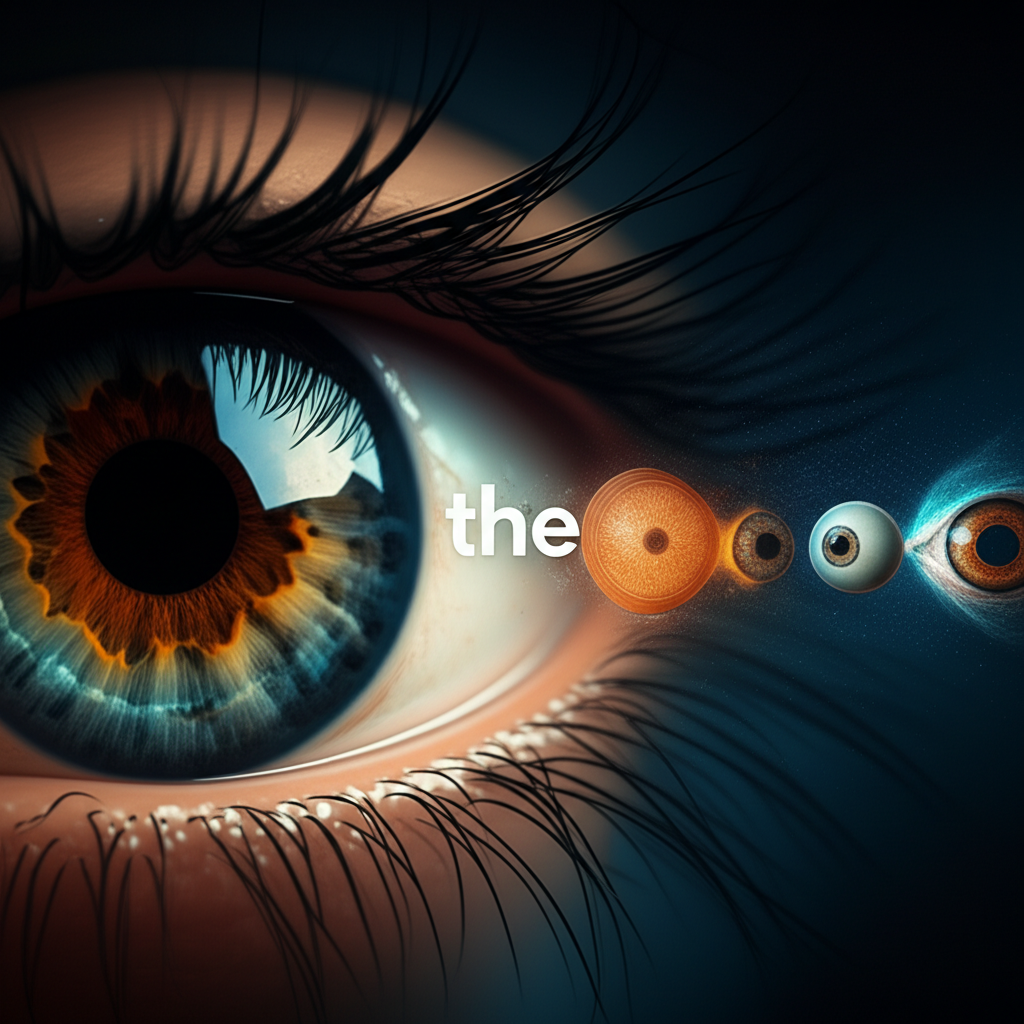
The Miracle of Vision: Tracing the Eye’s Evolutionary Odyssey
The human eye, a marvel of biological engineering, processes light into a symphony of color, form, and movement, allowing us to navigate and understand our world. It’s often cited as an example of irreducible complexity, leading some to question how such an intricate organ could have possibly evolved through gradual steps. Yet, the fossil record, comparative anatomy, and genetic studies paint a compelling picture of one of nature’s most extraordinary evolutionary journeys – a testament to the power of natural selection operating over hundreds of millions of years. Far from appearing fully formed, the eye underwent a stunning, step-by-step transformation, beginning with the simplest light-sensitive cells.
From Light Sensors to Complex Cameras: The Earliest Steps
The story of vision begins not with an eye, but with a patch of light-sensitive cells. Over 500 million years ago, in the primordial oceans, life forms emerged that possessed rudimentary photoreceptors – cells capable of detecting the presence or absence of light. These early “eye spots” or ocelli, similar to those found in modern-day flatworms, offered a distinct advantage. An organism could sense if it was in sunlight or shadow, allowing it to move towards food sources (often found in light) or retreat from predators (which might cast shadows). This basic ability to distinguish light from dark was the critical first step, providing a simple yet profound survival benefit. It wasn’t about seeing images, but merely sensing a change in environmental illumination.
The Dawn of Directional Vision: Pinhole Eyes and Beyond
The next crucial evolutionary leap involved creating a sense of direction. Imagine a simple cup-shaped indentation lined with photoreceptors. When light hit this “pit eye,” the intensity of light falling on different parts of the cup would vary depending on the light source’s direction. This allowed an organism to not just detect light, but to infer where the light was coming from. The nautilus, a living fossil, still possesses such a pinhole eye, which functions much like an ancient camera obscura. Light enters through a small aperture, projecting an inverted, albeit blurry, image onto the photoreceptor-lined back wall. While not sharp, it provided enough information to navigate and detect large, nearby objects, significantly enhancing survival prospects for these early creatures.
With improved directional sensing came another critical development: protection. As eyes became more exposed and specialized, a transparent layer evolved to cover the pit, protecting the delicate photoreceptors from debris and injury. This protective layer, the nascent cornea, marked another vital step towards the complex structures we see today.
The Invention of the Lens: Sharpening the Picture
While pinhole eyes offered direction, the images they produced were inherently dim and fuzzy. The solution to this problem was one of evolution’s most brilliant innovations: the lens. Over time, the transparent protective layer covering the pit eye began to thicken and curve, gradually forming a convex structure. This simple change had a revolutionary effect. By bending and focusing incoming light rays onto the photoreceptor surface, the lens transformed blurry light patterns into sharper, brighter images.
Different lineages developed lenses through various biochemical pathways, employing different crystalline proteins, showcasing convergent evolution – where unrelated species evolve similar traits independently. The advent of a true lens allowed for the discrimination of fine details, greatly enhancing an animal’s ability to locate prey, avoid predators, and navigate complex environments. It was a game-changer, laying the foundation for the incredible diversity of sophisticated eyes we observe today.
Divergence and Specialization: A Multifaceted World of Eyes
From this common ancestral blueprint, eyes diversified along myriad evolutionary paths, each tailored to specific ecological niches and survival strategies.
Compound Eyes: Insects and crustaceans evolved compound eyes, made up of thousands of individual light-sensing units called ommatidia. Each ommatidium points in a slightly different direction, providing a wide field of view and exceptional motion detection – vital for fast-moving fliers and agile hunters. While they produce a mosaic-like image, their temporal resolution (ability to perceive rapid changes) is far superior to ours.
Camera-Type Eyes: Vertebrates (including humans) and cephalopods (like octopuses and squids) developed camera-type eyes, remarkably similar in overall structure to each other despite their vastly different evolutionary lineages. Both feature a single lens that focuses light onto a retina containing millions of photoreceptors. This astounding example of convergent evolution highlights the optimal efficiency of this design for high-resolution vision.
Beyond these major types, nature boasts an array of other astonishing visual systems: the multi-lensed eyes of scallops, the complex eyes of mantis shrimp with their extraordinary color perception, or the dozens of eyes adorning the bell of a box jellyfish. Each configuration represents a unique solution to the universal challenge of extracting information from light.
The Genetic Toolkit: How Evolution Built the Eye
Modern genetic studies have shed light on the underlying mechanisms of eye development. Surprisingly, many diverse species, from insects to humans, share a common “master control gene” like Pax6. This gene, when switched on, can trigger the development of an eye. Its presence across such disparate species suggests a shared, ancient genetic toolkit that has been repeatedly leveraged and modified over evolutionary time. Evolution doesn’t build complex organs from scratch with every new species; rather, it tinkers with existing genetic pathways, adding, subtracting, and modifying components to create new adaptations.
The Ongoing Evolution of Vision
The evolution of the eye is not a story confined to the distant past. It’s an ongoing process, continually adapting to new environmental pressures and opportunities. Deep-sea creatures have evolved eyes capable of detecting bioluminescence in the perpetual gloom, while nocturnal animals often possess larger pupils and more rod cells for enhanced low-light vision. Humans, too, continue to experience subtle shifts in our visual capabilities, influenced by our lifestyles and environment.
The journey of the eye, from a simple patch of light-sensitive cells to the sophisticated organs capable of processing intricate visual information, is arguably one of the most compelling narratives in all of biology. It stands as profound evidence against the notion of intelligent design, showcasing instead the remarkable power of natural selection to iteratively refine and build complexity, one advantageous step at a time, creating organs of exquisite beauty and utility from the humblest of beginnings.
0 Comments