
- What is Quantum Entanglement? The Basics
- The "Spooky Action" Unpacked: A Deeper Look at Quantum Entanglement
- Experimental Proof: From Paradox to Reality
- Unlocking the Future: Practical Applications of Quantum Entanglement
- Addressing Common Misconceptions
- The Enduring Mystery and Our Evolving Understanding
Quantum entanglement is one of the most perplexing and fascinating phenomena in the universe, a concept that not only challenges our classical understanding of reality but also promises to unlock revolutionary technologies. Dubbed “spooky action at a distance” by Albert Einstein, this quantum mechanical link between particles—no matter how far apart they are—reveals a profoundly interconnected cosmos. It’s a truth so startling that it forces us to reconsider the very fabric of space and information, leading to what many consider the most shocking revelations about the universe we inhabit. This article will delve into the essence of quantum entanglement, explain its mind-bending implications, and explore its transformative potential.
What is Quantum Entanglement? The Basics
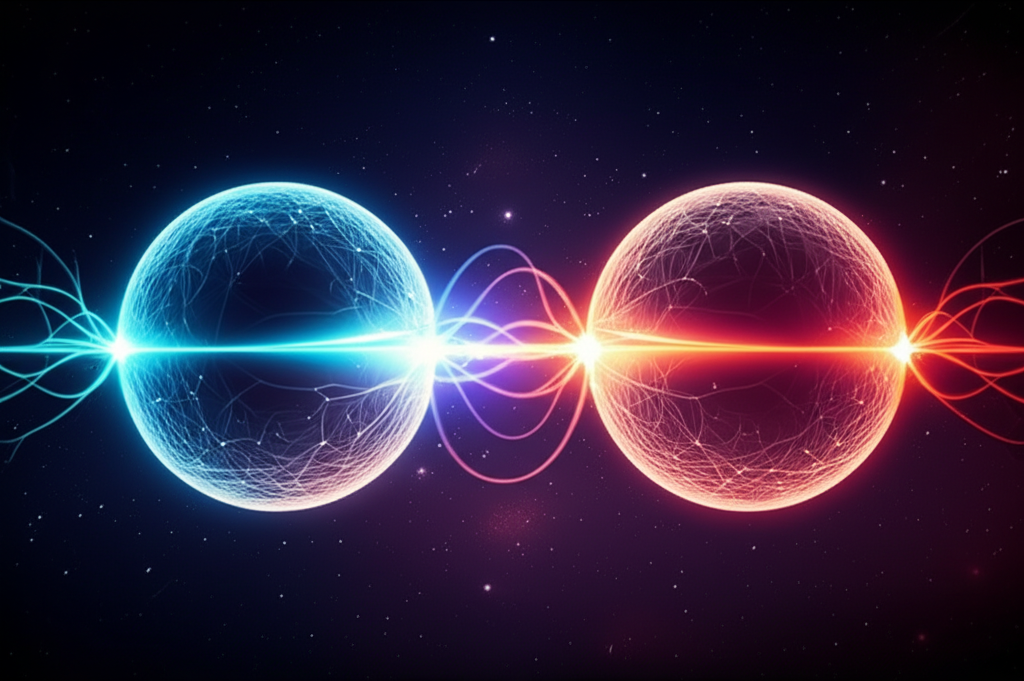
At its core, quantum entanglement describes a situation where two or more particles become linked in such a way that they share a unified quantum state, irrespective of the distance separating them. Imagine two coins that, once entangled, will always show opposite faces when flipped, even if one is in London and the other in New York. If the coin in London lands on heads, you instantly know the coin in New York must be tails, without having to look. In the quantum realm, this connection is even more profound: the particles don’t have a definite state (e.g., spin up or spin down) until one of them is measured. The act of measuring one particle immediately determines the state of its entangled partner. They are no longer independent entities but two parts of a single, interwoven system.
The “Spooky Action” Unpacked: A Deeper Look at Quantum Entanglement
Einstein found this prospect deeply disturbing because it seemed to imply instantaneous communication between entangled particles, violating his theory of special relativity, which posits that nothing can travel faster than the speed of light. The “spooky action” refers to the apparent non-local influence—the idea that a measurement on one particle instantaneously influences its distant entangled partner, without any physical signal traveling between them. This isn’t about sending information faster than light (which is impossible, as we’ll explain), but rather about the inherent interconnectedness of their shared quantum state.
Before measurement, both particles exist in a superposition of states, meaning they simultaneously possess all possible states (e.g., both spin-up and spin-down at the same time). Upon measurement, their wavefunctions collapse simultaneously, revealing their correlated properties. This revelation about shared destiny, transcending spatial separation, is arguably the most shocking aspect of quantum mechanics. It suggests that reality is far less “local” than we intuitively perceive, challenging the very notion of independent objects in space.
Experimental Proof: From Paradox to Reality
For decades, entanglement was a theoretical curiosity, even a point of contention among physicists. Einstein himself, along with Boris Podolsky and Nathan Rosen, proposed the “EPR paradox” in 1935, arguing that quantum mechanics must be incomplete because of this “spooky action.” However, experiments in the latter half of the 20th century, particularly those based on John Stewart Bell’s theorem, began to provide conclusive evidence.
Bell’s theorem posited a way to experimentally distinguish between quantum mechanics and “local realism”—the idea that particles have definite properties independent of measurement, and influences cannot travel faster than light. Numerous experiments, starting with Alain Aspect’s groundbreaking work in the 1980s and continuing to increasingly sophisticated tests today, have consistently violated Bell’s inequalities. These results unequivocally demonstrate that entangled particles indeed act in ways that defy classical, local-realistic explanations, confirming the reality of “spooky action at a distance” and solidifying quantum entanglement as a verified physical phenomenon. It’s no longer just a theory; it’s a proven fact of our universe.
Unlocking the Future: Practical Applications of Quantum Entanglement
The shocking truth of entanglement isn’t just a philosophical curiosity; it’s a foundational principle paving the way for a second quantum revolution with transformative technological potential.
Quantum Computing: Entanglement is central to quantum computers. Unlike classical bits that are either 0 or 1, quantum bits (qubits) can exist in superpositions of 0 and 1 simultaneously and can be entangled with each other. This entanglement allows quantum computers to perform vast numbers of calculations simultaneously, leading to exponential increases in processing power for specific types of problems. This could revolutionize fields like drug discovery, materials science, financial modeling, and complex optimization tasks by solving problems intractable for even the most powerful supercomputers today.
Quantum Communication and Cryptography: Entangled particles offer an intrinsically secure form of communication. Any attempt by an eavesdropper to measure an entangled particle immediately disturbs its quantum state, thereby alerting both sender and receiver to the intrusion. This principle is being harnessed to develop unhackable quantum communication networks, ensuring absolute privacy for sensitive data—a major leap forward for cybersecurity.
Quantum Sensing and Metrology: The heightened sensitivity of entangled particles can be leveraged to create extremely precise sensors for measuring tiny changes in magnetic fields, gravitational waves, and even time. This could revolutionize medical imaging, improve navigation systems, detect minute geological shifts, and enhance fundamental scientific research into the deepest mysteries of the cosmos.
Addressing Common Misconceptions
Despite its wondrous nature, quantum entanglement is often misunderstood. Crucially, it does not* allow for faster-than-light communication or information transfer. While the measurement of one entangled particle instantly influences its partner, the outcome of that measurement is fundamentally random until observed. You cannot choose what state the particle will collapse into, and therefore you cannot encode a message (e.g., “send heads for yes, tails for no”) to be instantly received. The correlation is instantaneous, but the information about that correlation can only be gathered and compared once classical communication (at or below the speed of light) confirms the shared results. Nor does entanglement imply mystical connections or consciousness directly influencing reality in a macroscopic way, as some popularizations suggest. It’s a precisely defined physical phenomenon governed by the rigorous rules of quantum mechanics.
The Enduring Mystery and Our Evolving Understanding
Even with decades of experimental verification and theoretical advancement, quantum entanglement continues to be a source of profound wonder and active research. Scientists are still exploring its deepest implications for the nature of reality, the relationship between space and time, and even theories of quantum gravity. As we unlock more of its secrets, entanglement stands not just as a bizarre quirk of the universe, but as a critical component in building the next generation of technologies—a testament to how understanding the most fundamental aspects of existence can lead to the most practical and astonishing innovations. The journey to fully comprehend this cosmic interconnectedness is far from over, promising even more shocking revelations in the years to come.
0 Comments