
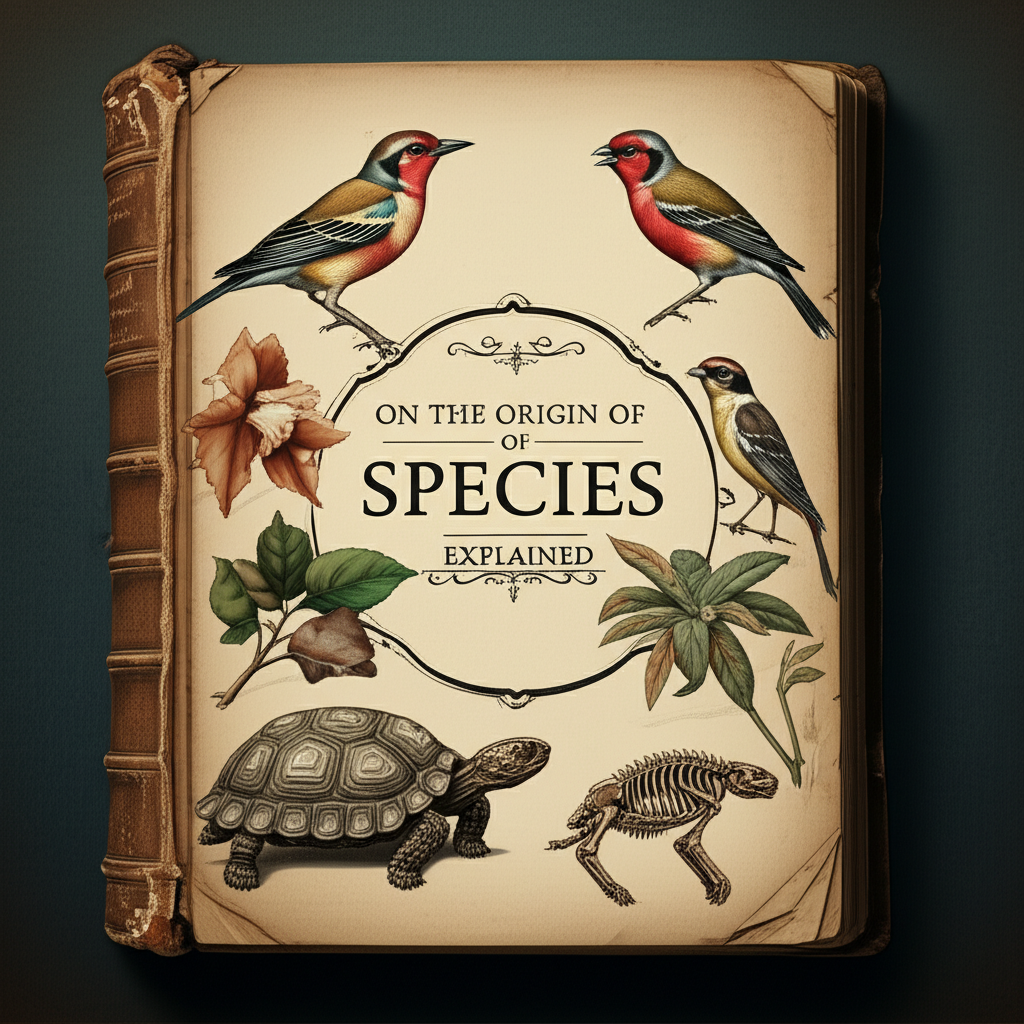
The Origin of Species by Charles Darwin is not just a book; it is a foundational pillar of modern science, a revolutionary text that fundamentally altered humanity’s understanding of life on Earth. Published in 1859, its full title, On the Origin of Species by Means of Natural Selection, or the Preservation of Favoured Races in the Struggle for Life, hints at the profound revelations contained within its pages. Far from being a dusty academic tome, Darwin’s work is a meticulously argued, evidence-packed exposition that laid the groundwork for evolutionary biology. For anyone seeking to grasp the fundamental mechanisms driving life’s incredible diversity, understanding The Origin of Species is an absolute must-have.
The World Before Darwin: A Static View of Life
Before Darwin, the prevailing scientific and societal view of life was largely static. Most believed that species were immutable, created independently and remaining unchanged since their conception. While some naturalists had hinted at the idea of species evolving, such as Jean-Baptiste Lamarck with his theory of acquired characteristics, a coherent and well-supported mechanism for such change was sorely lacking.
Darwin himself began his career within this framework. His transformative five-year voyage aboard HMS Beagle (1831-1836) was initially a geological survey, but it became an unparalleled opportunity for a keen naturalist to observe life across diverse ecosystems. From the peculiar finches and tortoises of the Galápagos Islands to the fossil megafauna of South America, Darwin accumulated a mountain of observations that challenged the static view of nature he had been taught. He noticed patterns of distribution, variation within species, and similarities between extinct and living forms that strongly suggested a dynamic, interconnected history of life.
The Mechanism of Natural Selection: Darwin’s Revolutionary Idea
Upon his return, Darwin spent decades meticulously compiling his evidence and refining his groundbreaking theory. He drew inspiration from diverse sources, including Thomas Malthus’s essay on population, which highlighted the “struggle for existence.” Darwin synthesized these insights into the concept of natural selection, a remarkably elegant yet powerful mechanism for evolutionary change.
The core tenets of natural selection, as outlined in The Origin of Species, can be broken down into a few key principles:
1. Variation: Within any population of organisms, individuals exhibit variations in their traits. No two individuals are perfectly identical.
2. Inheritance: Many of these variations are heritable, meaning they can be passed down from parents to offspring.
3. Overproduction: Organisms typically produce more offspring than can survive to reproduce themselves. This leads to competition for resources.
4. Differential Survival & Reproduction: Due to the struggle for existence, individuals with traits that are better suited or “favorable” to their specific environment are more likely to survive, reproduce, and pass on those advantageous traits. Over generations, these favorable traits become more common in the population, gradually leading to the evolution of new species.
Darwin argued that this process, occurring over vast spans of time, could explain the astonishing complexity and diversity of life. He called it “descent with modification,” emphasizing that all life shares a common ancestor and has diversified through this slow, continuous refinement by natural selection.
The Compelling Evidence: More Than Just an Idea
What made The Origin of Species so compelling and ultimately convincing was not just the elegantly simple theory of natural selection, but the sheer volume and breadth of evidence Darwin presented. He painstakingly drew from multiple scientific disciplines:
The Fossil Record: Darwin acknowledged the incompleteness of the fossil record but pointed to sequences of fossils showing gradual changes and transitional forms.
Comparative Anatomy: He highlighted homologous structures – similar anatomical features (like the bone structure in the limbs of mammals, birds, and reptiles) that serve different functions but indicate a shared ancestry.
Embryology: Darwin noted striking similarities in the early embryonic development of diverse vertebrate species, suggesting a common developmental blueprint.
Biogeography: The Origin of Species explained the peculiar distribution patterns of species on different continents and islands by invoking migration and adaptation to new environments.
Artificial Selection: Darwin used the familiar example of dog breeding and pigeon fancying to illustrate how humans deliberately select for desired traits, effectively mimicking the process of natural selection in a shorter timeframe.
By weaving together these disparate lines of evidence, Darwin built an unimpeachable case for evolution through natural selection, transforming it from a speculative idea into a robust scientific theory.
The Immediate Reception and The Enduring Impact on Science
Upon its publication, The Origin of Species was met with a mixture of awe, controversy, and outrage. While many scientists quickly grasped its profound implications, the idea of humans sharing a common ancestor with other animals, and of life evolving without direct divine intervention, clashed violently with prevailing religious dogma. Public debates, often sensationalized, ensued, solidifying the book’s place in both scientific and cultural history.
Despite the initial resistance, Darwin’s work rapidly gained traction within the scientific community. It provided a unifying framework for the biological sciences, explaining observations that had previously seemed disparate or inexplicable.
The enduring impact of The Origin of Species cannot be overstated:
Foundation of Modern Biology: It remains the cornerstone of evolutionary biology, which in turn underpins nearly all other biological disciplines, from genetics to ecology and medicine.
Scientific Methodology: Darwin’s meticulous evidence-gathering and logical argumentation set a high standard for scientific inquiry.
Challenging Dogma: It demonstrated the power of scientific observation and reasoning to challenge entrenched beliefs, paving the way for further intellectual and scientific revolutions.
Modern Synthesis: In the 20th century, Darwin’s ideas were spectacularly integrated with Mendelian genetics, leading to the “modern evolutionary synthesis,” which provided an even more complete understanding of heredity and variation.
Today, understanding evolution is crucial for addressing global challenges such as antibiotic resistance, conservation of biodiversity, and agricultural innovation. The Origin of Species equipped us with the fundamental tools to comprehend these complex issues.
In conclusion, The Origin of Species* is far more than an outdated historical document. It is a living testament to humanity’s capacity for observation, logical deduction, and paradigm-shifting insight. Its clarity, the depth of its evidence, and the profound implications of its central argument make it not just a significant book in scientific history, but a must-have text for anyone wishing to truly understand the breathtaking narrative of life on Earth. Its legacy continues to shape our scientific understanding, reminding us of the dynamic, ever-changing nature of the living world.
0 Comments