- The Classical Dichotomy: Waves vs. Particles
- The Double-Slit Experiment: Unveiling Quantum Mystery
- De Broglie's Hypothesis: Matter Waves
- The Fundamental Implications of Duality
- The Legacy and Future of Duality
The concept of wave-particle duality stands as one of the most perplexing, yet fundamental, pillars of modern physics. It’s a truth so counter-intuitive that even Albert Einstein struggled with its implications, famously remarking, “God does not play dice with the universe.” This mind-bending phenomenon reveals that the very building blocks of our reality don’t neatly fit into our classical categories of “wave” or “particle” but can exhibit characteristics of both, depending on how we observe them. Unveiling this duality forces us to reconsider the nature of existence itself and opens doors to understanding the universe at its most fundamental level.
The Classical Dichotomy: Waves vs. Particles
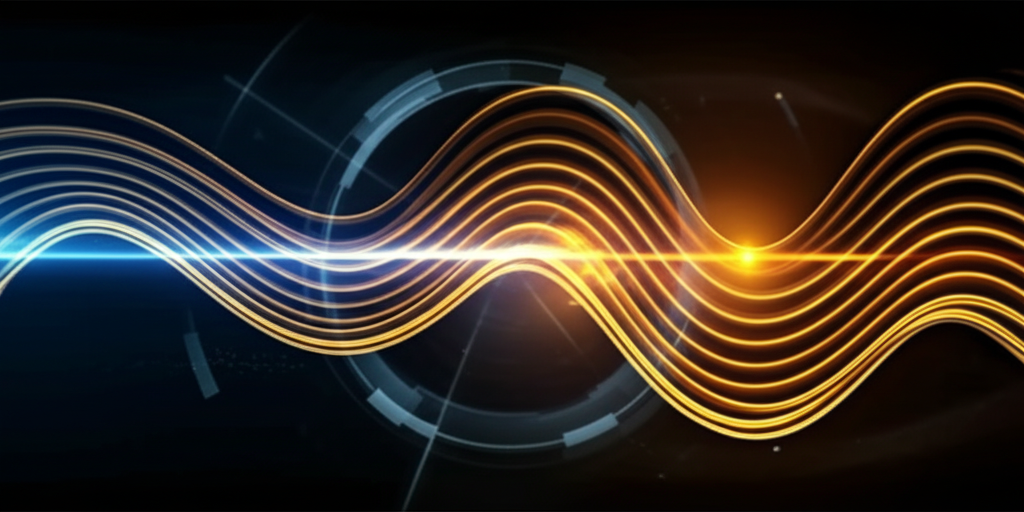
Before diving into the quantum strange, it’s essential to understand the classical distinction. In classical physics, a “particle” is a localized entity with a definite position and momentum, like a billiard ball. It occupies one place at one time. A “wave,” conversely, is a distributed disturbance that spreads out through space, like ripples on water or sound waves in air. Waves exhibit phenomena like interference (when two waves combine to amplify or cancel each other) and diffraction (spreading out as they pass through an opening). These two categories were considered mutually exclusive until a series of revolutionary discoveries at the turn of the 20th century shattered this clear-cut picture.
The Early Seeds of Duality: Light’s Puzzling Nature
The first hints of duality emerged from the long-standing debate about the nature of light. For centuries, scientists pondered whether light consisted of particles (corpuscles) or waves. Isaac Newton championed the particle theory, while Christiaan Huygens argued for a wave interpretation. By the early 19th century, experiments by Thomas Young demonstrating light interference seemed to conclusively prove its wave nature. James Clerk Maxwell’s electromagnetic theory further solidified this view, describing light as electromagnetic waves.
However, the problem wasn’t entirely resolved. In 1900, Max Planck introduced the concept of energy quantization to explain black-body radiation, suggesting that energy is emitted or absorbed in discrete packets, or “quanta.” Five years later, Albert Einstein took Planck’s idea further to explain the photoelectric effect – the emission of electrons from a metal when light shines on it. Einstein proposed that light itself consists of discrete bundles of energy, which he called “light quanta” (later named photons). These photons behaved like particles, carrying a specific amount of energy and momentum. Thus, light, which was universally accepted as a wave, also appeared to behave as a particle.
The Double-Slit Experiment: Unveiling Quantum Mystery
No experiment more vividly illustrates wave-particle duality than the double-slit experiment. Initially performed with light, its true “mind-blowing” nature became evident when physicists conducted it with individual electrons, and later, even larger particles like atoms and molecules.
Imagine firing a stream of particles, like tiny bullets, at a barrier with two narrow slits. If they are classical particles, we’d expect two distinct bands on a screen behind the barrier, corresponding to the bullets that passed through each slit.
When the experiment is done with light, an interference pattern emerges – alternating bright and dark fringes – characteristic of waves. This means light waves passed through both slits simultaneously, interfered with each other, and then hit the screen.
Here’s where it gets truly bizarre: When electrons (considered particles) are fired one at a time through the double slits, something astonishing happens. If researchers simply record where each electron lands on the screen, over time, an interference pattern still builds up! This suggests that even a single electron, behaving like a particle, somehow “knows” about both slits and interferes with itself. It acts like a wave until it hits the detector.
Even more perplexing, if we try to observe which slit the electron passes through (e.g., by placing a detector near one of the slits), the interference pattern disappears, and we get the classical two-band pattern. The act of observation forces the electron to “choose” one path, collapsing its wave function and making it behave distinctly as a particle. This “observer effect” is one of the most profound and challenging aspects of quantum mechanics.
De Broglie’s Hypothesis: Matter Waves
While light was performing its dual act, a young French physicist, Louis de Broglie, proposed a radical idea in 1924: if waves (like light) could behave like particles, then perhaps particles (like electrons) could also behave like waves. He hypothesized that every particle possesses a “matter wave” with a wavelength inversely proportional to its momentum. This de Broglie wavelength is given by the equation λ = h/p, where h is Planck’s constant and p is the particle’s momentum.
De Broglie’s hypothesis was met with skepticism but was soon experimentally confirmed. In 1927, Clinton Davisson and Lester Germer observed diffraction patterns when electrons were scattered from a nickel crystal, precisely as predicted by a wave model. Independently, G.P. Thomson (son of J.J. Thomson, who discovered the electron as a particle) performed similar experiments, also confirming the wave nature of electrons. The Nobel Prize-winning irony was that J.J. Thomson won his Nobel for proving the electron was a particle, while G.P. Thomson won his for proving it was a wave!
The Fundamental Implications of Duality
Wave-particle duality isn’t just an abstract curiosity; it’s a cornerstone of quantum mechanics and has profound implications for our understanding of reality:
Probabilistic Nature: It indicates that at the quantum level, predictability in the classical sense vanishes. We can only talk about the probability of finding a particle at a certain location. The wave function describes these probabilities.
The Role of Observation: The double-slit experiment highlights that the act of measurement itself influences reality. A quantum entity doesn’t have definite properties until it is observed or measured.
* A Unified View: Rather than being either a wave or a particle, quantum entities are something different entirely – a “quantum object” that manifests as one or the other depending on the context of the interaction.
Why don’t we observe this duality in our everyday macroscopic world? The de Broglie wavelength for macroscopic objects is incredibly tiny. For a baseball thrown at speed, its wavelength is so infinitesimally small that it’s physically impossible to detect its wave-like properties. The wave aspect only becomes significant for particles with very small masses and high momenta.
The Legacy and Future of Duality
The revelations of wave-particle duality have paved the way for monumental advancements in science and technology. It underpins the entire framework of quantum mechanics, leading to the development of lasers, transistors, semiconductors, electron microscopes, Magnetic Resonance Imaging (MRI), and the burgeoning field of quantum computing. Without understanding this fundamental aspect of reality, none of these technologies would exist.
While the “mind-blowing” strangeness of wave-particle duality might never fully align with our classical intuition, it stands as a testament to the elegant and utterly surprising nature of the universe. It reminds us that reality at its most fundamental level is far richer and more complex than meets the eye, consistently challenging our assumptions and pushing the boundaries of human comprehension. As we continue to delve deeper into the quantum realm, the wave-particle duality will remain a beacon, guiding our exploration of the cosmos’ most profound secrets.
0 Comments