- The Essential Ingredients for a Rainbow
- The Physics of Light: Refraction, Reflection, and Dispersion
- How Primary Rainbows Form: A Symphony of Angles
- The Beautiful Arc of Rainbows
- Beyond the Primary: Exploring Secondary Rainbows and More
- Every Rainbow Is Personal
Rainbows are among nature’s most breathtaking spectacles, ephemeral arcs of color that ignite wonder in all who witness them. More than just a fleeting optical illusion, these vibrant aerial ribbons are a masterful display of fundamental physics, orchestrated by sunlight and raindrops. Understanding the science behind their captivating beauty not only deepens our appreciation but also unveils the intricate dance of light and water that paints the sky after a storm.
The Essential Ingredients for a Rainbow
For a rainbow to grace the sky, three primary components must be present and perfectly aligned: sunlight, raindrops, and an observer positioned between them. The sun must be behind the observer, casting its rays toward the rain shower in front. This specific geometric arrangement is non-negotiable for the classical bow we all recognize. When these elements converge, a complex yet elegant process of light manipulation begins, transforming ordinary water into an extraordinary canvas of color.
The Physics of Light: Refraction, Reflection, and Dispersion
At the heart of every rainbow lies the fascinating interplay of three key optical phenomena: refraction, reflection, and dispersion.
Refraction: The Bending of Light
When sunlight, which appears white to the naked eye, encounters a water droplet, it doesn’t just pass straight through. Instead, it bends or changes direction – a phenomenon known as refraction. This happens because light travels at different speeds in different mediums. As light moves from the less dense air into the denser water, its speed decreases, causing it to “bend” or “refract” inward.
Dispersion: Unveiling White Light’s True Colors
Perhaps the most crucial aspect of rainbow formation is dispersion. White sunlight is not a single color but a spectrum of many colors, each with a slightly different wavelength. Red light has the longest wavelength, followed by orange, yellow, green, blue, indigo, and violet (ROYGBIV), which has the shortest wavelength. Critically, each of these wavelengths bends at a slightly different angle when it refracts into the water droplet. Red light bends the least, and violet light bends the most. This differential bending is what separates the white light into its constituent colors, just as a prism does.
Internal Reflection: Bouncing Back to You
After entering the droplet and dispersing, the light travels to the opposite side of the internal surface. Here, instead of passing straight out, most of the light is reflected back towards the front of the droplet. This is called internal reflection. The light then travels back across the droplet and refracts once more as it exits the water and re-enters the air, further separating the colors before reaching our eyes.
How Primary Rainbows Form: A Symphony of Angles
The classic primary rainbow is formed by a single internal reflection within each raindrop. Sunlight enters a raindrop, refracts and disperses into its colors. These separated colors then travel to the back of the droplet, reflect off the inner surface, and finally refract again as they exit the droplet and travel towards the observer’s eye.
The magic of the rainbow lies in the precise angle at which these color-separated light rays emerge. For the brightest primary rainbow, the light exits the raindrops at a specific angle relative to the incoming sunlight – about 42 degrees for red light and 40 degrees for violet light. It is this narrow range of angles that directs the dispersed colors towards an observer’s eyes, creating the visible arc.
The Beautiful Arc of Rainbows
Why do we see a bow, and not just a colorful patch? This is a question of geometry and perspective. Each individual raindrop acts like a tiny prism, dispersing and reflecting light. However, you only see the light from the raindrops that are positioned at the specific 40-42 degree angle relative to your eye. When billions of raindrops are illuminated, each reflecting and dispersing light, your eye perceives a circle of light made up of all the droplets at that precise angle. Since the ground blocks the lower half of this circle, what we perceive is a majestic arc. From an airplane, it’s sometimes even possible to see a full, unbroken circle!
Beyond the Primary: Exploring Secondary Rainbows and More
While the primary rainbow is the most common and vibrant, observant individuals may occasionally spot a secondary rainbow arching above the primary one. This fascinating phenomenon occurs when sunlight undergoes two internal reflections within the raindrop instead of one.
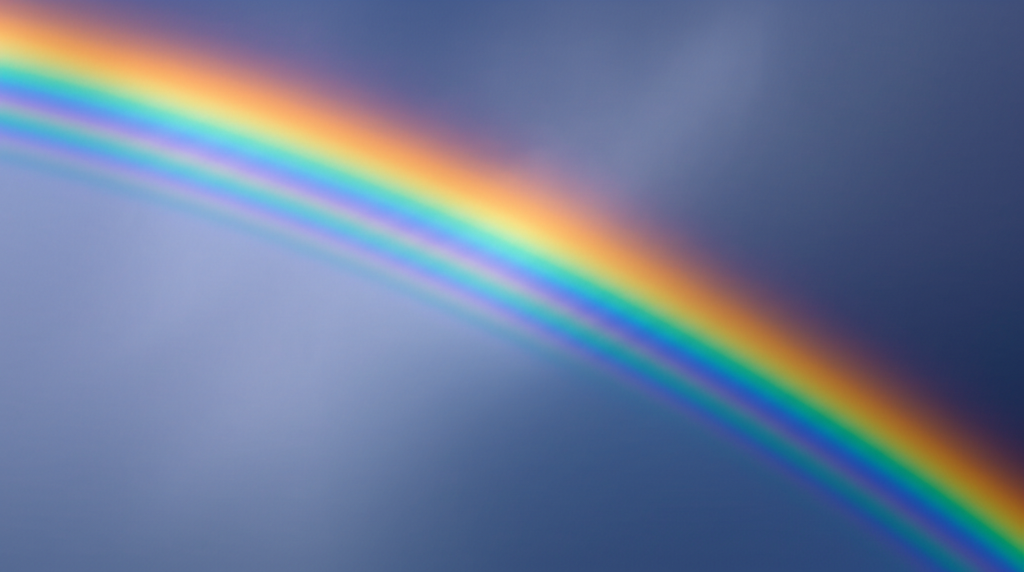
Because the light makes an extra bounce inside the droplet, the colors in a secondary rainbow are reversed compared to the primary – violet is on the outside and red on the inside. Consequently, secondary rainbows are also dimmer and wider than their primary counterparts, as more light is scattered with each additional reflection. The exit angle for a secondary rainbow is around 50-53 degrees.
Nature’s optical repertoire extends beyond these two common types. Occasionally, one might witness supernumerary bows — faint, narrow bands of color inside the primary bow — caused by wave interference effects. Twinned bows, where two primary bows share a common base but separate higher up, are rarer still, often formed by raindrops of different sizes or shapes. Fog bows, or “white rainbows,” appear in fog rather than rain and are much fainter due to the smaller water droplets causing less distinct color separation.
Every Rainbow Is Personal
One of the most profound aspects of rainbows is their inherent individuality. Because the formation depends entirely on the specific angle of light entering your eye from particular raindrops, no two people ever see precisely the same rainbow. Your rainbow is unique to you, a personal spectacle born from your specific vantage point relative to the sun and the rain. This means that chasing “the end of the rainbow” is, by definition, an impossible quest, as the rainbow constantly shifts with your movement.
From the simple bending of light to the complex interplay of angles and personal perspective, the brilliant physics of stunning rainbows transforms an ordinary afternoon shower into an extraordinary canvas. Next time you behold this natural wonder, remember the intricate scientific ballet unfolding within each tiny raindrop, a testament to the elegant laws that govern our universe.
0 Comments