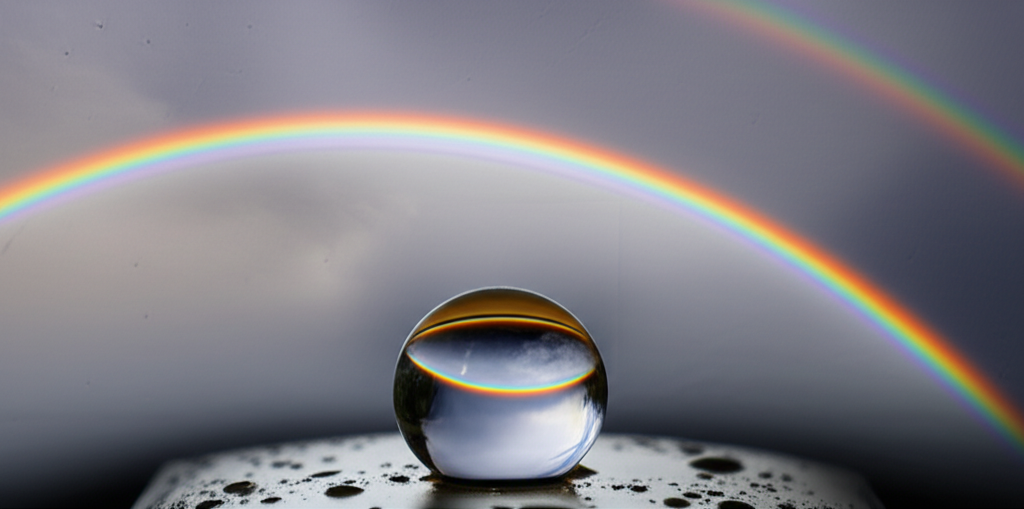
The rainbow, a spectacular arch of vibrant colors spanning the sky, has captivated humanity for millennia. It’s a fleeting masterpiece of nature, appearing as if by magic after a downpour, only to vanish as quickly as it arrived. Yet, beneath its ethereal beauty lies a profound and elegant display of physics, a testament to the fundamental principles governing light and matter. Understanding the science behind this breathtaking phenomenon only deepens our appreciation for its wonder.
What is a Rainbow?
At its core, a rainbow is an optical and meteorological phenomenon that causes a spectrum of light to appear in the sky when the sun shines onto droplets of moisture in the Earth’s atmosphere. It always takes the form of a multicoloured arc, with red on the outside and violet on the inside. To see a rainbow, you need two things: sunlight behind you and water droplets in front of you. Your back must be to the sun, and the rain, mist, or spray must be in front of you.
The Science Behind The Spectacle
The formation of a rainbow is a sophisticated interplay of three key optical principles: refraction, reflection, and dispersion. Each tiny water droplet in the atmosphere acts like a miniature prism, splitting sunlight into its constituent colors and funneling it towards our eyes.
1. Refraction: The Bending of Light
When a ray of white sunlight encounters a spherical raindrop, it first enters the droplet. As light moves from one medium (air) to another (water), its speed changes, causing it to bend. This bending of light is called refraction. The light doesn’t just enter; it effectively changes direction twice – once upon entering the water droplet and again upon exiting it.
2. Reflection: Bouncing Back
After entering the droplet and refracting, the light ray travels to the opposite inner surface of the raindrop. Here, most of the light is reflected internally, bouncing off the back curve of the droplet, similar to how a mirror works. This internal reflection is crucial for the light to return towards the observer. A small amount of light will pass through the back of the droplet, but the reflected portion is what forms the rainbow.
3. Dispersion: Unveiling The Colors
Perhaps the most enchanting part of the rainbow’s physics is dispersion. White sunlight is not a single color but a spectrum of colors, each with a slightly different wavelength. When white light passes through a medium like water, these different wavelengths slow down and bend at slightly different angles. Red light, with the longest wavelength, bends the least, while violet light, with the shortest wavelength, bends the most. This differential bending causes the white light to spread out, separating into the distinct colors of the spectrum: red, orange, yellow, green, blue, indigo, and violet (ROYGBIV).
The Role of Water Droplets:
Every single water droplet acts independently as a tiny prism. Millions of these droplets, each performing the same refraction, reflection, and dispersion, all work together to create the magnificent arc we perceive. Each droplet disperses a full spectrum of colors, but only a single color from each droplet reaches an observer’s eye at a specific angle.
Why The Arc Shape? The Geometry of Light
The arc shape isn’t a physical object you can touch; it’s an optical illusion created by the specific angle at which sunlight is internally reflected and refracted by millions of individual raindrops relative to your eye. When sunlight hits a water droplet, the dispersed colors emerge from the droplet at various angles. For the primary rainbow, the most intense light for each color emerges at a specific angle relative to the incoming sunlight.
Red light emerges at approximately 42 degrees, and violet light at about 40 degrees. This means that for you to see red, there must be water droplets positioned such that the light they reflect reaches your eye at an angle of 42 degrees from the line extending from the sun through your eye. For violet, this angle is 40 degrees. As you move your head, different droplets will provide the light that forms the rainbow, always at these specific angles relative to your vision and the sun.
Since these angles form a cone with your eye at the apex and the sun’s rays running through its axis, you see a circular arc—or rather, a segment of a circle. From an airplane, or atop a very tall building, it’s sometimes possible to see a full circular rainbow if the conditions are right and your view isn’t obstructed by the horizon.
Beyond The Primary: Secondary Rainbows and More
While the primary rainbow is the most common and vibrant, you might sometimes spot a fainter, secondary rainbow arching above the primary one. This occurs when light undergoes two internal reflections within the raindrop instead of one. Due to this extra reflection, the colors in a secondary rainbow are reversed, with violet on the outside and red on the inside, and it appears at a larger angle (around 50-53 degrees).
Other, rarer phenomena include supernumerary bows (faint, narrow bands of pastel colors hugging the primary bow, caused by interference effects), twin rainbows (two primary rainbows originating from the same point), and moonbows (very rare rainbows formed by moonlight instead of sunlight). Each variation offers a subtle twist on the fundamental physics of light.
Experiencing The Magic
Next time you witness a rainbow, take a moment to appreciate not just its stunning beauty but also the intricate dance of physics that brings it to life. The bending, bouncing, and splitting of light within countless tiny water droplets—all perfectly orchestrated to paint a transient masterpiece across the sky. It’s a powerful reminder that even the most commonplace natural events are often underpinned by complex and fascinating scientific principles, waiting to be revealed and admired.
0 Comments