- The Dance of Light and Water Droplets
- Refraction: Bending The Light Fantastic
- Reflection: The Inner Mirror
- A Second Refraction: Exiting The Stage
- Why Arches and Specific Color Orders? The Angle's Secret
- Beyond The Primary: Double Rainbows and More
- Your Perspective: The Personal Phenomenon
The awe-inspiring beauty of a rainbow has captivated humanity for millennia, inspiring myths, art, and wonder. Appearing as if by magic after a rain shower, this vibrant arc of colors stretching across the sky seems almost otherworldly. Yet, beneath its ethereal charm lies a profound and elegant display of physics. Understanding the science behind rainbows reveals not a diminished wonder, but an even deeper appreciation for the intricate natural laws governing our world. It’s a testament to the fact that sometimes, the most stunning secrets are hidden in plain sight, waiting for sunlight and water to reveal them.
The Dance of Light and Water Droplets
At its core, a rainbow is a spectacle of light interacting with water. For a rainbow to form, three key ingredients are precisely required: sunlight, water droplets, and an observer positioned correctly relative to both. Each tiny raindrop acts as a miniature prism, orchestrating “the” transformation of white sunlight into a spectrum of colors.
Refraction: Bending The Light Fantastic
The journey of light inside a raindrop begins with refraction. As sunlight—which appears white but is actually composed of all the colors of the spectrum—enters a water droplet, it slows down and bends. This bending is not uniform for all colors. Different wavelengths of light (which we perceive as different colors) bend at slightly different angles. This phenomenon is known as dispersion. Violet light, with its shorter wavelength, bends the most, while red light, with its longer wavelength, bends the least. This initial split of white light into its constituent colors is the first vital step in forming a rainbow.
Reflection: The Inner Mirror
After entering the spherical raindrop and undergoing the first refraction and dispersion, the separated colors of light travel to the opposite side of the droplet. Here, they encounter the inner surface of the water droplet and are reflected. This is internal reflection, similar to how light bounces off a mirror. For a primary rainbow, this reflection happens once within each droplet. The precise angle at which the light hits the back of the droplet dictates whether it reflects internally or passes straight through. It’s this internal bounce that directs the light back towards the observer.
A Second Refraction: Exiting The Stage
Finally, the light, now separated into its individual colors and having reflected internally, travels back to the front surface of the raindrop. As it exits the water droplet and re-enters the air, it undergoes a second refraction. This second bending further separates the colors and sends them traveling at specific angles towards the observer’s eyes. It is this specific sequence – primary refraction and dispersion, internal reflection, and secondary refraction and dispersion – that precisely directs the colored light to our eyes.
Why Arches and Specific Color Orders? The Angle’s Secret
The most striking feature of a rainbow is its arc shape and the consistent order of its colors. This is not arbitrary; it’s a direct consequence of the angles at which light exits the water droplets.
For a primary rainbow, the brightest and most common type, light exits the water droplets at an angle of approximately 40-42 degrees relative to the incoming sunlight. This specific angle means that only raindrops at a certain position relative to the sun and the observer will send light to the observer’s eyes. The collection of all these raindrops forms a circular arc. Imagine all the droplets around you, each reflecting light at that 42-degree angle, forming a giant cone of light with “the” observer at its apex. Since we usually see only a portion of this cone above the horizon, we perceive it as an arc.
The consistent color order—red on the outermost edge and violet on the innermost—is also due to this precise angular dispersion. Red light consistently exits the droplets at slightly larger angles (around 42 degrees) than violet light (around 40 degrees). This tiny difference in exit angles creates the distinct band of colors we observe, always in the sequence: red, orange, yellow, green, blue, indigo, violet (ROYGBIV).
Beyond The Primary: Double Rainbows and More
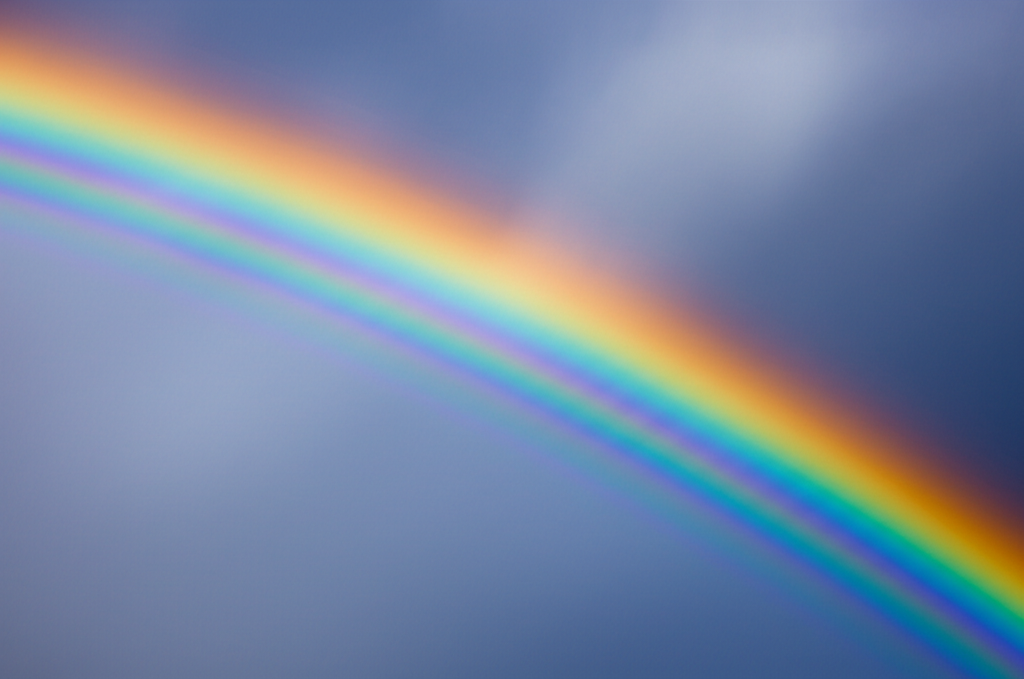
Sometimes, nature treats us to an even grander spectacle: the double rainbow. This occurs when light undergoes two internal reflections within the raindrop instead of just one. Each additional reflection causes more light to be lost, which is why the secondary bow is always fainter than the primary.
Crucially, “the” double reflection also reverses the order of colors in the secondary rainbow, placing violet on the outside and red on the inside. Furthermore, the secondary rainbow appears at a wider angle, typically around 50-53 degrees from the observer’s anti-solar point (the point directly opposite the sun). The space between the primary and secondary rainbow often appears darker; this region is known as Alexander’s band and is a result of the way light distribution works during internal reflections.
Other fascinating atmospheric optical phenomena include:
Supernumerary bows: Faint, narrow, colored bands sometimes seen inside the primary rainbow, caused by the wave nature of light (diffraction and interference).
Fogbows: Broad, faint, and often white bows formed by very tiny water droplets in fog, which lead to less distinct color separation.
* Moonbows: Rainbows produced by moonlight rather than sunlight. Because moonlight is much fainter, moonbows are often perceived as white, though careful observation or long-exposure photography can reveal their subtle colors.
Your Perspective: The Personal Phenomenon
One of “the” most remarkable aspects of a rainbow is its personalized nature. Each observer sees their own unique rainbow. The angle of 40-42 degrees is constant, but the specific set of raindrops fulfilling that condition changes depending on your position. Move a few feet, and you’re seeing light from an entirely different set of water droplets. Consequently, no two people ever see precisely the same rainbow. Your rainbow is always centered on your anti-solar point—the projection of the sun’s position directly behind you. This is why if you ever look for a rainbow, the sun must always be behind you.
The physics of rainbows is a beautiful testament to the precision and elegance of the natural world. From the simple elements of light and water, an intricate dance of refraction, reflection, and dispersion unfolds, painting the sky with an ephemeral masterpiece. Knowing “the” stunning secrets behind this everyday wonder only deepens our appreciation for the magic woven into the fabric of our universe. So, the next time a rainbow graces the sky, take a moment to marvel not just at its beauty, but at the sophisticated science that allows it to shine.
0 Comments