
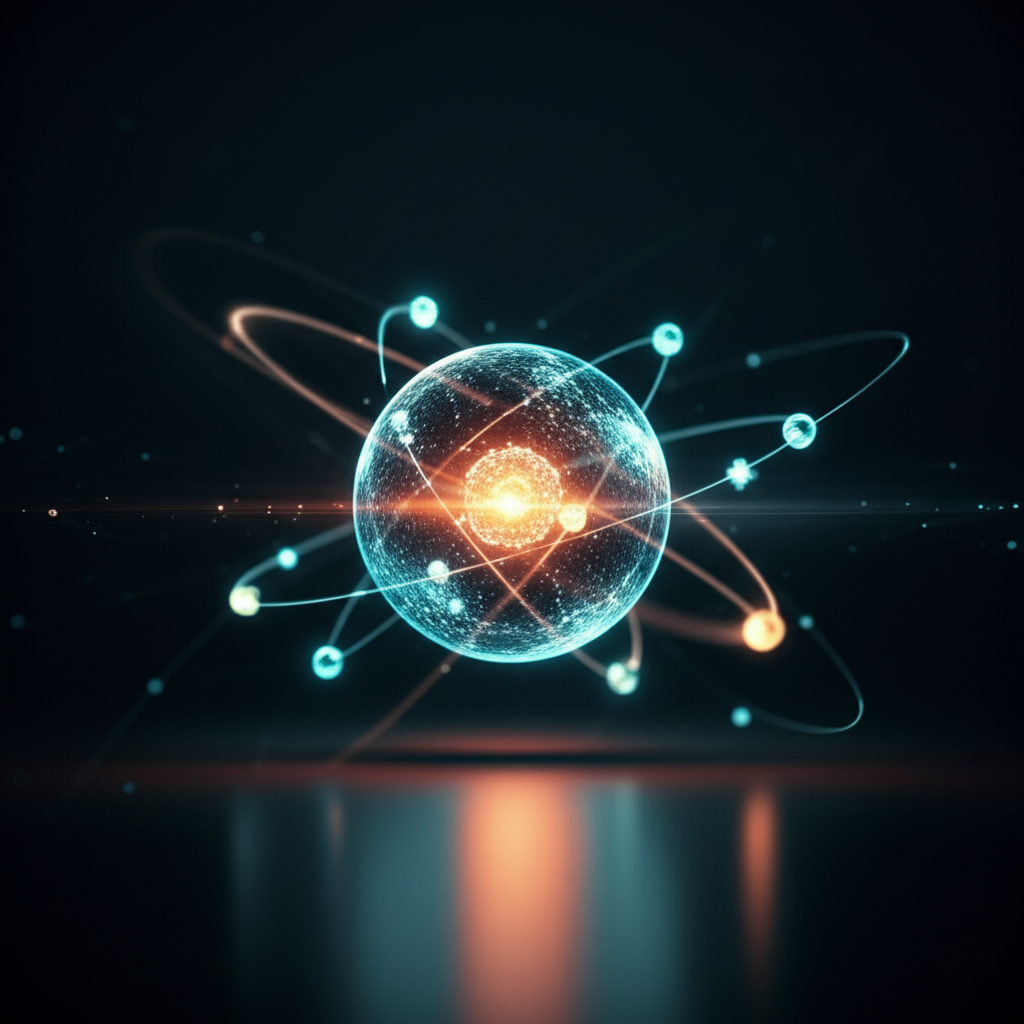
Quantum physics often conjures images of super-intelligent scientists, baffling equations, and concepts so mind-bending they seem plucked from science fiction. Yet, at its core, the quantum world offers a stunningly simple explanation for how our universe truly operates at its most fundamental level. Far from being an esoteric pursuit, understanding the basics of quantum mechanics is key to grasping the very fabric of reality, from the light that illuminates our world to the technology that powers our lives.
So, what exactly is quantum physics? Simply put, it’s the branch of physics that studies matter and energy at the most microscopic scales – the world of atoms, electrons, and photons. Classical physics, the kind that describes falling apples and orbiting planets, works brilliantly for large objects, but when you zoom into the incredibly tiny, the rules change dramatically. This is where quantum mechanics steps in, providing a new set of rules to explain phenomena that classical physics simply cannot.
The Granular Nature of Reality: Meet the Quanta
The word “quantum” itself comes from the Latin word “quantus,” meaning “how much.” In physics, a “quantum” refers to the smallest possible discrete unit of any physical entity involved in an interaction. Think of it like this: when you climb a ramp, you can stop at any point; your height changes continuously. But when you climb a staircase, your height only changes in discrete steps – you can be on the first step, the second step, but not truly in between steps.
This “stepped” nature is what quantization is all about. Energy, for example, isn’t a continuous flow that can be broken down indefinitely. Instead, it comes in tiny, indivisible packets, or quanta. A photon is a quantum of light, and an electron in an atom can only exist at specific, quantized energy levels, much like rungs on a ladder. It can jump between these rungs, but it cannot exist in the space between them. This fundamental idea, first proposed by Max Planck and later fleshed out by Albert Einstein and Niels Bohr, revolutionized our understanding of energy and matter.
Understanding the Quantum Realm: Key Principles
To truly appreciate the quantum world, we need to grapple with a few mind-bending, yet incredibly well-supported, principles:
Wave-Particle Duality: One of the most counter-intuitive aspects of quantum theory is that particles, like electrons and photons, can behave as both waves and particles. Imagine a tiny billiard ball that, when no one is looking, acts like a ripple in a pond. If you try to observe it, it snaps back into being a definite particle. This duality isn’t just theoretical; it’s been experimentally proven countless times. Light, for example, sometimes acts like a stream of particles (photons) and other times like a wave (electromagnetic radiation).
Superposition: This principle suggests that a quantum particle can exist in multiple states at the same time, until it is observed or measured. It’s like a coin spinning in the air: until it lands, it is simultaneously heads and tails. Only when it lands (is observed) does it “choose” one state. The famous Schrödinger’s Cat thought experiment illustrates this paradox: a cat in a sealed box, whose fate is linked to a quantum event, is considered both alive and dead simultaneously until someone opens the box and observes it.
Entanglement: Perhaps the most mysterious of all quantum phenomena, entanglement occurs when two or more particles become linked in such a way that they share the same fate, no matter how far apart they are. If you measure a property (like spin) of one entangled particle, you instantly know the corresponding property of the other, even if it’s light-years away. Einstein famously called this “spooky action at a distance,” because it seems to defy the speed limit of light. There’s no information being instantaneously transmitted; rather, the particles are fundamentally connected as a single quantum system.
Why The Quantum World Matters: From Gadgets to The Future
While the concepts of quantum physics might seem abstract and far removed from everyday life, its influence is profoundly practical. Without quantum mechanics, much of our modern technology wouldn’t exist:
Lasers: The fundamental principle behind lasers relies on electrons transitioning between quantized energy levels. Lasers are ubiquitous, from barcode scanners and fiber optic communications to medical surgery and Blu-ray players.
Transistors & Microchips: The entire semiconductor industry, which powers all our computers, smartphones, and electronic devices, is built upon quantum mechanics. Understanding how electrons behave in materials like silicon is crucial for designing and fabricating integrated circuits.
MRI Scanners: Magnetic Resonance Imaging (MRI) uses the quantum property of spin in atomic nuclei to create detailed images of the inside of the human body, revolutionizing medical diagnostics.
* Future Technologies: The quantum realm isn’t just about what we have; it’s about what’s coming. Quantum computing harnesses superposition and entanglement to potentially solve problems intractable for even the most powerful classical supercomputers. Quantum cryptography promises unbreakable encryption, and quantum sensors could offer unprecedented precision in measurement.
Embracing the Weirdness
It’s natural to find these ideas strange, even confusing. Many physicists throughout history have struggled with the implications of quantum mechanics because it operates on rules so different from our macroscopic experience. But despite its counter-intuitive nature, quantum theory is incredibly successful. It provides the most accurate descriptions and predictions for the behavior of matter and energy at atomic and subatomic scales, and its predictions have been verified by countless experiments with astonishing precision.
In essence, quantum physics peeled back another layer of the universe’s onion, revealing a reality that is far more nuanced, interconnected, and fundamentally granular than we ever imagined. It teaches us that at its smallest scale, the universe doesn’t operate like a miniature clockwork machine, but rather like a probabilistic, dynamic, and wonderfully mysterious dance of energy packets and waves, constantly shifting until observed. It’s a stunningly simple explanation because it boils down everything to fundamental, irreducible units, creating a universe that is both incredibly complex and elegantly structured from its most basic components.
0 Comments