How vast is the universe? This seemingly simple question opens a door to one of the most profound and mind-boggling aspects of existence. From the smallest particles to the grandest cosmic structures, the scale of our cosmos is a testament to natural grandeur and an ongoing source of fascination and scientific inquiry. It challenges our perception of distance, time, and even our place within the grand scheme of things.
The term “vast” barely begins to capture the sheer incomprehensibility of cosmic dimensions. We’re not just talking about the mere presence of stars and planets; we’re delving into distances so immense that our everyday units of measurement become utterly meaningless. To truly grasp the universe’s scale, we must recalibrate our understanding, moving beyond kilometers and miles to light-years and parsecs, and even then, these figures only scratch the surface of the unfathomable.
How Do We Measure the Unmeasurable?
Before we dive into the numbers, it’s crucial to understand the tools astronomers use to measure such colossal distances. The primary unit is the light-year, the distance light travels in one Earth year – approximately 9.46 trillion kilometers (5.88 trillion miles). For even larger scales, astronomers use parsecs, with one parsec being about 3.26 light-years. These units are essential because they allow us to conceptualize the universe not just as a static space, but as a dynamic entity where distance is intrinsically linked to time. When we look at distant objects, we are effectively looking back in time to how they appeared billions of years ago.
Our journey outward begins in our celestial backyard. The Moon is a mere 1.3 light-seconds away. The Sun, the heart of our solar system, is about 8 light-minutes from Earth. Even Pluto, one of the most distant known objects in our immediate planetary neighborhood, is only about 5.5 light-hours away. Extend that to the edge of the Oort Cloud, the vast spherical shell of icy objects believed to surround our solar system, and you’re already reaching out to nearly a light-year. This is where the truly mind-bending scale begins.
Our Galactic Home: The Milky Way
Our solar system is just one tiny speck within a much larger structure: the Milky Way galaxy. This magnificent spiral galaxy is estimated to be between 100,000 and 200,000 light-years in diameter. Within it, there are likely 100 to 400 billion stars, each potentially orbited by its own retinue of planets. If you could travel at the speed of light, it would take you 100,000 years to cross from one side of our home galaxy to the other. And remember, we’re just talking about one galaxy.
How Many Galaxies Are Out There?
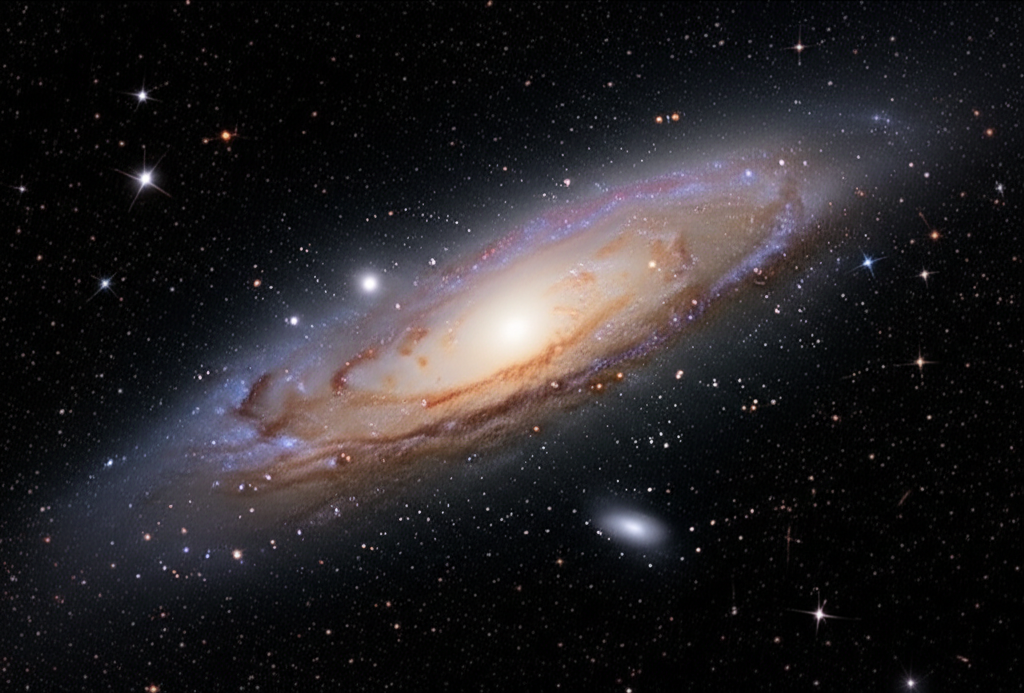
The Milky Way is far from alone. It’s part of a “Local Group” of about 50 galaxies, including our nearest large galactic neighbor, Andromeda, which is a staggering 2.5 million light-years away. Andromeda is on a collision course with the Milky Way, an event that will unfold over billions of years. This Local Group, in turn, is part of an even larger structure called the Virgo Supercluster, spanning about 110 million light-years and containing thousands of galaxies. And even the Virgo Supercluster is just one minor branch of an even larger structure called Laniakea, which stretches for about 500 million light-years and encapsulates hundreds of thousands of galaxies.
Ponder this for a moment: scientists estimate that there are at least 2 trillion galaxies in the observable universe. Yes, that’s trillion with a ‘T’. Each containing potentially hundreds of billions of stars, and each star a potential sun for planets, moons, and perhaps, life. The sheer volume of celestial bodies is overwhelming.
The Observable Universe: A Horizon of Light
The concept of the “observable universe” is critical. It refers to the portion of the universe from which light has had time to reach us since the Big Bang. Because the universe has a finite age (approximately 13.8 billion years) and light travels at a finite speed, there’s a limit to how far back in space-time we can see. However, due to the continuous expansion of the universe, the objects whose light we are receiving today have moved much further away since that light originally emitted.
The current accepted diameter of the observable universe is astonishing: approximately 93 billion light-years. This doesn’t mean the universe ends there; it simply means that beyond this horizon, light from those regions hasn’t had enough time to reach us. It’s like standing on a ship in the middle of the ocean; you can only see so far, but you know the ocean continues far beyond your visible horizon. The true size of the entire universe is unknown and might even be infinite.
Adding another layer of complexity is the presence of dark matter and dark energy. Dark matter, which doesn’t interact with light, accounts for about 27% of the universe’s mass-energy content and provides the gravitational scaffolding for galaxies and clusters. Dark energy, even more mysterious, makes up about 68% and is responsible for the accelerating expansion of the universe. These invisible components profoundly influence the universe’s structure, evolution, and ultimately, its incomprehensible vastness.
The universe is so fantastically vast that our minds struggle to truly grasp its scale. It’s a realm teeming with billions of galaxies, each housing billions of stars, each a potential sun for countless celestial bodies. This immense scale humbles us, yet it also ignites our curiosity, pushing the boundaries of scientific discovery and philosophical thought. The quest to understand how vast the universe truly is remains one of humanity’s most enduring and fascinating endeavors.
0 Comments