
- The Atmospheric Stage: Building the Charge
- How Charge Separation Happens: The Crucial Collision
- Building the Path: How Lightning Strikes
- Beyond the Flash: Types of Lightning and Thunder
- Conclusion
How lightning forms is one of nature’s most spectacular and awe-inspiring phenomena, yet its intricate dance of electricity and air remains a mystery to many. Far from being a simple flash, the process involves a complex interplay of atmospheric conditions, charge separation, and rapid energy discharge that transforms a seemingly calm sky into a dazzling light show. Unlocking these stunning secrets reveals not just the mechanics of a thunderstorm but also the immense power contained within our atmosphere.
The Atmospheric Stage: Building the Charge
Before lightning can strike, the stage must be set. This begins with the formation of towering cumulonimbus clouds, often called thunderheads. These colossal clouds are born from warm, moist air rising rapidly into the atmosphere – a process known as convection. As this air ascends, it cools and the water vapor condenses into tiny liquid droplets and ice crystals.
The key to lightning generation lies within these vertically developed clouds, where temperatures vary dramatically from bottom to top. The lower parts of the cloud are often above freezing, containing water droplets, while the middle and upper regions are well below freezing, housing a mix of ice crystals, supercooled water droplets (liquid water below 0°C), and a soft hail called graupel.
How Charge Separation Happens: The Crucial Collision
The heart of lightning formation is the separation of electrical charges within the cloud. This doesn’t happen spontaneously but is the result of countless collisions between these different particles moving within the cloud’s turbulent updrafts and downdrafts.
Imagine a bustling highway inside the cloud:
1. Collision Course: Lighter ice crystals are pushed upward by strong updrafts. Heavier graupel particles, formed when supercooled water freezes onto ice crystals, tend to fall or remain in the middle and lower parts of the cloud due to their weight.
2. Frictional Charging (Triboelectrification): As these ice crystals and graupel collide, electrons are exchanged. Crucially, when an ice crystal collides with a graupel particle, the smaller, lighter ice crystal typically loses electrons and becomes positively charged. The larger, heavier graupel particle gains these electrons, becoming negatively charged.
3. Gravitational Sorting: Because the positively charged ice crystals are lighter, they continue to be carried upwards by the updrafts to the top of the cloud. The heavier, negatively charged graupel particles sink towards the middle and lower sections of the cloud where downdrafts might also be present.
This process leads to a distinct separation of charges: the top of the cumulonimbus cloud primarily collects positive charges, while the middle and lower regions accumulate negative charges. A smaller, localized pocket of positive charge can sometimes form at the very bottom of the cloud, induced by the ground’s positive charge. This separation creates an enormous electrical potential difference, creating an invisible, powerful force field within the storm cloud and between the cloud and the ground.
Building the Path: How Lightning Strikes
With immense electrical tension building up, the atmosphere can only withstand so much. Air, usually an excellent insulator, eventually breaks down, allowing electricity to flow. This is the moment lightning begins its journey.
1. The Stepped Leader: From the negatively charged lower regions of the cloud, a “stepped leader” initiates. This is an invisible, zigzagging channel of ionized air that pushes downward in a series of rapid “steps,” each about 50 meters long, probing for a path of least resistance towards the ground. It looks for the easiest route through the air, often following imperfections or areas of already ionized air.
2. The Ground’s Response (Streamer): As the negatively charged stepped leader gets closer to the ground (within about 50-100 meters), the intense electric field it creates induces an opposite positive charge on objects on the ground directly beneath it. Tall objects like trees, buildings, and even people develop upward-reaching “streamers” of positive charge, eager to connect with the descending negative leader.
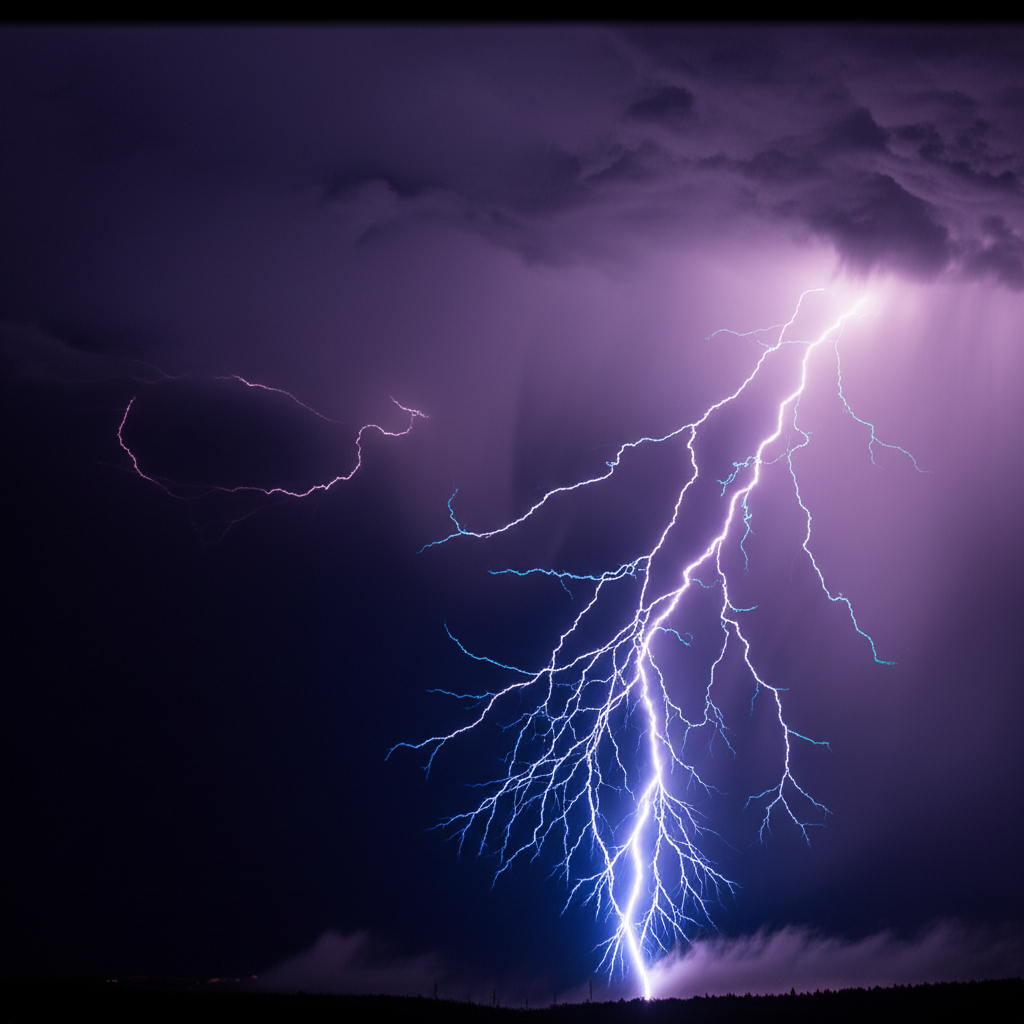
3. The Connection and Return Stroke: When a stepped leader and an upward streamer meet, they create a complete, conductive channel from the cloud to the ground. This connection triggers the most dramatic part of the lightning display: the “return stroke.” A surge of positive charge rockets upward from the ground, through the ionized channel, to the cloud. This upward surge of electricity is incredibly fast and intensely bright, illuminating the entire channel practically instantaneously – this is the brilliant flash we perceive as lightning. The return stroke neutralizes the negative charge that initiated the stepped leader, temporarily restoring electrical balance.
It’s important to remember that while the stepped leader travels downwards, the visible return stroke we see travels upwards. This phenomenon happens so quickly that our eyes perceive it as a single flash from the sky to the ground.
Beyond the Flash: Types of Lightning and Thunder
While cloud-to-ground (CG) lightning is what most people picture, it’s actually relatively rare compared to other types. The vast majority of lightning (up to 90%) occurs within the cloud (intracloud, IC) or between different clouds (cloud-to-cloud, CC). These inner-cloud flashes help equalize charge differences within the storm itself.
And what about thunder? Thunder is simply the sound created by the rapid expansion of air along the lightning channel. When the return stroke flashes, the immense electrical current instantly heats the air along its path to temperatures hotter than the surface of the sun – up to 30,000°C (54,000°F). This explosive heating causes the air to expand violently, creating a powerful shockwave that travels outward as sound waves. The rumbling we hear is due to the sound waves reflecting off terrain and different parts of the lightning channel being at varying distances from us.
Conclusion
From the gentle uplift of warm, moist air to the dramatic, superheated channel connecting storm and ground, the formation of lightning is a stunning testament to the dynamic forces at play in our atmosphere. Understanding how these atmospheric giants generate and unleash such raw electrical power not only deepens our appreciation for nature’s majesty but also reinforces the importance of respecting the dangers inherent in these spectacular storms. Each bolt is a fleeting yet powerful reminder of the hidden energy that shapes our world.
0 Comments