
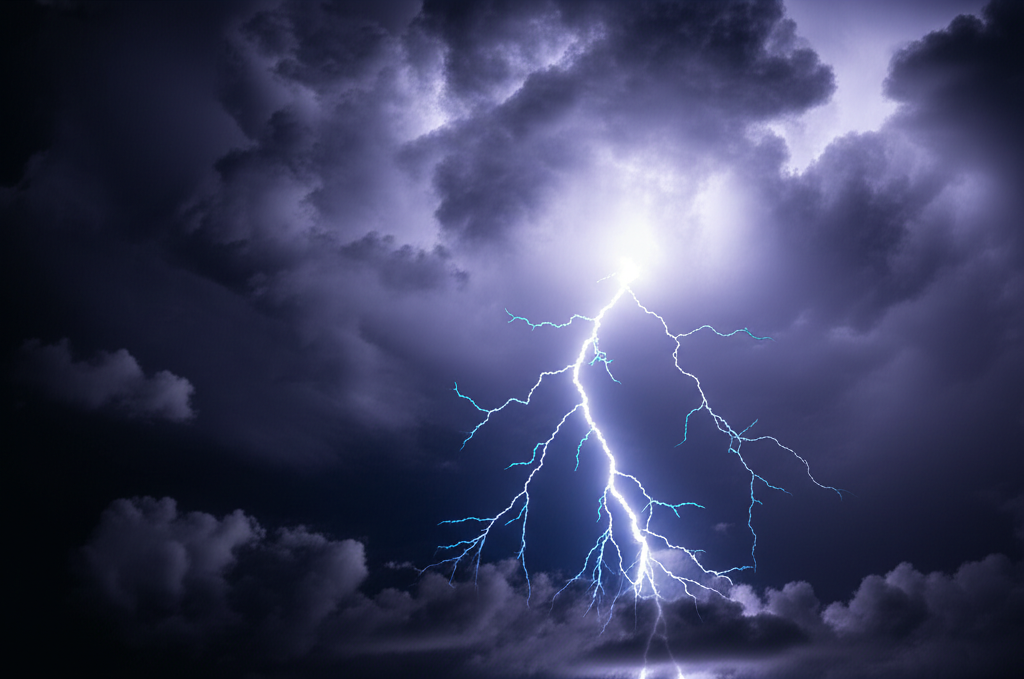
How lightning forms is a question that has fascinated humanity for millennia, inspiring myths, scientific inquiry, and a healthy dose of awe. This spectacular display of nature’s power, capable of tearing through the sky and shaking the ground with thunder, is far more complex and captivating than meets the eye. Unraveling the secrets behind lightning’s birth takes us deep into the heart of towering thunderstorms, where a intricate dance of ice, water, and electrical charge culminates in one of Earth’s most breathtaking phenomena.
The Genesis of a Thunderstorm: Setting the Stage
Lightning does not simply appear; it requires very specific atmospheric conditions to form. The process begins with the development of formidable cumulonimbus clouds, often referred to as thunderheads. These colossal clouds can stretch vertically for several miles, from near the Earth’s surface to altitudes well into the stratosphere. For a cumulonimbus cloud to form, three ingredients are essential:
1. Moisture: Abundant water vapor is needed to condense and fuel the cloud’s growth.
2. Instability: The atmosphere must be unstable, meaning warm, moist air near the ground can rise rapidly through cooler, drier air above it.
3. A Lifting Mechanism: Something must trigger this initial upward movement, such as solar heating of the ground, a topographical feature like a mountain, or the convergence of air masses.
As moist air rises, it cools and condenses, forming tiny water droplets and ice crystals. Powerful updrafts within the cloud continue to carry these particles higher, eventually reaching altitudes where temperatures are well below freezing, even -40°C or colder. It’s in this frigid environment, a swirling witches’ brew of supercooled water droplets (liquid water below freezing), ice crystals, and soft hail called graupel, that the electrifying magic truly begins.
How Charges Separate Within the Cloud
The most crucial step in lightning formation is the separation of electrical charges within the storm cloud. Without this separation, there can be no lightning. Scientists have long debated the exact mechanics, but the prevailing theory centers on collisions between various ice particles within the cloud.
Imagine countless tiny ice crystals, supercooled water droplets, and graupel pellets churning violently within the powerful updrafts and downdrafts of the thunderstorm. As these particles collide, they exchange electrons. Crucially, heavier, softer ice particles (graupel) tend to acquire a negative charge and, being heavier, are pulled downwards by gravity towards the lower and middle regions of the cloud. Conversely, smaller, lighter ice crystals tend to become positively charged and are carried upwards by the strong updrafts to the top of the cloud.
This continuous process of collisions and charge transfer leads to a distinct electrical stratification:
The top of the cloud accumulates a net positive charge.
The middle and lower parts of the cloud become predominantly negatively charged.
A smaller, localized region of positive charge can also develop at the very bottom of the cloud.
This electrical polarization creates an enormous electrical potential difference, or voltage, both within the cloud and between the cloud and the ground. The ground beneath the negatively charged cloud base also develops an induced positive charge, drawn upwards towards the massive negative charge above it. The atmosphere, normally an excellent insulator, can only withstand so much electrical tension before it breaks down.
How Lightning Initiates and Strikes
Once the electrical field becomes sufficiently strong – often exceeding millions of volts per meter – the air can no longer act as an insulator. This is when lightning preparation begins.
1. Leader Initiation: The process typically starts in the negatively charged region of the cloud. A faint, invisible channel of ionized air, called a “stepped leader,” begins to propagate downwards in a series of jerky, short steps (hence “stepped”). Each step is about 50 meters long and lasts for microseconds, with a brief pause in between. This leader is rich in negative electrons and seeks the path of least resistance through the air. It often has a branched, tree-like appearance as it probes different pathways.
2. Ground Connection: As the negative stepped leader approaches the ground, the positive charges induced on the Earth’s surface are strongly attracted to it. Tall objects on the ground – trees, buildings, utility poles, even people – become sources for upward-moving “positive streamers.” These are channels of positive charge reaching upwards from the ground towards the descending leader.
3. The Connection and Return Stroke: When a positive streamer from the ground meets one of the downward-propagating branches of the stepped leader, a complete conductive channel is established between the cloud and the ground. This connection point can be anywhere from a few meters to tens of meters above the ground. Instantly, an incredibly powerful surge of current, comprised of positive charges from the ground, races up* this newly formed channel towards the cloud. This upward surge is the “return stroke,” and it’s what we perceive as the dazzling flash of lightning.
The return stroke is extraordinarily fast, heating the air along its path to temperatures hotter than the surface of the sun (up to 30,000°C) in a fraction of a second. This rapid heating causes the air to expand explosively, creating a supersonic shockwave that we hear as thunder. The sheer speed of the return stroke (around 220,000 miles per hour) means that while the primary current flows upwards, our eyes perceive the flash almost instantaneously from the ground up to the cloud.
Most lightning flashes consist of multiple return strokes, as the initial channel remains briefly conductive. Subsequent strokes, known as “dart leaders,” follow the same ionized path but without the “stepping” nature, resulting in the flickering appearance of a lightning bolt.
The Impact and Power of Lightning
Lightning is not just a light show; it is an incredible force of nature. A single lightning bolt can carry an average of 30,000 amperes of current and deliver billions of watts of power. While dangerous to humans and capable of igniting wildfires, lightning also plays a vital ecological role, converting atmospheric nitrogen into forms usable by plants, a process known as nitrogen fixation.
Understanding how lightning forms removes none of its mystery or grandeur, but rather deepens our appreciation for the intricate and astounding processes constantly at play in our atmosphere. From the microscopic collisions of ice crystals to the sweeping drama of a superheated channel of air, lightning remains a powerful testament to the dynamic forces shaping our world.
0 Comments