- The Everyday Magic: Newton's Simple Rules
- The Ultimate Secret Revealed: Einstein's Curvature of Spacetime
- How Gravitational Phenomena Manifest
- The Unfinished Symphony: Gravity and Quantum Mechanics
How does gravity work? It’s a question that has puzzled philosophers and scientists for millennia, a fundamental force that shapes the universe yet remains, in some ways, an enduring enigma. From the everyday experience of an apple falling from a tree to the majestic dance of galaxies across cosmic distances, gravity is the invisible architect of our reality. While its effects are clear and predictable, the true nature of this force, and the “ultimate secrets” behind its operation, are a journey from centuries-old insights to cutting-edge physics.
The Everyday Magic: Newton’s Simple Rules
Before we delve into the deeper mysteries, let’s start with the revolutionary understanding provided by Sir Isaac Newton. In the late 17th century, Newton didn’t just observe the apple falling; he famously wondered if the same force pulling the apple to Earth also kept the moon in orbit around our planet. His eureka moment led to the Law of Universal Gravitation.
Newton’s insight was beautifully simple yet profoundly powerful: every particle of matter in the universe attracts every other particle with a force that is directly proportional to the product of their masses and inversely proportional to the square of the distance between their centers. In essence, the more massive objects are, and the closer they are, the stronger the gravitational pull between them. This explained why planets orbit the sun, how tides are caused by the moon’s gravity, and indeed, why we aren’t constantly floating off into space. Newton gave us the first clear “how” – gravity was an attractive force acting instantaneously across space, dependent on mass and distance. It was a descriptive rather than explanatory theory, but it worked with incredible precision for centuries.
The Ultimate Secret Revealed: Einstein’s Curvature of Spacetime
Newton’s model, while brilliantly effective, left a crucial question unanswered: how exactly did this force transmit itself across the vast emptiness of space? What was the mechanism? It wasn’t until the early 20th century that Albert Einstein offered a radical new perspective with his General Theory of Relativity. This theory didn’t just refine Newton’s ideas; it utterly revolutionized our understanding of gravity.
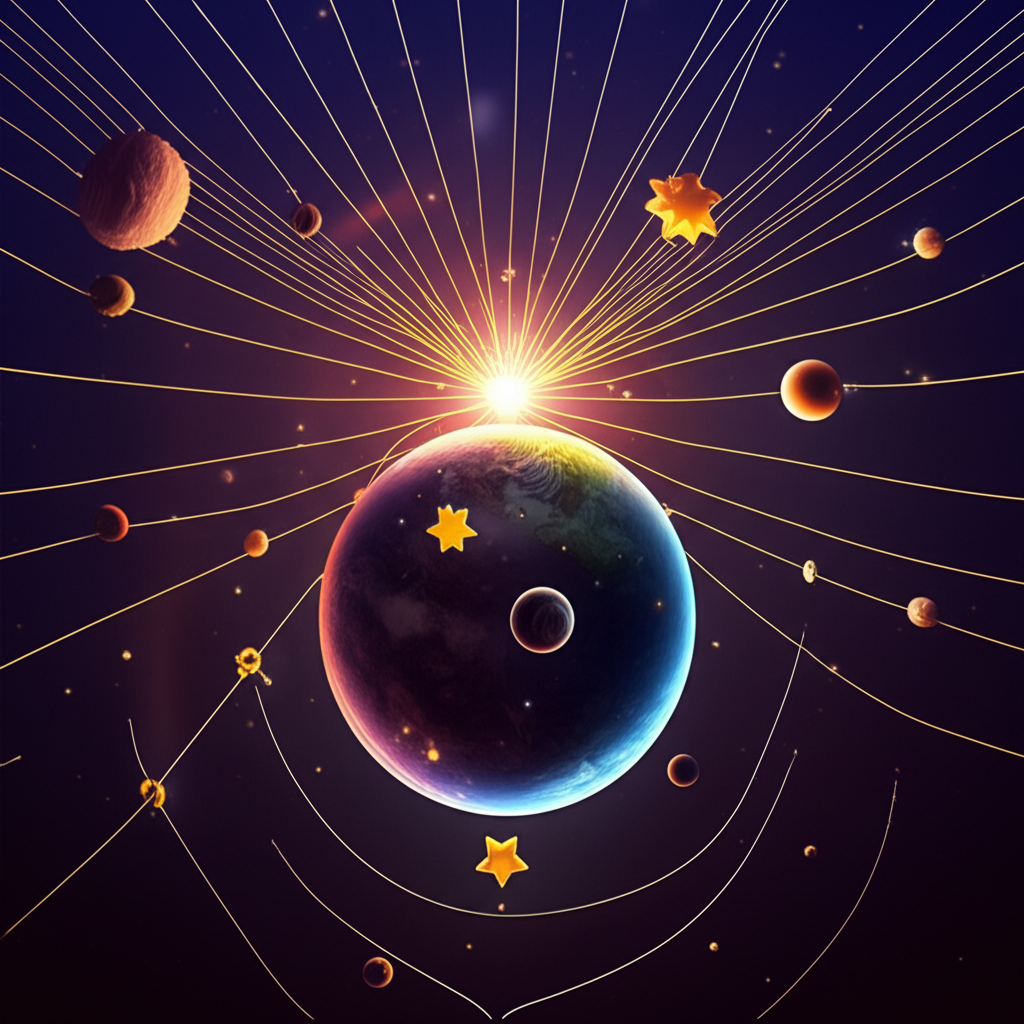
Einstein presented gravity not as a force pulling objects together, but as a consequence of the way mass and energy warp the fabric of space and time. Imagine a stretched rubber sheet. If you place a bowling ball in the center, it creates a dip. Now, roll a marble across the sheet; its path will curve inward towards the bowling ball, not because the bowling ball “pulled” it, but because the sheet beneath it is curved.
Similarly, massive objects like planets and stars curve the four-dimensional fabric of spacetime around them. Other objects, like comets or light rays, don’t feel a mysterious “force” from the star; instead, they simply follow the shortest path along the curved spacetime. This path, in our perception, appears as acceleration – the very definition of gravity. This was the ultimate secret hidden in plain sight: gravity isn’t a force operating through space, but rather a manifestation of spacetime itself.
How Gravitational Phenomena Manifest
Einstein’s theory provided robust explanations for phenomena that Newton’s model struggled with, and predicted new ones that have since been confirmed:
Planetary Orbits: Planets don’t orbit the sun because of an invisible rope, but because they are following the curvature in spacetime created by the sun’s immense mass. Their “straight line” through curved spacetime manifests as an elliptical orbit.
Gravitational Lensing: Just as a lens bends light, massive objects can bend the path of light from distant stars or galaxies as it passes by them. This “gravitational lensing” creates distorted or multiple images of the background object, a powerful confirmation of spacetime curvature.
Time Dilation: One of the most mind-bending predictions of General Relativity is that time passes more slowly in stronger gravitational fields. Clocks placed near a massive object will tick slower than those far away. This isn’t just theoretical; it’s a practical concern for GPS satellites, whose onboard clocks must be constantly adjusted to account for the weaker gravity (and thus faster time) they experience compared to Earth’s surface.
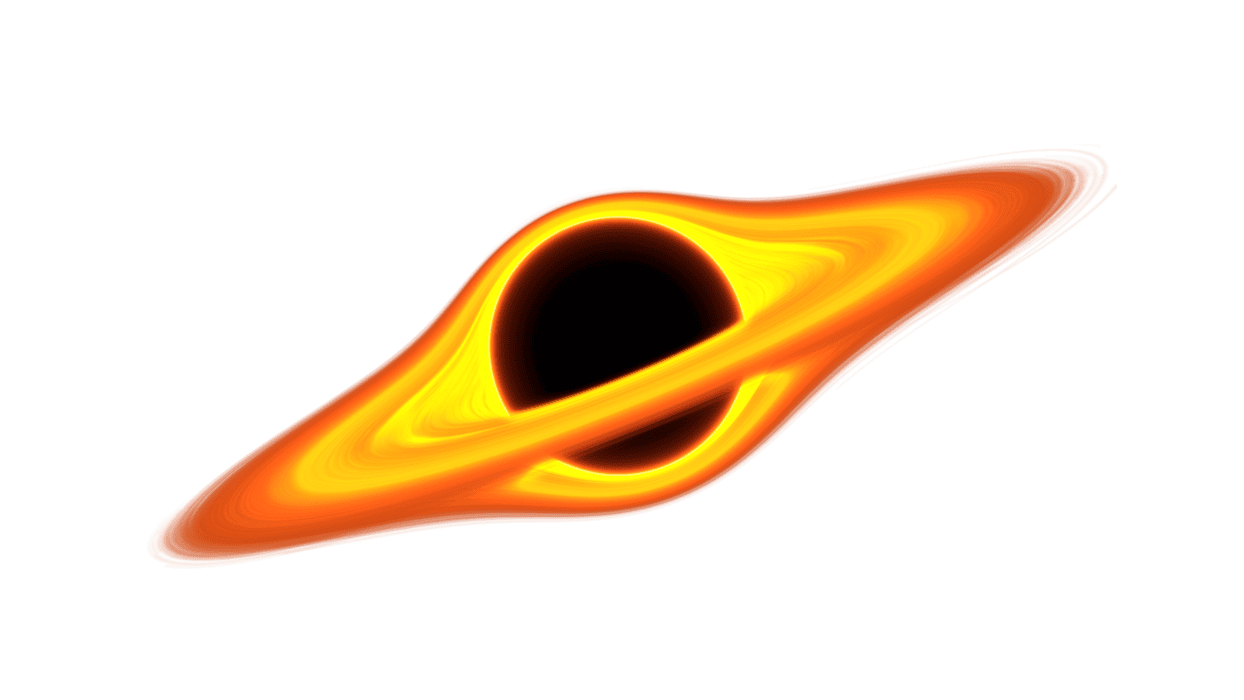
Black Holes: These cosmic behemoths represent regions where spacetime is so intensely curved that nothing, not even light, can escape once it crosses an event horizon. They are the ultimate gravitational traps, direct consequences of Einstein’s theory.
* Gravitational Waves: Like ripples on a pond, gravitational waves are disturbances in spacetime itself, propagating outwards from accelerating massive objects (like merging black holes or neutron stars). Predicted by Einstein over a century ago, they were directly detected for the first time in 2015 by the LIGO experiment, opening a new window for observing the universe.
The Unfinished Symphony: Gravity and Quantum Mechanics
Despite the profound successes of General Relativity, the “ultimate secrets” of gravity aren’t fully uncovered. The biggest challenge in modern physics is reconciling General Relativity (which describes gravity on large cosmic scales) with Quantum Mechanics (which describes the other fundamental forces – electromagnetism, strong and weak nuclear forces – at the subatomic level).
These two foundational theories, while incredibly accurate in their respective domains, are incompatible. Where gravity becomes extremely strong at very small scales, such as within a black hole or at the moment of the Big Bang, our current understanding breaks down. Physicists are striving for a unified “theory of everything” that would seamlessly integrate gravity into the quantum world. Ideas like String Theory and Loop Quantum Gravity attempt to visualize gravity’s quantum nature, perhaps with hypothetical particles called gravitons mediating the gravitational force, similar to how photons mediate electromagnetism.
So, while we have moved from the simple description of massive objects attracting each other to the elegant explanation of spacetime curvature, the full “how” of gravity’s deepest workings, especially at its most fundamental, quantum level, remains the subject of intense research and a frontier of human knowledge. From an apple falling to the birth of the universe, gravity continues to inspire wonder and drive our quest for ultimate understanding.
0 Comments