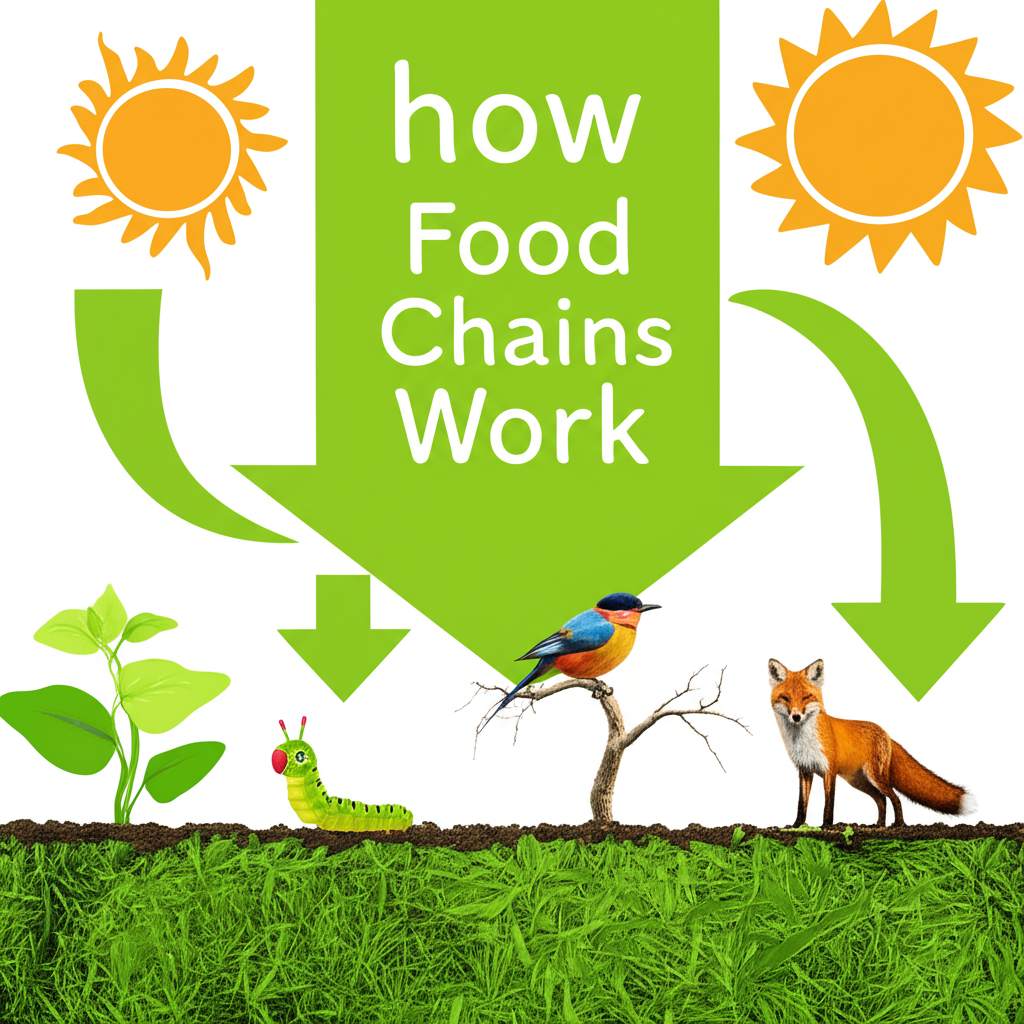
How food chains work is a fundamental concept for understanding the interconnectedness of life on Earth. Far from being a complex scientific mystery, the principles governing who eats whom and how energy flows through ecosystems are surprisingly straightforward once broken down. This ultimate easy guide will demystify the mechanics of food chains, revealing the intricate dance of survival and energy transfer that sustains all living things.
What is a Food Chain? The Basic Blueprint
At its core, a food chain describes a sequence of organisms where energy is transferred from one to another. Think of it as a pathway tracing who gets the energy by eating another organism. Every living thing needs energy to survive, grow, and reproduce, and that energy primarily comes from food. Starting from the sun, the ultimate energy source, energy is captured, converted, and then passed along, creating a vital link between all species within an ecosystem. Without this continuous flow, life as we know it simply wouldn’t exist.
The Foundation: Producers, Consumers, and Decomposers
To understand how food chains function, we first need to meet the main players:
1. Producers (Autotrophs): These are the self-feeders. They don’t eat other organisms; instead, they produce their own food using energy from the environment. Most producers, like plants, algae, and some bacteria, use photosynthesis to convert sunlight into chemical energy (sugars). They form the base of every food chain, capturing energy that all other organisms will eventually rely on.
2. Consumers (Heterotrophs): These organisms obtain energy by consuming other organisms. They can be categorized further based on what they eat:
Primary Consumers (Herbivores): Animals that eat only producers (e.g., deer eating grass, rabbits eating carrots).
Secondary Consumers (Carnivores/Omnivores): Animals that eat primary consumers (e.g., foxes eating rabbits, birds eating insects). Omnivores eat both plants and animals.
Tertiary Consumers (Top Carnivores): Animals that eat secondary consumers (e.g., eagles eating foxes, wolves eating deer).
Some food chains might even have Quaternary Consumers at the very top, preying on tertiary consumers.
3. Decomposers: These vital organisms, primarily bacteria and fungi, break down dead organic matter (dead plants and animals, waste products) from all levels of the food chain. They recycle nutrients back into the soil, water, and air, making them available again for producers. Without decomposers, the Earth would be buried in waste, and essential nutrients would quickly become locked away, halting the cycle of life.
How Energy Moves Through Trophic Levels
The journey of energy through a food chain isn’t a simple straight line; it involves distinct “trophic levels,” each representing a step in the chain.
Level 1: Producers (e.g., grass, trees)
Level 2: Primary Consumers (herbivores like deer, insects)
Level 3: Secondary Consumers (carnivores/omnivores like foxes, small birds)
Level 4: Tertiary Consumers (top carnivores like wolves, eagles)
As energy passes from one trophic level to the next, a significant amount is lost. This is often referred to as the “10% rule,” meaning that only about 10% of the energy from one level is transferred to the next. The remaining 90% is used by the organism for its own life processes (metabolism, heat, movement) or lost as waste. This explains why there are typically fewer organisms at higher trophic levels – there simply isn’t enough energy to support large populations of top predators. This energy loss creates a hierarchical structure, often visualized as an energy pyramid, with a broad base of producers and a much narrower top of tertiary consumers.
From Chains to Webs: The Reality of Ecosystems
While food chains provide a clear, linear way to understand energy flow, real ecosystems are far more complex. Most animals don’t eat just one type of food; they have varied diets. A fox might eat rabbits, mice, and berries, while a hawk might eat mice, snakes, and even small birds. This interconnectedness creates a food web, which is a network of interconnected food chains.
A food web illustrates that:
Organisms can occupy multiple trophic levels (e.g., an omnivore might be a primary and secondary consumer).
Changes in one population can have ripple effects throughout the entire web. If the rabbit population declines, the fox might switch to eating more mice, impacting the mouse population, and so on.
Understanding food webs gives us a more accurate picture of the delicate balance and intricate relationships within an ecosystem.
The Imperative Role of Decomposers
While often overlooked, decomposers are unsung heroes. Imagine a forest floor without fungi and bacteria – it would be piled high with dead leaves, fallen trees, and animal carcasses. Decomposers are nature’s recycling crew. They break down the complex organic compounds in dead matter into simpler nutrients that can be absorbed by the soil and subsequently taken up by producers. This completes the cycle, ensuring that vital resources like nitrogen, phosphorus, and carbon are continuously available for new life to flourish. Without decomposers, the flow of nutrients would grind to a halt, making it impossible for food chains and webs to sustain themselves.
Why Understanding Food Chains Matters
Grasping the mechanics of food chains and webs isn’t just an academic exercise; it’s crucial for understanding the health of our planet and our place within it. Human activities, such as pollution, deforestation, overfishing, and climate change, can disrupt these delicate balances. When a species is removed or introduced, or when habitat is destroyed, it can have cascading effects throughout the entire food web, potentially leading to widespread ecological collapse. By understanding how food chains work, we gain insights into the fragility of ecosystems and the importance of conservation efforts to protect the biodiversity that sustains all life.
In conclusion, food chains are the invisible threads that tie every living thing together, from the smallest microbe to the largest whale. They illustrate the fundamental principle of energy transfer and interdependence. By appreciating these intricate connections, we can better understand the natural world and our responsibility to protect its delicate balance.
0 Comments