
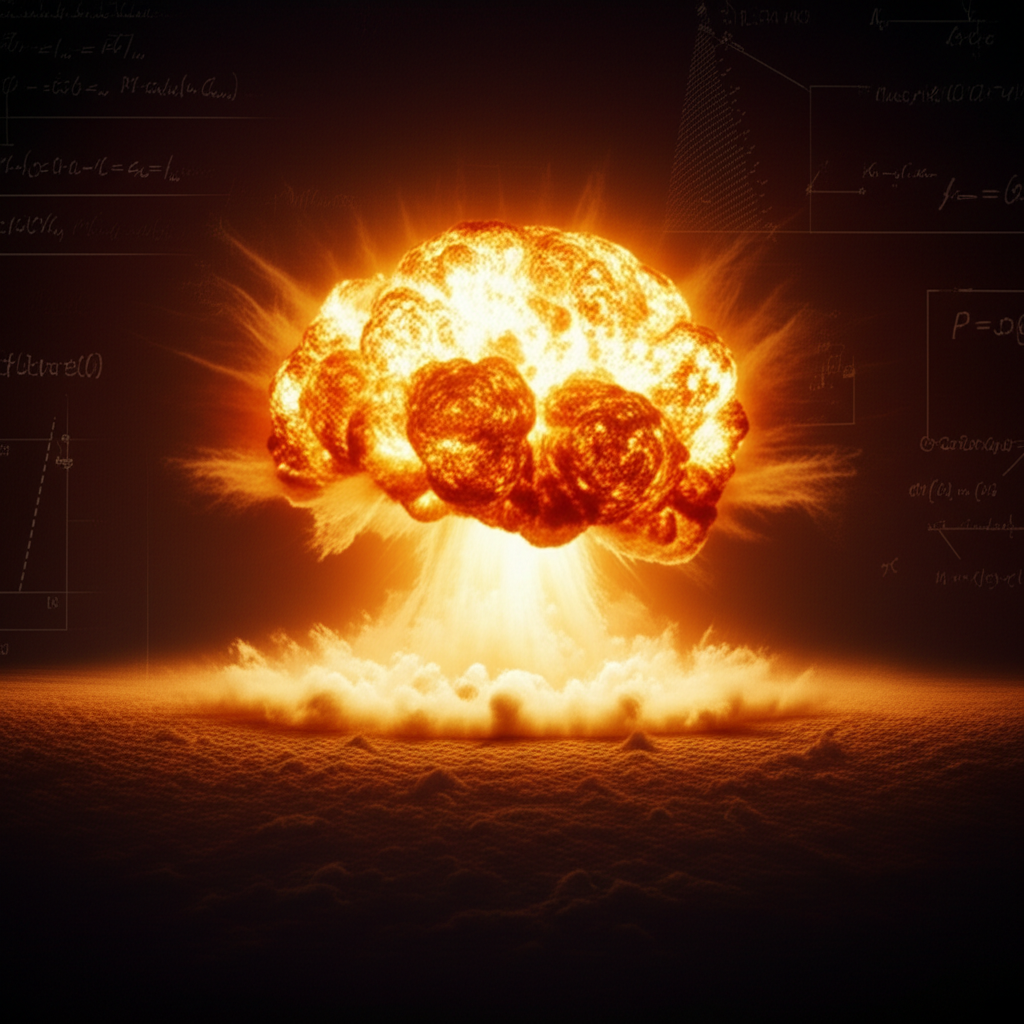
How explosions work is a subject that fascinates and terrifies in equal measure, revealing the raw power that can be unleashed when matter undergoes rapid transformation. From the controlled blasts of demolition sites to the unimaginable force of a nuclear detonation, understanding the core mechanics behind these events is crucial – not just for scientific curiosity, but for safety, engineering, and defense. An explosion is fundamentally a rapid increase in volume and release of energy in an extreme manner, usually accompanied by the generation of high temperatures and the release of gases. What follows is a dive into the devastating facts behind this powerful phenomenon.
What Exactly Is an Explosion?
At its simplest, an explosion is a rapid expansion of volume, which generates a significant pressure wave. This instantaneous transformation involves the conversion of stored potential energy into kinetic energy, heat, and often light and sound. The key ingredients typically include a fuel (something that can react), an oxidant (something that enables the reaction, like oxygen), and an ignition source (a spark, heat, or shock). The speed at which this reaction propagates dictates much about its character, leading to two primary classifications for chemical explosions: deflagration and detonation.
The Core Mechanics: How Energy is Unleashed
The energy released in an explosion can originate from various sources, each with distinct mechanisms and resulting power.
Chemical Explosions: The Power of Rapid Reactions
The most common type, chemical explosions, involve extremely fast exothermic reactions where a substance rapidly decomposes or combines with an oxidant, producing hot, high-pressure gases.
Deflagration: This is a subsonic combustion process, meaning the flame front propagates at a speed slower than the speed of sound in the unburnt material. Think of gunpowder burning in a firework: it’s rapid, but not instantaneous. The pressure buildup is primarily due to the rapid heating and expansion of gases.
Detonation: This is a much more violent process, where the reaction front (a shockwave) propagates at supersonic speeds through the explosive material. This shockwave compresses the unreacted material, triggering its decomposition, leading to an incredibly rapid and powerful energy release. High explosives like TNT and C4 operate via detonation, generating immense destructive force over a very short period.
Physical Explosions: Pressure and Phase Changes
Not all explosions involve chemical reactions. Physical explosions occur when a physical change in a substance leads to a sudden release of energy.
Boiling Liquid Expanding Vapor Explosion (BLEVE): A classic example occurs when a vessel containing a superheated liquid (like propane) ruptures. The sudden depressurization causes the liquid to flash into vapor, expanding thousands of times in volume and creating a colossal pressure wave. If the vapor is flammable, it can then ignite, leading to a fireball.
Pressure Rupture: Any container holding gas under high pressure can explode if its structural integrity is compromised. The potential energy stored in the compressed gas is instantly released as the gas expands outwards.
Volcanic Explosions: Driven by the rapid depressurization and expansion of dissolved gases (like water vapor and CO2) within magma, leading to eruptions of ash, rock, and gas.
Nuclear Explosions: Mass-Energy Conversion
The most powerful explosions on Earth harness the immense energy stored within the atomic nucleus.
Fission: Heavy atomic nuclei (like uranium-235 or plutonium-239) are split by neutrons, releasing colossal amounts of energy and more neutrons, triggering a chain reaction. This is the principle behind atomic bombs.
Fusion: Light atomic nuclei (isotopes of hydrogen) are forced together under extreme temperature and pressure to form a heavier nucleus, releasing even greater amounts of energy. This powers the sun and hydrogen bombs.
Nuclear explosions are unique in their energy source (mass conversion via E=mc²) and propagate differently, emitting vast amounts of thermal radiation, electromagnetic pulse (EMP), and radioactive fallout, in addition to the blast wave.
The Devastating Facts: How Explosions Cause Damage
The destructive power of an explosion stems from several distinct but interrelated mechanisms, each contributing to the overall devastation.
1. Blast Wave (Overpressure): This is the primary damage mechanism. Upon detonation, the rapidly expanding gases create a high-pressure shockwave that travels outwards faster than the speed of sound. This wave consists of a positive pressure phase (compression) that pushes outwards with immense force, followed by a negative pressure phase (rarefaction) as the air rushes back in. The positive phase can flatten buildings, rupture organs, and propel objects, while the negative phase can cause structures to collapse inward and exert suction.
2. Fragmentation/Projectiles: Many explosives are encased, and the force of the blast wave shatters these casings, turning them into high-velocity projectiles (shrapnel). Additionally, surrounding objects, debris, and even human bodies can be accelerated to dangerous speeds, causing further injury and damage.
3. Thermal Radiation (Heat): The intense heat generated during an explosion can cause severe burns, ignite flammable materials, and produce firestorms. This is particularly significant in larger explosions, especially nuclear weapons, where a substantial portion of the energy is released as thermal radiation, capable of incinerating objects over vast distances.
4. Ground Shock: For explosions at or near the ground surface, a portion of the energy is transmitted through the earth as seismic waves, similar to an earthquake. These ground shocks can damage foundations, underground utilities, and trigger secondary effects like landslides.
5. Environmental Impact: Beyond immediate damage, explosions can release harmful chemicals, dust, and in the case of nuclear events, radioactive fallout, leading to long-term health and ecological consequences.
Factors Influencing Explosive Power and How They Matter
The precise effects of an explosion are not solely dependent on the type of explosive but also on various external factors:
Explosive Yield: The total amount of energy released, typically measured in kilotons or tons of TNT equivalent. Higher yield means more destructive power.
Confined vs. Unconfined: An explosion in a confined space (e.g., inside a building or a bomb casing) will generate much higher pressures and more destructive blast waves than an explosion of the same material in the open air. Confinement prevents the rapid dissipation of gases, concentrating their energy.
Proximity/Stand-off Distance: The damage wrought by an explosion diminishes rapidly with increasing distance from the blast source. The inverse cube law often roughly applies to overpressure, meaning a small increase in distance can significantly reduce the force felt.
* Environment: Explosions underwater behave differently than in air, generating powerful hydraulic shockwaves. Underground explosions create craters and seismic activity.
Safety and Mitigation: Understanding the Science to Prevent Disaster
A thorough understanding of how explosions work is paramount for safety and defense. This knowledge informs the design of blast-resistant structures, aids in the development of safer industrial processes, guides military strategy, and is essential for forensic investigations. From the careful handling of explosive materials to modeling blast effects for emergency preparedness, the scientific principles behind these phenomena empower us to mitigate their devastating potential.
In conclusion, explosions are complex yet fundamental physical and chemical processes resulting in the rapid release of stored energy, manifesting as destructive blast waves, heat, and fragmentation. Whether driven by chemical reactions, physical transformations, or nuclear forces, their capacity for devastation necessitates continuous study, enabling us to harness their power responsibly and protect against their calamitous effects.
0 Comments