
- The Unseen Hand: Why We Believe in Dark Matter
- The Quest for Dark Matter's True Nature
- Dark Matter's Cosmic Architecture Role
- Stunning Secrets Yet to Be Unlocked
Dark Matter, the universe’s most elusive ingredient, represents one of the profoundest mysteries in modern cosmology. This enigmatic substance, invisible to all our instruments and comprising roughly 27% of the universe’s mass-energy budget, acts as a cosmic puppet master, shaping galaxies and dictating the very structure of the cosmos. For decades, scientists have grappled with its perplexing nature, piecing together clues from gravitational effects to understand a presence that cannot be directly seen, touched, or measured. The quest to unravel its stunning secrets continues to drive cutting-edge research, promising to revolutionize our understanding of physics and the universe itself.
The Unseen Hand: Why We Believe in Dark Matter
Our conviction in the existence of dark matter stems not from direct observation, but from its undeniable gravitational influence on visible matter. Without it, the universe as we know it simply wouldn’t make sense.
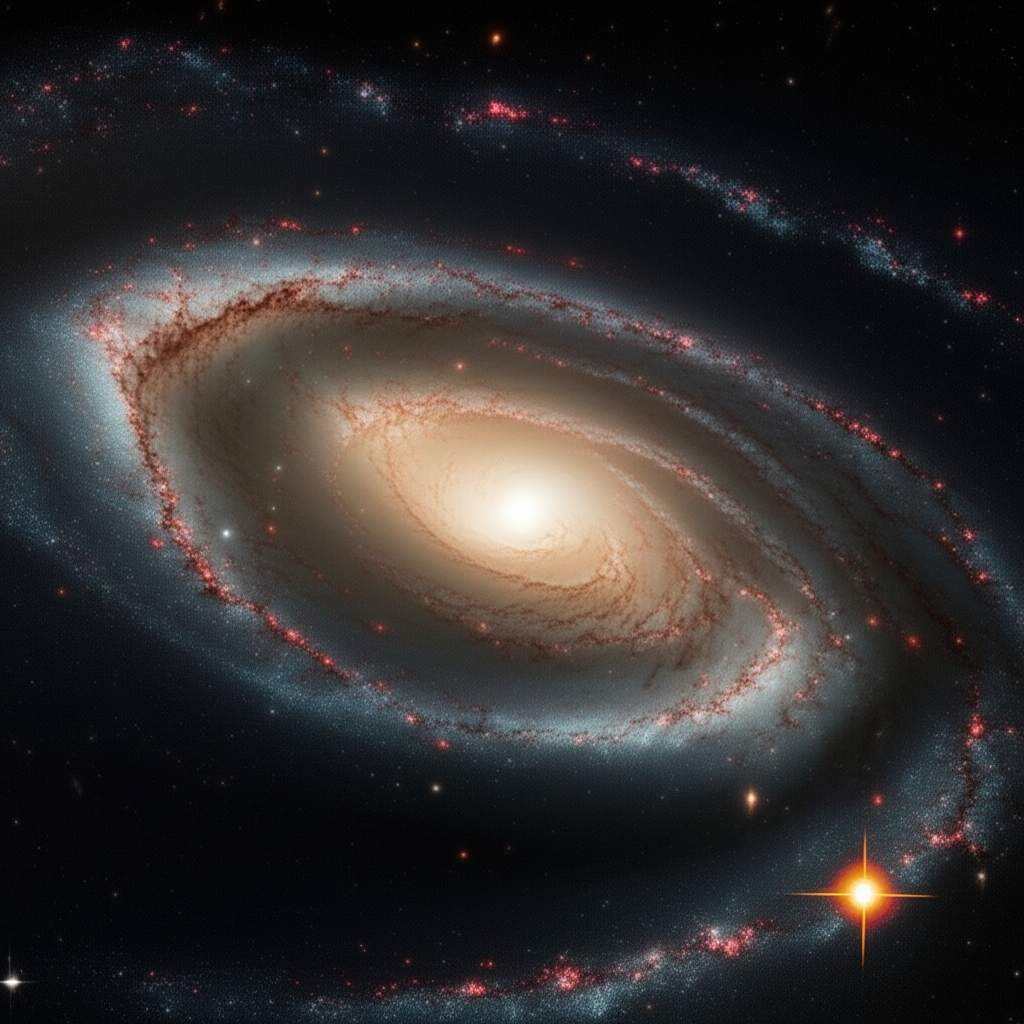
Galaxy Rotation Curves: One of the earliest and most compelling pieces of evidence came from observing how galaxies spin. Stars at the edges of galaxies rotate far too quickly to be held together by the gravity of the visible matter alone. There must be an immense, unseen halo of mass providing the additional gravitational pull, preventing galaxies from flying apart.
Gravitational Lensing: Massive objects, according to Einstein’s theory of general relativity, bend the fabric of spacetime, deflecting the path of light, much like a lens. Astronomers regularly observe instances where light from distant galaxies is distorted by foreground galaxy clusters. The degree of this “gravitational lensing” often suggests much more mass than can be accounted for by the visible galaxies and hot gas within the cluster, pointing to a vast reservoir of dark matter.
Cosmic Microwave Background (CMB): The CMB, the oldest light in the universe, is a snapshot of the early cosmos. Fluctuations in its temperature distribution provide a precise recipe for the universe’s ingredients. These measurements strongly indicate that baryonic (normal) matter makes up only about 5% of the universe, with dark energy accounting for 68% and dark matter for the remaining 27%.
Large-Scale Structure: Computer simulations designed to model the formation of cosmic structures – from galaxies to galaxy clusters and vast cosmic webs – fail spectacularly if dark matter is excluded. Only by incorporating dark matter can these simulations accurately reproduce the universe’s observed large-scale structure.
The Quest for Dark Matter’s True Nature
Despite the overwhelming evidence for its existence, the precise nature of dark matter remains one of science’s greatest puzzles. Scientists worldwide are engaged in an unprecedented effort to directly detect this phantom substance and uncover its fundamental properties.
For years, the leading candidate for dark matter has been a hypothetical particle known as a Weakly Interacting Massive Particle (WIMP). As the name suggests, WIMPs would be massive but interact with normal matter only through gravity and possibly the weak nuclear force, making them incredibly difficult to detect. Experiments like LUX-ZEPLIN (LZ) and XENONnT, located deep underground to shield them from cosmic rays, seek to detect the faint recoil of an atomic nucleus when a WIMP hypothetical collides with it. While these experiments have pushed the limits of sensitivity, they have yet to yield a definitive WIMP detection.
Another prominent candidate is the axion, an ultra-light particle theorized to solve a different puzzle in particle physics related to the strong nuclear force. Experiments such as ADMX (Axion Dark Matter eXperiment) aim to convert axions into detectable microwave photons in the presence of strong magnetic fields.
Beyond these primary contenders, other exotic possibilities include sterile neutrinos, dark photons, or entirely new dimensions. Particle colliders, like the Large Hadron Collider (LHC), also play a role, attempting to produce dark matter particles in high-energy collisions, though this too has proven challenging. The Enigma of Dark Matter’s Identity is a relentless pursuit that fuses cutting-edge astrophysics, particle physics, and engineering.
Dark Matter’s Cosmic Architecture Role
Far from being an inert background component, dark matter played a crucial role in shaping the universe we see around us. Without it, the journey from the smooth, hot early universe to the universe of galaxies and stars would have been impossible.
Normal matter, interacting strongly with light, was subject to intense radiation pressure in the early universe, preventing it from clumping together easily. Dark matter, however, felt no such pressure. It could begin to collect under its own gravity, forming subtle overdensities – essentially the “seeds” of future cosmic structures. These dark matter “halos” acted as gravitational wells, attracting normal matter over billions of years. As the universe expanded and cooled, normal matter eventually fell into these dark matter scaffolds, condensing to form the first stars, then galaxies, and eventually the vast galaxy clusters we observe today. In essence, dark matter provided the structural backbone upon which the entire cosmic web was built.
Stunning Secrets Yet to Be Unlocked
The journey to understand dark matter is far from over. Each experiment, while perhaps not yielding a direct detection, refines our understanding, narrowing the search and prompting new theoretical insights. The stunning secrets that remain to be revealed include:
The Particle Nature: Is it a single particle, or a “dark sector” with its own complex interactions and even different dark forces?
Interaction with Itself: Does dark matter interact with other dark matter particles, beyond gravity? This could dictate subtle differences in structure formation within galaxies.
Unification with Standard Model: Can dark matter be incorporated into our existing Standard Model of particle physics, or will its discovery necessitate entirely new physics, hinting at a much grander, more complex universe than we currently imagine?
Fine-Scale Distribution: How is dark matter distributed on very small scales within galaxies? Precise measurements could offer clues about its interaction properties.
The search for dark matter is more than just curiosity; it’s a quest for fundamental knowledge that touches upon the very fabric of reality. Its discovery would not only complete our cosmic inventory but could also open entirely new avenues in physics, potentially leading to unforeseen technological advancements and a profound re-evaluation of our place in the cosmos. The universe’s most profound secrets often lie just beyond the edge of our current understanding, waiting to be unveiled.
0 Comments