- The Cosmic Womb: Giant Molecular Clouds
- The Trigger: Disturbing the Equilibrium
- How a Star's Journey Begins: Gravitational Collapse
- The Protostar Phase: A Star in the Making
- The Moment of Truth: Nuclear Ignition
- Stellar Diversity: From Midgets to Giants
- Conclusion
How do stars begin their luminous journey across the vast canvas of the cosmos? It’s a question that has fascinated humanity for millennia, and thanks to modern astronomy, we’re steadily uncovering the incredible secrets behind the birth of these celestial powerhouses. Far from being instantaneous events, stars undergo a protracted and dramatic process, emerging from nothing more than swirling clouds of gas and dust, eventually igniting into the brilliant beacons we admire.
The Cosmic Womb: Giant Molecular Clouds
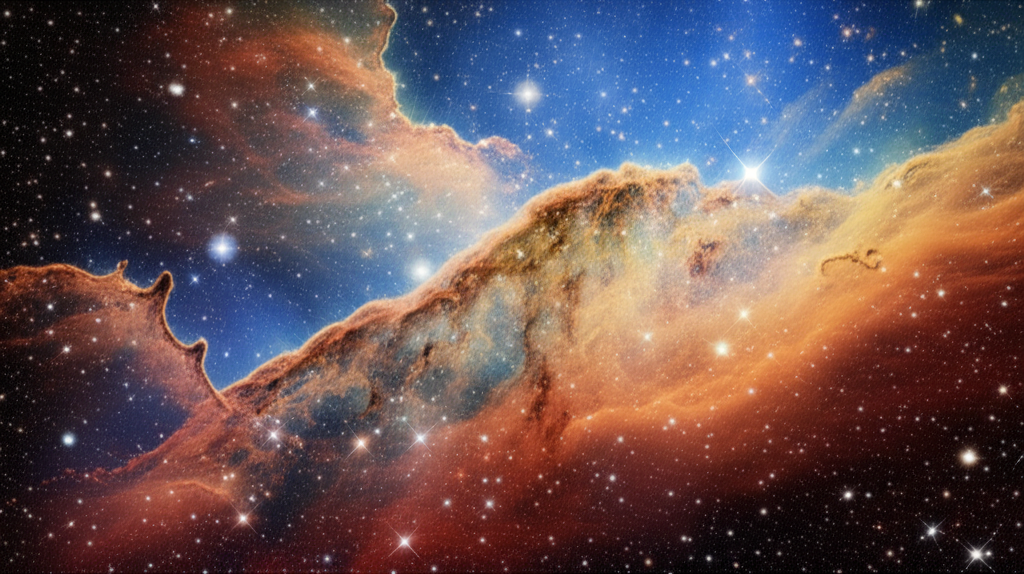
The story of a star’s birth begins in what astronomers call giant molecular clouds (GMCs). These colossal structures, found within galaxies, are among the largest objects in the Milky Way, spanning tens to hundreds of light-years across. Unlike the relatively empty space between stars, GMCs are vast reservoirs of cold molecular hydrogen, helium, and tiny specks of cosmic dust. They are incredibly dense by interstellar standards, though still far more tenuous than any vacuum creatable on Earth. These dark, cold, and quiet nebulae are the universe’s ultimate maternity wards, holding the raw material for countless future stars.
For millions of years, these clouds can remain largely quiescent, held together by their own gravity but prevented from collapsing entirely by internal turbulence and magnetic fields. However, this delicate balance is often disturbed, triggering the initial stages of star formation.
The Trigger: Disturbing the Equilibrium
The initial impetus for a star to begin forming is usually an external shockwave. What causes these powerful disturbances? Several phenomena can act as the catalyst:
Supernova explosions: The explosive death of massive stars sends shockwaves rippling through space, compressing nearby GMCs.
Galactic collisions: When galaxies merge or even just interact, their gravitational forces can stir up and compress gas clouds.
Spiral arm density waves: As galaxies rotate, their spiral arms act as “traffic jams” for gas and dust, increasing density in certain regions.
Stellar winds from massive stars: Powerful outflows from pre-existing massive stars can also sweep up and compress surrounding material.
Regardless of the trigger, the result is localized regions within the GMC that become dense enough for gravity to begin to assert its dominance over the internal pressure supporting the cloud.
How a Star’s Journey Begins: Gravitational Collapse
Once a section of a GMC reaches a critical density, gravity takes over. The cloud fragment begins to contract, pulling material inwards. As it collapses, the fragment often breaks apart into smaller, denser clumps. This explains why stars rarely form in isolation; instead, they usually emerge in clusters from the same parent cloud. Each of these collapsing clumps is destined to become a new star.
As a clump shrinks, its gravitational potential energy is converted into kinetic energy, causing the gas molecules to speed up and collide more frequently. This, in turn, increases the temperature and pressure at the core of the contracting object. This intensely contracting, glowing ball is now known as a protostar.
The Protostar Phase: A Star in the Making
A protostar is not yet a true star because its core isn’t hot enough to begin nuclear fusion. However, it’s a star in the making. During this phase, which can last for hundreds of thousands to millions of years, the protostar continues to accumulate mass from the surrounding cloud.
Much of the incoming material often flattens into a swirling accretion disk around the protostar. This disk is crucial: it funnels gas and dust onto the protostar, causing it to grow, and it’s also where planets might eventually form. As material falls into the protostar, powerful jets of gas, often bipolar (ejecting material from the protostar’s poles), are frequently observed. These jets, known as Herbig-Haro objects when they collide with surrounding gas, help to clear away the remaining gas and dust from the protostar’s immediate vicinity, preventing it from growing indefinitely.
The protostar’s core temperature and pressure relentlessly climb as more and more material is drawn in and compressed.
The Moment of Truth: Nuclear Ignition
The protostar continues to contract and heat up until a crucial threshold is reached. When the core temperature reaches approximately 15 million degrees Celsius (about 27 million degrees Fahrenheit), the atoms are moving so fast and colliding with such force that nuclear fusion begins. Specifically, hydrogen atoms in the core begin to fuse together to form helium atoms, releasing an immense amount of energy in the process.
This ignition of nuclear fusion is the defining moment of a star’s birth. The outward pressure generated by the energy released from fusion perfectly balances the inward pull of gravity from the star’s mass. This stable equilibrium marks the end of the protostar phase and the beginning of the main sequence phase – the longest and most stable period in a star’s life. Our own Sun has been a main sequence star for about 4.6 billion years and will remain so for another 5 billion.
Stellar Diversity: From Midgets to Giants
While the fundamental process of gravitational collapse and nuclear ignition is universal, stars form in a variety of masses, leading to their diverse characteristics. Low-mass stars, like red dwarfs, form slowly and quietly, burning their fuel at a leisurely pace for trillions of years. Massive stars, on the other hand, form rapidly, can be thousands of times more luminous than our Sun, and live comparatively short, spectacular lives, often ending in dramatic supernova explosions.
Furthermore, many stars, perhaps even most, form in multiple-star systems, where two or more stars orbit a common center of mass, emerging from the same collapsing cloud fragment.
Conclusion
The birth of a star is a testament to the immense power of gravity and the fundamental forces of the universe. From the cold, dark depths of a giant molecular cloud, through the chaotic protostar phase, to the brilliant ignition of nuclear fusion, each star’s journey is a cosmic epic. Understanding how stars are born not only illuminates the origins of the light that warms our planet and fuels life, but also reveals the dynamic cycles of creation that perpetually reshape the galaxies around us, reminding us of the universe’s unending capacity for wonder.
0 Comments