
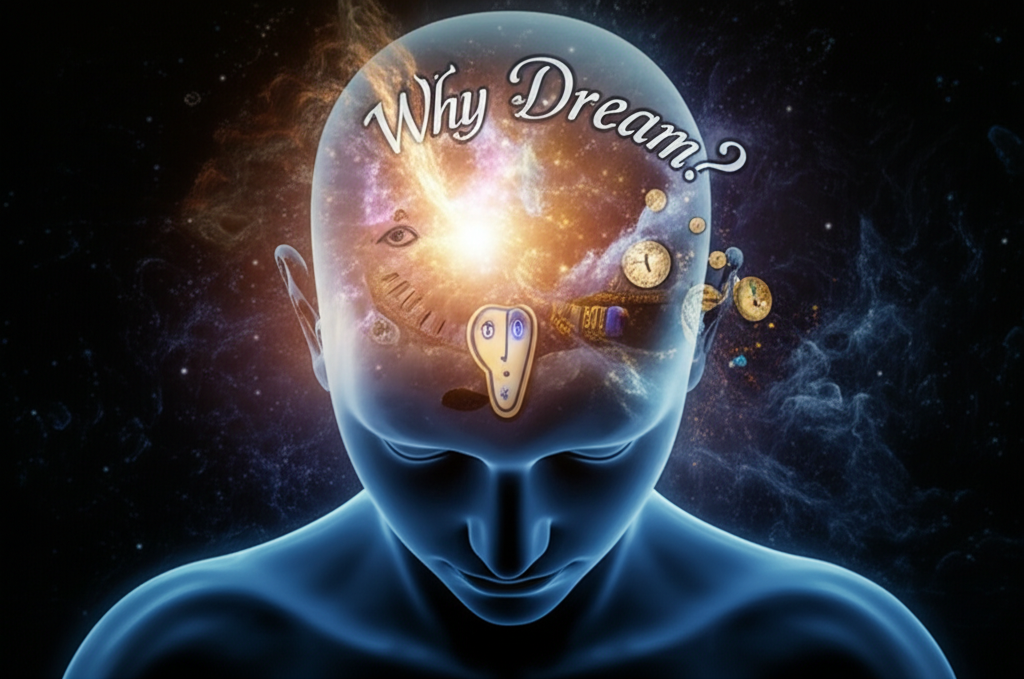
Why do we dream? It’s a question that has captivated philosophers, scientists, and spiritual leaders for millennia, a nightly enigma that unfolds within the theatre of our own minds. These vivid, often surreal narratives that play out during sleep offer a fascinating, albeit frequently perplexing, glimpse into our inner world. While the precise, universally agreed-upon answer remains elusive, modern research and historical interpretations have peeled back layers of mystery, revealing stunning truths about these nocturnal adventures and their profound importance to human existence.
From the earliest civilizations, dreams were not merely random brain activity but portals to other realms, messages from the divine, or omens of future events. Ancient Egyptians meticulously recorded their dreams, believing them to be prophecies or communications from gods and ancestors. Shamans across various indigenous cultures used dreams as a source of healing and guidance, venturing into spiritual landscapes to bring back insights for their communities. Greek and Roman cultures housed dream interpreters in temples, where supplicants would seek meaning from their nocturnal visions, hoping to gain an advantage in war, love, or health. Throughout much of history, dreaming was perceived as a sacred or significant act, holding immense power and informing major life decisions.
The Neuroscience Beneath the Veil of Sleep
To truly understand why we dream, we must first look at the mechanics of sleep itself. Dreaming occurs most vividly and frequently during Rapid Eye Movement (REM) sleep, a distinct stage characterized by increased brain activity, muscle paralysis, and, as the name suggests, rapid eye movements. During REM sleep, the brain’s prefrontal cortex, responsible for logical thought and decision-making, becomes less active, while areas associated with emotion, memory, and spatial awareness light up. This shift explains why dreams often feel illogical, emotionally charged, and visually rich.
Neurotransmitters like acetylcholine, responsible for REM sleep initiation, and norepinephrine, which is almost entirely absent during this phase, play crucial roles. The hippocampus, vital for memory formation, and the amygdala, the brain’s emotional center, are highly active, piecing together fragments of experience and emotion into a coherent (or sometimes incoherent) narrative. This complex neurological dance isn’t accidental; it serves various crucial functions that contribute to our mental and emotional well-being.
Why We Dream: Exploring the Leading Theories
The scientific community has proposed several compelling theories explaining the purpose of dreams, moving beyond ancient superstitions to explore their biological and psychological functions:
Memory Consolidation and Learning: One of the most widely accepted theories suggests that dreams play a vital role in processing and consolidating memories. During sleep, particularly REM sleep, the brain sifts through the day’s events, strengthening important neural connections and discarding irrelevant information. It’s like your brain’s nightly defragmentation and organization process. Studies have shown that individuals who are deprived of REM sleep perform worse on tasks requiring learning and memory retention, suggesting dreams are essential for turning short-term memories into long-term knowledge.
Emotional Regulation and Therapy: Dreams often act as a crucial emotional outlet. The activation of the amygdala during REM sleep allows us to process and integrate difficult or intense emotions experienced during our waking hours. Psychologist Ernest Hartmann famously described dreams as “therapy,” suggesting they provide a safe, symbolic space to confront fears, anxieties, and trauma. By engaging with these emotions in a controlled environment, dreams can help us come to terms with upsetting experiences, reduce their emotional impact, and foster psychological healing.
Problem-Solving and Creativity: It’s no coincidence that many groundbreaking ideas and creative solutions have emerged from dreams. From the structure of the benzene ring revealed to chemist August Kekulé to the melody of Paul McCartney’s “Yesterday,” dreams can tap into our subconscious mind, allowing it to work on problems without the constraints of waking logic. When we sleep, our minds can make novel connections between disparate ideas, offering fresh perspectives and inspiring innovative solutions that elude us during the day.
Threat Simulation Theory: Developed by Antti Revonsuo, this evolutionary theory posits that dreams, particularly nightmares, serve as a sort of “practice ground” for dangerous situations. By simulating threats in a safe environment, our brains can rehearse responses and develop coping mechanisms, preparing us for potential dangers in our waking lives. This function would have provided a significant evolutionary advantage, enhancing our ancestors’ survival skills.
Simply a Byproduct of Brain Activity (Activation-Synthesis Theory): Not all theories assign a grand purpose to dreams. The activation-synthesis theory, proposed by J. Allan Hobson and Robert McCarley, suggests that dreams are merely the brain’s attempt to make sense of random neural signals and memories generated during sleep. While it doesn’t entirely dismiss the idea of meaning in dreams, it posits that the cause* of dreaming is largely physiological, with the “story” being a secondary interpretation crafted by the brain.
The Unconscious Conversation
Beyond the scientific understanding, dreams remain a profound avenue for self-discovery. Psychologists like Sigmund Freud and Carl Jung emphasized the symbolic language of dreams as a window into the unconscious mind. While their interpretations differ, both believed that dreams reveal suppressed desires, unresolved conflicts, and hidden aspects of our personality, offering invaluable insights for personal growth and understanding. The narratives, characters, and settings in our dreams often reflect our innermost thoughts and feelings, granting us a unique form of introspection.
Ultimately, the act of dreaming is a testament to the incredible complexity and adaptive nature of the human brain. It’s not a singular, simple phenomenon but a multifaceted biological and psychological process that, while still partially shrouded in mystery, clearly plays a critical role in our memory, emotional well-being, creativity, and perhaps even our survival. As we continue to delve deeper into the nature of sleep and consciousness, the stunning truths about why we dream continue to unfold, reminding us of the endless wonders contained within our own minds.
0 Comments