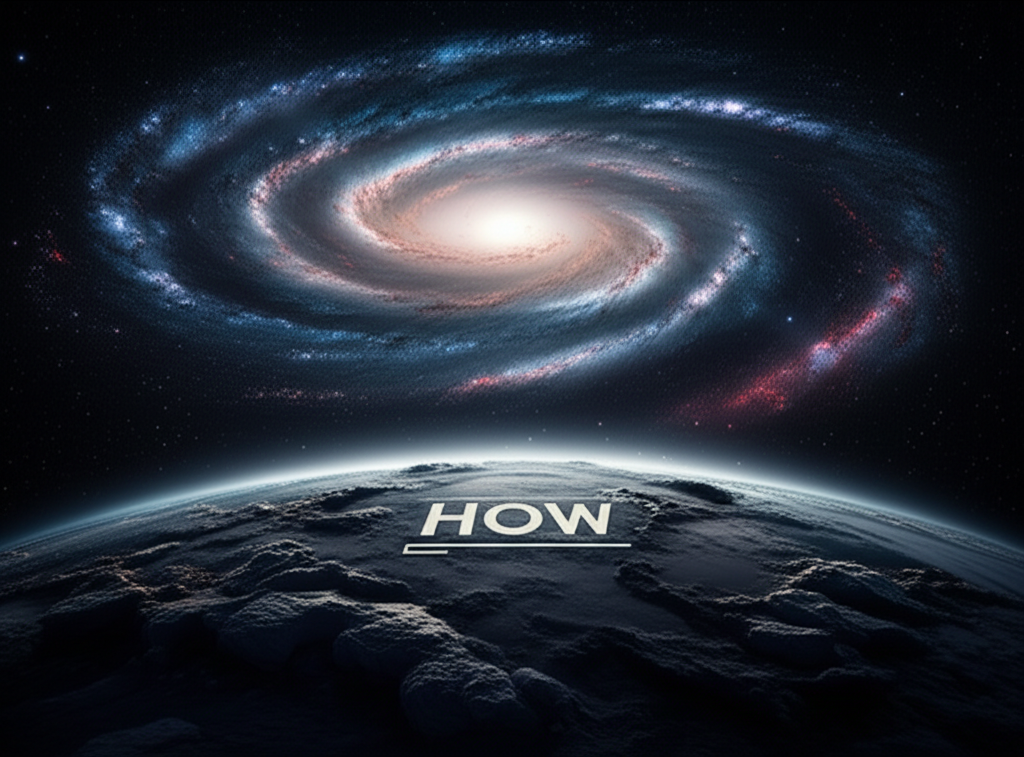
- Unveiling the Cosmos: The Mind-Boggling Scale of Our Universe
- The Observable Universe: A Glimpse of Infinity
- Beyond the Horizon: The True Scale of Reality
- How Many Galaxies Are There? Counting the Cosmic Jewels
- The Invisible Architects: Dark Matter and Dark Energy
- A Constantly Unfolding Tapestry
Unveiling the Cosmos: The Mind-Boggling Scale of Our Universe
How do we even begin to comprehend the sheer immensity of the universe? It’s a question that has captivated philosophers, scientists, and dreamers for millennia. From the moment we gaze at a starry night sky, a profound sense of wonder and insignificance washes over us. But the reality is far more astonishing than what our naked eyes can perceive. The universe is not just big; it’s vast beyond imagination, continually expanding, and brimming with mysteries that push the boundaries of human understanding.
The Observable Universe: A Glimpse of Infinity
To start unraveling the universe’s scale, we must first understand the concept of the “observable universe.” This isn’t the entire universe, but rather the portion from which light has had enough time to reach us since the Big Bang. Because light travels at a finite speed (the cosmic speed limit), we can only see as far as light has traveled in the roughly 13.8 billion years since the universe began.
While one might assume this means the observable universe is 13.8 billion light-years across, it’s actually much larger: about 93 billion light-years in diameter. This counter-intuitive fact is due to the continuous expansion of space itself. As light from distant galaxies travels towards us, the space it’s traversing is also stretching, much like dots on an inflating balloon moving further apart. So, an object whose light we see today, emitted 13 billion years ago, is now much farther away than its initial distance. A light-year, by the way, is the distance light travels in one Earth year – approximately 9.46 trillion kilometers (5.88 trillion miles). Imagine measuring 93 billion of those!
Beyond the Horizon: The True Scale of Reality
The observable universe, while incredibly vast, is just a fraction of the entire cosmos. Most cosmologists believe the universe extends far beyond what we can currently see, potentially infinitely. Evidence for this idea comes from the universe’s “flatness.” If the universe were finite and curved like a sphere or a saddle, we would detect that curvature in the cosmic microwave background radiation. Instead, observations show the universe to be remarkably flat, suggesting it extends far beyond our cosmic horizon, making our observable bubble a tiny part of a much grander whole.
This grander scale is often attributed to a period called “cosmic inflation,” a theoretical epoch very early in the universe’s history where it expanded exponentially faster than the speed of light for a tiny fraction of a second. If inflation indeed occurred, it would have stretched any initial curvature to an undetectable flatness, and also pushed vast swaths of the universe beyond our observable reach, effectively making the universe many, many orders of magnitude larger than 93 billion light-years. Some estimates suggest it could be at least 250 times larger, while others lean towards true spatial infinitude.
How Many Galaxies Are There? Counting the Cosmic Jewels
Within our observable universe alone, the numbers are dizzying. Scientists estimate there are at least 2 trillion galaxies. And that’s just a conservative estimate! Each galaxy, on average, contains hundreds of billions of stars. Our own Milky Way Galaxy, a relatively average spiral galaxy, is home to an estimated 100 billion to 400 billion stars, and it’s approximately 100,000 light-years across.
Consider the Andromeda Galaxy, our nearest large galactic neighbor. It’s about 2.5 million light-years away and contains roughly 1 trillion stars. Andromeda and the Milky Way are gravitationally bound within a larger structure called the Local Group, which is itself part of an even bigger agglomeration of galaxies known as the Laniakea Supercluster, spanning 520 million light-years and containing the mass of 100 million billion suns in 100,000 galaxies. And Laniakea is just one of many superclusters in the observable universe.
The Invisible Architects: Dark Matter and Dark Energy
Adding to the complexity and scale of the universe are two mysterious components: dark matter and dark energy. We can’t see them directly, but their presence is inferred through their gravitational effects. Dark matter, which doesn’t interact with light, accounts for about 27% of the universe’s mass-energy content. It acts as the gravitational glue, holding galaxies and galaxy clusters together. Without it, the visible matter in galaxies would fly apart.
Even more dominant is dark energy, making up about 68% of the universe’s mass-energy. This enigmatic force is responsible for the accelerating expansion of the universe. It’s a kind of anti-gravity that pushes galaxies further apart, preventing the universe from collapsing back in on itself and ensuring its continued, ever-increasing vastness. The existence of these invisible components means that everything we can see – stars, planets, nebulae, galaxies – comprises less than 5% of the cosmos!
A Constantly Unfolding Tapestry
The question of “how vast is the universe?” ultimately leads to an answer that stretches beyond our immediate grasp. It’s a place where distances are measured in light-years and billions, where galaxies number in the trillions, and where the unseen forces of dark matter and dark energy dictate its fate. Each new discovery, from exoplanets to distant quasars, only serves to underscore the profound depth and complexity of the cosmos.
The universe is a constantly unfolding tapestry, with each thread representing a star, a galaxy, or a cosmic phenomenon yet to be fully understood. While we may never fully comprehend its absolute limits, the journey of discovery itself is arguably the most breathtaking aspect of this boundless existence. Looking up at the night sky, we are not just seeing distant lights; we are witnessing a testament to a scale that dwarfs our wildest imaginations, inviting us to forever wonder, explore, and expand our perception of reality.
0 Comments