
- Beyond the Apple: What Is Gravity?
- How Einstein Reshaped Our Understanding: Gravity as Spacetime Curvature
- Concrete Evidence for Spacetime Curvature
- Gravity's Profound Role in the Cosmos
- The Ongoing Quest: Merging Gravity with the Quantum World
How Gravity Works: A Stunningly Simple Explanation
How does gravity work? It’s one of the universe’s most ubiquitous and yet, for many, most mysterious forces. From the slightest tug that makes an apple fall to the colossal pull that shapes galaxies, gravity dictates the very structure and dynamics of the cosmos. While its effects are undeniable and often taken for granted in our daily lives, the underlying mechanism is far more elegant and mind-bending than simply “things falling down.” Let’s embark on a journey from the classical understanding to Einstein’s revolutionary insights, explaining this fundamental force in a refreshingly straightforward way.
Beyond the Apple: What Is Gravity?
For centuries, “gravity” was understood as an invisible force pulling objects towards each other. Isaac Newton famously developed the first comprehensive mathematical description of this phenomenon in the late 17th century. His groundbreaking insight, often associated with the falling apple anecdote, wasn’t just that objects fall, but that the same force that pulls an apple to the Earth also keeps the Moon in orbit around the Earth, and the Earth in orbit around the Sun.
Newton’s Law of Universal Gravitation states that every particle of matter attracts every other particle with a force that is directly proportional to the product of their masses and inversely proportional to the square of the distance between their centers. This was a magnificent achievement; it allowed for precise predictions of planetary motion and laid the foundation for classical mechanics. It conceptualized gravity as an instantaneous “action at a distance” – a pull that somehow reached across empty space without any intermediary.
Despite its incredible success, Newton’s model had some limitations. It couldn’t fully explain certain observed phenomena, like the subtle precession in Mercury’s orbit, and it didn’t explain how this “action at a distance” actually occurred. It described what gravity did, but not truly how it worked at a deeper, intrinsic level.
How Einstein Reshaped Our Understanding: Gravity as Spacetime Curvature
Fast forward to the early 20th century, and a young Albert Einstein revolutionized our understanding of gravity with his theory of General Relativity. This wasn’t merely an improvement on Newton’s laws; it was a complete paradigm shift, changing our very conception of space and time.
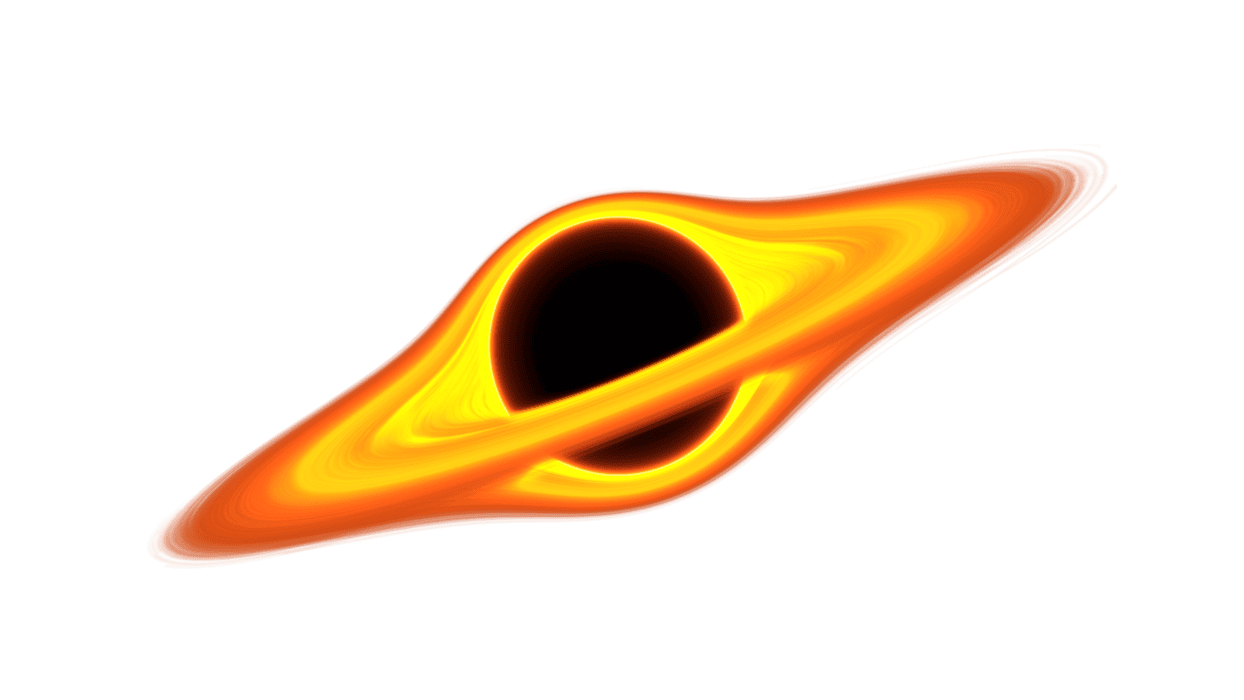
Einstein proposed that gravity isn’t a force pulling objects together in the traditional sense. Instead, he suggested that massive objects, like planets, stars, and galaxies, literally warp – or curve – the fabric of spacetime around them. Imagine spacetime as a colossal, invisible, flexible sheet or trampoline. If you place a bowling ball in the center, it creates a dip. If you then roll a marble nearby, it won’t be “pulled” towards the bowling ball; instead, its path will simply follow the curve or dip in the sheet created by the bowling ball.
In this analogy:
The bowling ball represents a massive object (like the Sun).
The rubber sheet represents spacetime.
The marble represents a smaller object (like Earth or a planet).
The curve in the sheet is what we perceive as gravity.
So, when the Earth orbits the Sun, it isn’t because the Sun is “pulling” it directly with a force. Rather, the Sun’s immense mass curves the spacetime around it, and the Earth simply follows the natural geodesic (the shortest path) through that curved spacetime. The Earth is essentially “rolling” through the dip created by the Sun. This is how gravity truly works at its most fundamental level, according to modern physics.
Concrete Evidence for Spacetime Curvature
Einstein’s theory wasn’t just a beautiful idea; it made specific, testable predictions that differed from Newton’s. And time and again, experiments and observations have validated General Relativity:
1. Bending of Light (Gravitational Lensing): Since light travels through spacetime, a massive object’s curvature of spacetime should literally bend the path of light passing near it. During a solar eclipse in 1919, Arthur Eddington observed stars whose light was bent by the Sun’s gravity, precisely matching Einstein’s predictions. Today, astronomers regularly observe “gravitational lensing,” where entire galaxy clusters act as cosmic magnifying glasses, distorting and multiplying the images of background galaxies.
2. Gravitational Waves: If spacetime can be warped, then sudden, violent events like the collision of black holes or neutron stars should create ripples in this fabric, akin to dropping a stone in a pond. These “gravitational waves” were directly detected for the first time in 2015 by the LIGO experiment, providing astounding confirmation of Einstein’s theory.
3. Gravitational Time Dilation: A consequence of spacetime curvature is that time itself passes slightly slower in regions of stronger gravity. This isn’t just theoretical; it’s a practical factor in our daily lives. GPS satellites, which orbit Earth, experience weaker gravity than we do on the surface. Their clocks run slightly faster. Without accounting for these relativistic effects, GPS systems would quickly accumulate errors and be inaccurate.
Gravity’s Profound Role in the Cosmos
Gravity, understood as spacetime curvature, is not just some esoteric concept; it’s the architect of the universe.
It’s the force that draws together dust and gas to form stars and planets.
It organizes billions of stars into magnificent galaxies.
It influences the expansion of the entire universe on a cosmic scale.
And, on a much smaller scale, it keeps our feet firmly planted on the ground, preventing us from floating off into space.
The Ongoing Quest: Merging Gravity with the Quantum World
While General Relativity beautifully explains gravity on large, cosmic scales, it faces challenges when trying to reconcile with quantum mechanics, the theory that describes the universe at its smallest scales. Physicists are still striving for a unified theory of “quantum gravity,” which would seamlessly integrate all fundamental forces of nature. Concepts like string theory and loop quantum gravity are vibrant areas of ongoing research, attempting to describe gravity at the quantum level, perhaps involving hypothetical particles called “gravitons.”
In essence, while Newton gave us an incredibly useful “how-to” guide for calculating gravitational effects, Einstein delivered the profound “why” – explaining that gravity isn’t a force in the traditional sense, but a manifestation of the universe’s geometry. It’s a testament to the stunning elegance of nature that such a ubiquitous and powerful phenomenon arises from the simple, yet profound, warping of spacetime itself.
0 Comments