
- What Exactly Are Greenhouse Gases?
- The Major Players: Key Greenhouse Gases
- How Greenhouse Gases Influence Our Planet
- Measuring the Impact: Global Warming Potential
- Addressing the Challenge: Limiting Greenhouse Gas Emissions
What precisely are greenhouse gases, and why are they so central to understanding our planet’s climate? These atmospheric components play a dual role: they are essential for life as we know it, yet their increasing concentrations pose one of the most significant challenges humanity has ever faced. Often discussed in the context of climate change, these gases are naturally occurring and have kept Earth habitable for millions of years. However, human activities have drastically altered their balance, leading to a phenomenon known as the enhanced greenhouse effect. Understanding what they are, how they work, and their implications is crucial for grasping the climate crisis and the steps needed to address it.
What Exactly Are Greenhouse Gases?
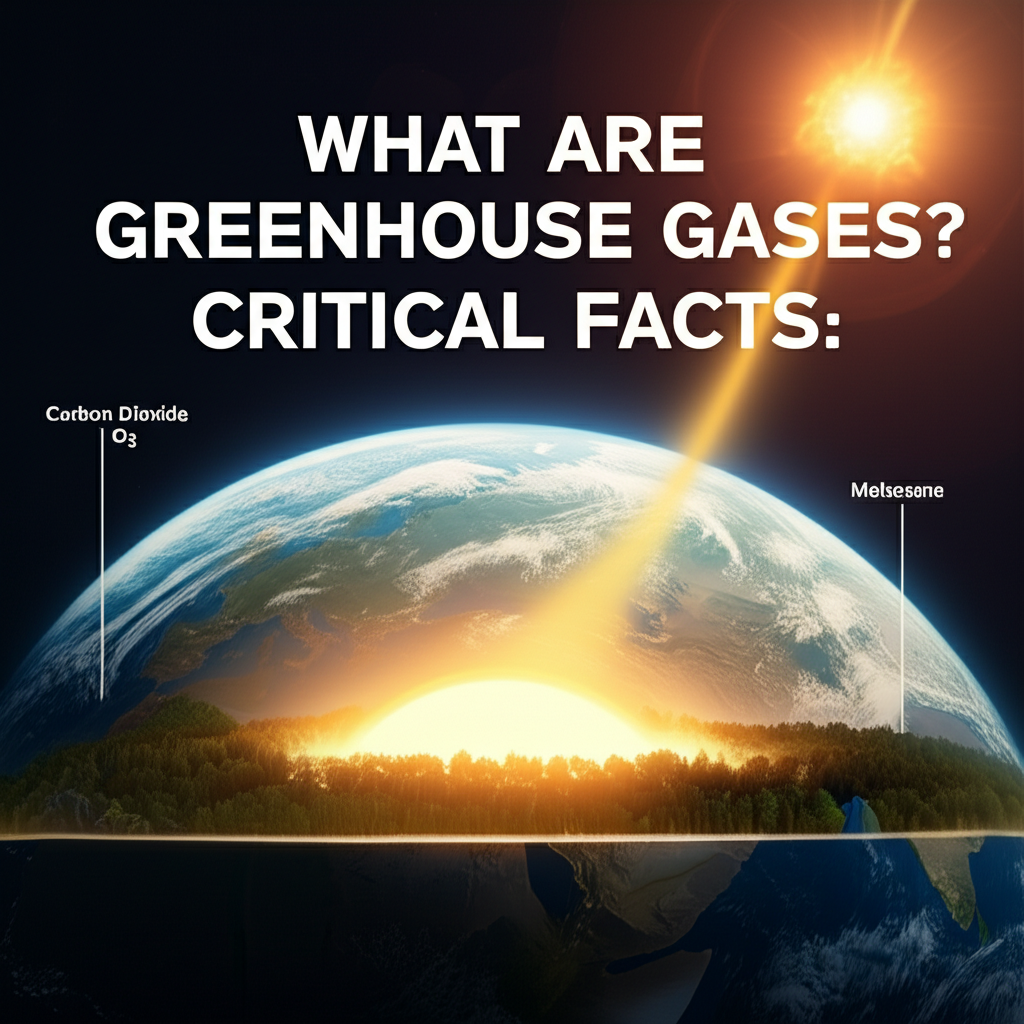
At their core, greenhouse gases (GHGs) are specific gases in Earth’s atmosphere that absorb and emit radiant energy within the thermal infrared range. This process is the fundamental cause of the “greenhouse effect.” Imagine a blanket wrapped around the Earth; GHGs act similarly, trapping heat that would otherwise escape into space.
Here’s a breakdown of how it works:
1. Incoming Solar Radiation: The sun emits shortwave radiation, which easily passes through the Earth’s atmosphere and warms the planet’s surface.
2. Heat Re-emission: As the Earth’s surface warms, it re-emits this energy as longwave (infrared) radiation.
3. Absorption and Re-emission by GHGs: Instead of escaping directly into space, a portion of this infrared radiation is absorbed by greenhouse gas molecules in the atmosphere. These molecules then re-emit the energy in all directions, including back towards the Earth’s surface.
4. Warming Effect: This re-emission of heat back to the surface and lower atmosphere leads to a warming effect. Without this natural process, Earth’s average temperature would be a frigid -18°C (0°F), making life impossible for most species.
The Major Players: Key Greenhouse Gases
While many gases absorb infrared radiation, a few stand out due to their abundance, potency, and significant contribution to the greenhouse effect, both naturally and through human activities.
Carbon Dioxide ($text{CO}_2$): This is the most significant anthropogenic (human-caused) greenhouse gas. It’s released through the burning of fossil fuels (coal, oil, natural gas) for energy, industrial processes, deforestation, and cement production. While its global warming potential (GWP) is used as a baseline (GWP=1), its sheer volume and long atmospheric lifetime (up to hundreds of years) make it the primary driver of climate change.
Methane ($text{CH}_4$): Methane is a potent greenhouse gas, far more effective at trapping heat than $text{CO}_2$ over a shorter timeframe (GWP of 28-36 over 100 years). Its major sources include agriculture (livestock enteric fermentation, rice cultivation), waste landfills, and the production and transport of coal, natural gas, and oil. Although it has a shorter atmospheric lifetime (around 12 years) than $text{CO}_2$, its powerful heat-trapping ability makes it a significant concern.
Nitrous Oxide ($text{N}_2text{O}$): With a GWP about 265-298 times that of $text{CO}_2$ over 100 years and an atmospheric lifetime of approximately 121 years, nitrous oxide is another powerful GHG. Its main sources are agricultural activities (especially fertilizer use), industrial processes, and the combustion of fossil fuels and solid waste.
Fluorinated Gases (F-gases): This category includes hydrofluorocarbons (HFCs), perfluorocarbons (PFCs), sulfur hexafluoride ($text{SF}_6$), and nitrogen trifluoride ($text{NF}_3$). These are synthetic, powerful greenhouse gases used in various industrial applications, such as refrigerants, aerosol propellants, and fire suppressants. They have extremely high GWPs (thousands to tens of thousands times that of $text{CO}_2$) and very long atmospheric lifetimes (from decades to thousands of years), though they are present in lower concentrations than $text{CO}_2$.
Water Vapor ($text{H}_2text{O}$): The most abundant greenhouse gas, water vapor accounts for the largest percentage of the natural greenhouse effect. However, it functions differently. It’s not directly emitted by human activities in significant quantities that directly warm the planet. Instead, it acts as a feedback mechanism: as the Earth warms due to other GHGs, more water evaporates, increasing atmospheric water vapor, which in turn traps more heat, further enhancing warming.
How Greenhouse Gases Influence Our Planet
The delicate balance of greenhouse gases is essential for life, but human interventions have significantly disrupted this balance, leading to the “enhanced” greenhouse effect.
Natural Greenhouse Effect: This is the warming process that keeps Earth’s average temperature at an inhabitable 15°C (59°F). Without it, our planet would be frozen solid.
Enhanced Greenhouse Effect: Since the Industrial Revolution, the concentration of atmospheric GHGs, particularly $text{CO}_2$, has risen dramatically due to human activities. This increase means more heat is trapped, leading to a discernible rise in global average temperatures—a phenomenon known as global warming.
The consequences of this enhanced effect are far-reaching:
Rising Global Temperatures: Leading to hotter heatwaves and changes in climate patterns.
Melting Glaciers and Ice Sheets: Contributing to sea-level rise.
Sea-Level Rise: Threatening coastal communities and ecosystems.
More Extreme Weather Events: Including more intense storms, prolonged droughts, and increased flooding.
Ocean Acidification: Oceans absorb a significant amount of excess $text{CO}_2$, which reacts with seawater to form carbonic acid, making the oceans more acidic and threatening marine life.
Disruption to Ecosystems and Biodiversity: Species struggle to adapt to rapid changes in their habitats.
Measuring the Impact: Global Warming Potential
To compare the impact of different GHGs, scientists use a metric called Global Warming Potential (GWP). GWP quantifies how much energy the emissions of 1 ton of a gas will absorb over a given period (usually 100 years), relative to the emission of 1 ton of carbon dioxide. This allows policymakers and researchers to understand the relative urgency and contribution of various gases to global warming. For example, knowing methane has a much higher GWP than $text{CO}_2$ highlights its immediate warming effect, even if it doesn’t linger as long in the atmosphere.
Atmospheric concentrations of key GHGs are meticulously monitored, with instruments measuring levels globally. The famed Keeling Curve, for instance, shows the continuous rise in atmospheric $text{CO}_2$ since 1958, serving as a stark visual representation of humanity’s impact.
Addressing the Challenge: Limiting Greenhouse Gas Emissions
Mitigating the risks associated with increasing greenhouse gases requires a global, concerted effort. The goal is to reduce emissions significantly and transition towards a more sustainable future. Key strategies include:
Transition to Renewable Energy: Shifting from fossil fuels to solar, wind, hydro, and geothermal power.
Improving Energy Efficiency: Using less energy in homes, transportation, and industry through better insulation, more efficient appliances, and smart grids.
Sustainable Agriculture and Land Use: Reducing methane from livestock, improving soil management, and halting deforestation while promoting reforestation.
Carbon Capture and Storage (CCS) Technologies: Developing methods to capture $text{CO}_2$ emissions directly from industrial sources and store them underground.
International Cooperation and Policies: Agreements like the Paris Agreement set targets for emissions reductions and encourage global collaboration.
* Individual Actions: Making conscious choices about consumption, waste, transportation, and energy use.
Understanding greenhouse gases is not merely an academic exercise; it’s a critical component of comprehending our planet’s future. While they are a fundamental part of Earth’s life-support system, their excessive accumulation due to human activity is undeniably altering our climate. By informing ourselves about these vital atmospheric components, we empower ourselves to participate in the collective effort to manage their impact and safeguard a habitable planet for generations to come.
0 Comments