
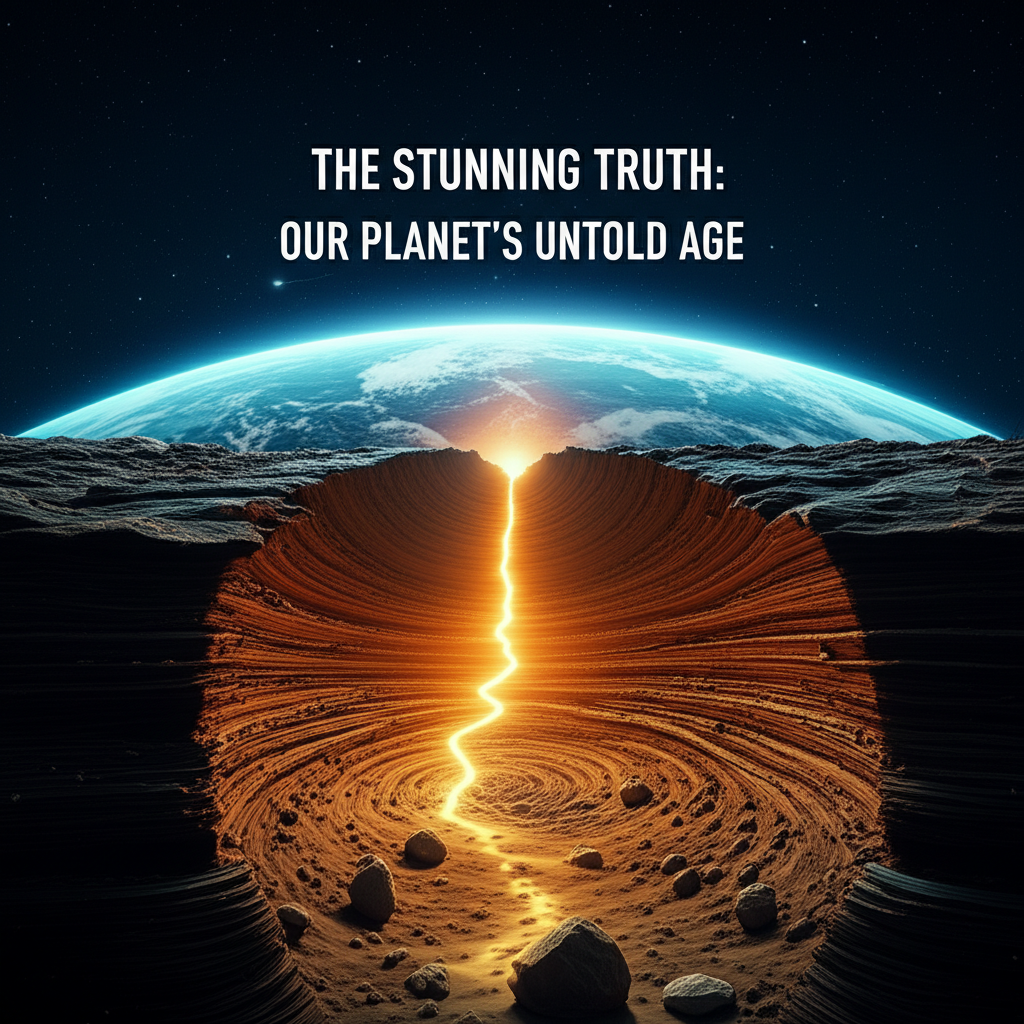
- The Long Quest for Earth's Birthday
- The Breakthrough of Radiometric Dating
- Evidence from The Solar System
- The Profound Implications of Deep Time
The breathtaking expanse of geological time is one of humanity’s most profound scientific discoveries. For centuries, our understanding of Earth’s age was limited by religious texts, philosophical reasoning, or incomplete observations, leading to estimates wildly short of reality. Today, thanks to remarkable scientific advancements, we know that our planet isn’t just old; it’s ancient beyond immediate human comprehension, a testament to billions of years of cosmic and terrestrial evolution. This modern scientific consensus reveals not an “untold age” but a meticulously deciphered one, a stunning truth layered within rocks, minerals, and even cosmic dust.
The Long Quest for Earth’s Birthday
Before the advent of modern science, pinpointing Earth’s age was largely a matter of theological interpretation or educated guesswork. Many cultures had creation myths, often implying a relatively young world, spanning thousands rather than millions of years. In the Western tradition, calculations based on biblical genealogies, such as those famously made by Archbishop James Ussher in the 17th century, placed creation at precisely nightfall on October 22, 4004 BC. While these efforts were sincere attempts to use available information, they were inherently limited by their scope and methodology.
As the Enlightenment dawned, early scientists began to challenge these timelines. Geologists like James Hutton in the late 18th century observed geological processes – erosion, sedimentation, uplift – acting at incredibly slow rates. He famously concluded that Earth showed “no vestige of a beginning, no prospect of an end,” implying a vast, unimaginable scale of time necessary for mountains to form and erode, and for stratigraphy to build up. This concept, later termed “deep time,” was revolutionary but lacked a precise numerical value.
Later, in the 19th century, physicists like Lord Kelvin attempted to calculate Earth’s age based on its cooling rate from a molten state. His calculations, while a monumental scientific effort, yielded an age between 20 million and 400 million years. This was a significant leap from biblical timelines, but still far too young. Kelvin’s model, brilliant as it was, couldn’t account for an unknown factor at the time: radioactivity, which continuously generates heat within Earth’s interior, maintaining higher temperatures for much longer than he could predict.
The Breakthrough of Radiometric Dating
The true revolution in dating Earth’s age came with the discovery of radioactivity at the turn of the 20th century. Marie Curie’s pioneering work, followed by the insights of Ernest Rutherford and Bertram Boltwood, revealed that certain unstable isotopes of elements decay into stable ones at a fixed, predictable rate. This decay rate, known as a half-life, became the ultimate geological clock.
Radiometric dating works by measuring the ratio of a radioactive “parent” isotope to its stable “daughter” product within a mineral or rock sample. Common parent-daughter pairs include uranium-lead, potassium-argon, and rubidium-strontium. By knowing the half-life of the parent isotope, scientists can calculate how long it has taken for the observed amount of daughter product to accumulate, thereby revealing the age of the rock since its formation.
This method provided the first truly reliable mechanism for establishing absolute ages for rocks. Early applications quickly demonstrated that Earth’s crust contained rocks far older than Kelvin’s estimates. The oldest terrestrial rocks discovered so far are found in the Acasta Gneiss in Canada, dated at approximately 4.03 billion years old. Mineral grains within these rocks, specifically tiny zircons from Jack Hills, Western Australia, have pushed the record back even further, with some individual zircon crystals crystalizing as early as 4.4 billion years ago. These microscopic time capsules offer direct evidence of the very earliest crustal formation.
Evidence from The Solar System
While Earth’s oldest rocks provide invaluable clues, our planet’s relentless geological activity – plate tectonics, erosion, volcanism, and metamorphism – means that very little of its original crust has survived intact. To truly pinpoint Earth’s formation age, scientists turned their gaze beyond our world, to the pristine remnants from the early solar system: meteorites.
Meteorites are fragments of asteroids that represent the primordial material from which our solar system, including Earth, formed. Because asteroids are generally small and geologically inactive, they preserve their original composition, acting as fossilized blueprints of the solar system’s formation event. By radiometrically dating various meteorites, scientists consistently arrive at an age of approximately 4.54 billion years for these celestial bodies.
This figure, 4.54 billion years, is widely accepted as the age of our solar system and, by extension, the age of Earth. The consensus is that Earth, along with the other planets, accreted from the same protoplanetary disk of gas and dust that formed the Sun. The slight difference between the 4.54 billion-year age of meteorites and the 4.4 billion-year age of the oldest Earth zircons reflects the period it took for Earth to fully accrete, differentiate into its core, mantle, and crust, and for the first stable crust to form and solidify.
The Profound Implications of Deep Time
The staggering age of 4.54 billion years is more than just a number; it is a fundamental pillar of modern science. This immense span of “deep time” provides the necessary backdrop for phenomena that would be impossible in a younger world:
Evolution of Life: Billions of years allowed single-celled organisms to emerge, diversify, and gradually evolve into the complex biodiversity we see today. Without deep time, Darwinian evolution is nonsensical.
Plate Tectonics: The slow, inexorable movement of continental plates, responsible for mountain building, ocean basin formation, and earthquakes, requires millions to billions of years to shape the Earth’s surface.
Climate Cycles: Understanding ancient climate change, ice ages, and warm periods relies on recognizing their occurrence over vast geological epochs.
Formation of Resources: The concentration of valuable mineral ores and fossil fuels is a product of long-term geological processes, accumulating over immense timescales.
Understanding Earth’s antiquity profoundly reshapes our perspective on our place in the cosmos. It tells a story of unimaginable patience, of processes unfolding over eons, shaping everything from the air we breathe to the ground beneath our feet.
In conclusion, the journey to understand Earth’s age has been a compelling saga of human curiosity, from educated guesses to sophisticated scientific discovery. From the limitations of early biblical chronologies and thermodynamic models to the revelatory power of radioactivity and extraterrestrial samples, our understanding has progressively expanded. Today, the 4.54-billion-year figure stands as one of science’s most enduring triumphs, revealing a planet far older, more dynamic, and more wondrous than our ancestors could ever have dreamed. This stunning truth about our planet’s age is not untold, but rather beautifully articulated by the rocks and meteorites themselves, awaiting our continued study and appreciation.
0 Comments