
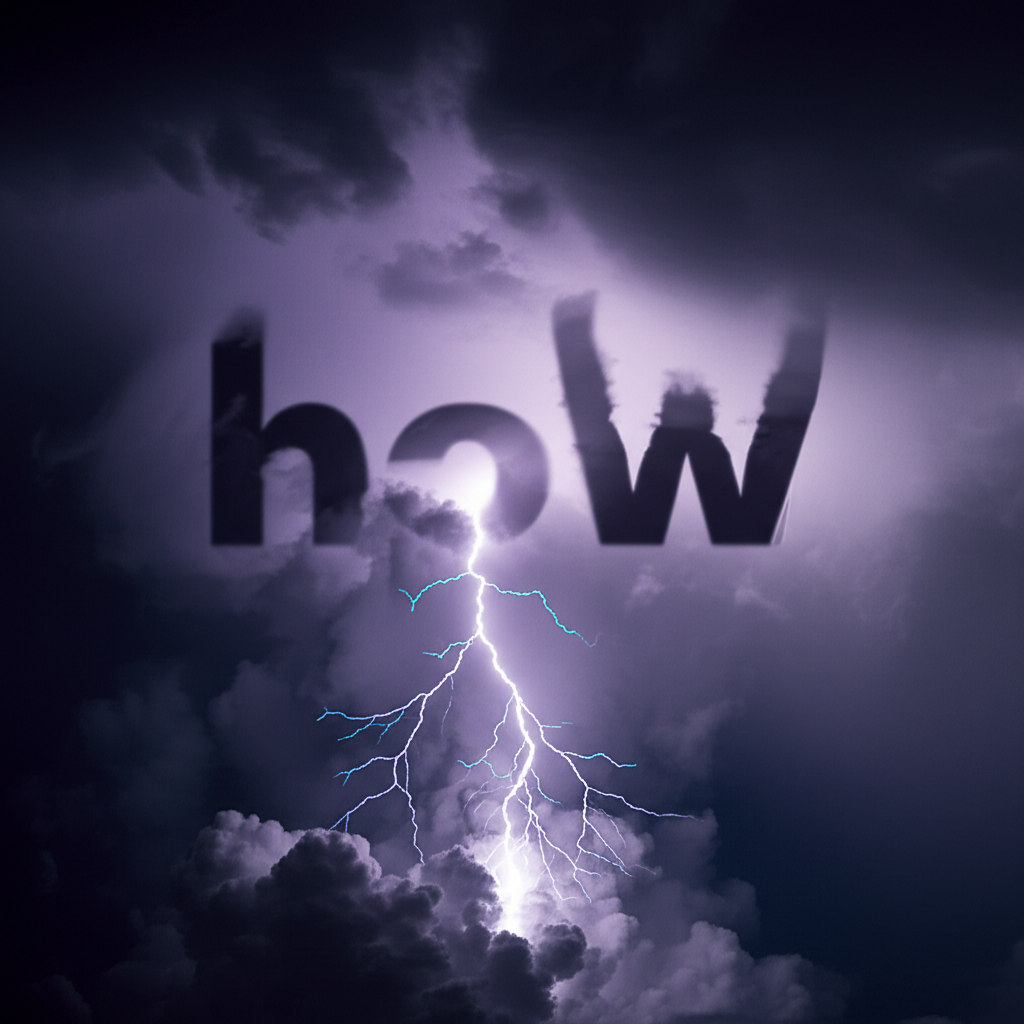
- The Electrifying Dance Inside Storm Clouds
- How Charges Separate: The "Rubbing Effect"
- The Invisible Pathways: Stepped Leaders and Streamers
- The Brilliant Flash: Return Stroke and Thunder
- How Lightning Manifests: Beyond Cloud-to-Ground
- Fascinating Facts and Safety Insights
How does nature unleash such raw, electrifying power, momentarily tearing through the sky with a blinding flash and a deafening roar? The phenomenon we call lightning, while seemingly instantaneous and chaotic, is in fact a precisely choreographed dance of physics occurring within the turbulent heart of a storm cloud. Far from a simple spark, its formation involves an intricate series of steps, turning everyday atmospheric components into one of Earth’s most spectacular and dangerous displays. Understanding this process reveals not just the stunning mechanics of storms, but also the sheer energetic forces at play above our heads.
The Electrifying Dance Inside Storm Clouds
The stage for lightning is typically set within colossal cumulonimbus clouds, often referred to as thunderclouds. These towering behemoths can stretch over 10 miles high, piercing into the stratosphere, and are characterized by their distinct anvil shape at the top. But it’s not just their size that makes them special; it’s the dynamic interactions occurring within their diverse internal climate. These clouds are laboratories of weather, containing vast quantities of water vapor, ice crystals, supercooled water droplets (water below freezing but still liquid), and a form of soft hail known as graupel.
How Charges Separate: The “Rubbing Effect”
The very first and most crucial step in lightning formation is the separation of electrical charges within the cloud. This isn’t due to an external force, but rather a constant, microscopic “rubbing effect” between the various particles swirling inside the storm.
As strong updrafts and downdrafts carry particles rapidly throughout the cloud, collisions become inevitable and frequent. Lighter ice crystals are pushed upwards towards the colder top of the cloud, while heavier graupel and hail tend to fall downwards. During these collisions, electrons are transferred between the particles. Typically, the lighter ice crystals lose electrons and become positively charged, continuing their ascent. The heavier graupel and hail gain electrons, becoming negatively charged, and descend towards the middle and lower sections of the cloud.
This continuous process leads to a distinct separation of charges: the upper portions of the cloud accumulate a net positive charge, while the middle and lower regions become predominantly negatively charged. A smaller, localized positive charge can also sometimes form near the bottom of the cloud. This massive electrical imbalance, much like stretching a rubber band to its limit, creates an immense potential difference, priming the sky for an electrical discharge.
The Invisible Pathways: Stepped Leaders and Streamers
With a colossal charge separation in place, the atmosphere can no longer contain the electrical tension. The negatively charged region in the cloud’s base seeks to neutralize itself, most commonly by discharging towards the positively charged ground.
The initial bridge for this discharge is called a stepped leader. From the negatively charged area of the cloud, a dim, barely visible channel of ionized air begins to dart downwards in a series of rapid, segmented steps, each step about 50 yards long. This stepped leader is essentially feeling its way through the air, seeking the path of least resistance. As it descends, it ionizes the air directly in front of it, making it more conductive.
As the stepped leader approaches the ground – usually within a few hundred feet – the extreme negative charge overhead induces an opposite positive charge on the surface below. Tall objects like trees, buildings, utility poles, and even people, become points where this positive charge concentrates. From these points, upward-moving channels of positive electricity, known as streamers, launch upwards towards the descending stepped leader.
The Brilliant Flash: Return Stroke and Thunder
The moment a stepped leader meets an upward streamer, the circuit is complete. This connection provides a highly conductive pathway between the cloud and the ground. The result is the dramatic return stroke. An incredibly powerful surge of current rushes upwards from the ground along the ionized channel, back towards the cloud. This upward rush is what we perceive as the brilliant, dazzling flash of lightning.
The return stroke is breathtakingly fast, occurring in mere microseconds, and it’s ferociously hot. The temperature within the lightning channel can reach up to 30,000°C (54,000°F) – five times hotter than the surface of the sun!
This intense heat causes the air immediately surrounding the lightning channel to expand explosively outwards. This sudden, violent expansion generates a powerful shockwave. As this shockwave propagates through the atmosphere, it creates the sound we know as thunder. Because light travels vastly faster than sound, we always see the lightning flash before we hear its thunderous roar, a delay that allows us to estimate the strike’s distance.
How Lightning Manifests: Beyond Cloud-to-Ground
While cloud-to-ground lightning is the most recognized and impactful form, it accounts for only about 20-25% of all lightning activity. The vast majority of lightning happens within the cloud itself.
Intra-cloud (or In-cloud) Lightning: This is the most common type, occurring entirely within a single storm cloud, jumping between regions of opposite charge. The flash often illuminates the entire cloud from within.
Cloud-to-cloud Lightning: This occurs when lightning jumps between two separate storm clouds.
Cloud-to-air Lightning: Less common, this type of lightning discharges from a cloud directly into the surrounding clear air, without striking the ground or another cloud.
Sheet Lightning: This is simply the visual effect of distant lightning, often intra-cloud, where the flash is diffused by clouds and dust, appearing as a broad, diffuse illumination rather than a distinct bolt.
Fascinating Facts and Safety Insights
Lightning is not just a spectacle; it’s a force of immense power. On average, there are about 40-50 lightning flashes per second globally, translating to several million strikes every day. A single lightning bolt typically carries gigawatts of power, enough to light up hundreds of thousands of homes for an instant.
Dispelling a common myth, lightning can and often does strike the same place twice – tall structures like the Empire State Building can be hit dozens of times a year. Its path is determined by charge distribution, conductivity, and proximity, not memory.
Given its power, lightning is also incredibly dangerous. Following basic safety guidelines is crucial: “When thunder roars, go indoors.” Seek shelter in a sturdy building or a fully enclosed vehicle. Avoid open fields, tall trees, water, and metal objects during a thunderstorm.
From the microscopic collisions of ice particles to the explosive roar of thunder, the formation of lightning is a testament to the elegant yet fearsome power of natural forces. It’s a reminder that even in seemingly empty skies, an intricate dance of electricity is always unfolding, ready to illuminate the world in a stunning, unforgettable flash.
0 Comments