- Understanding How Rockets Generate Thrust
- The Anatomy of Propulsion: Key Components
- How the Nozzle Amplifies Force
- The Continuous Battle Against Gravity
- Guiding the Ascent: Staying on Course
How rockets work is a concept that often evokes images of incredibly complex machinery, intricate calculations, and the pinnacle of human engineering. While all of that is true to a certain extent, the stunning simplicity at the heart of rocket propulsion is what truly makes their journey to the stars so fascinating. Stripped down to its essence, a rocket operates on one of the most fundamental laws of physics, making the seemingly miraculous act of leaving Earth’s atmosphere an elegant demonstration of action and reaction.
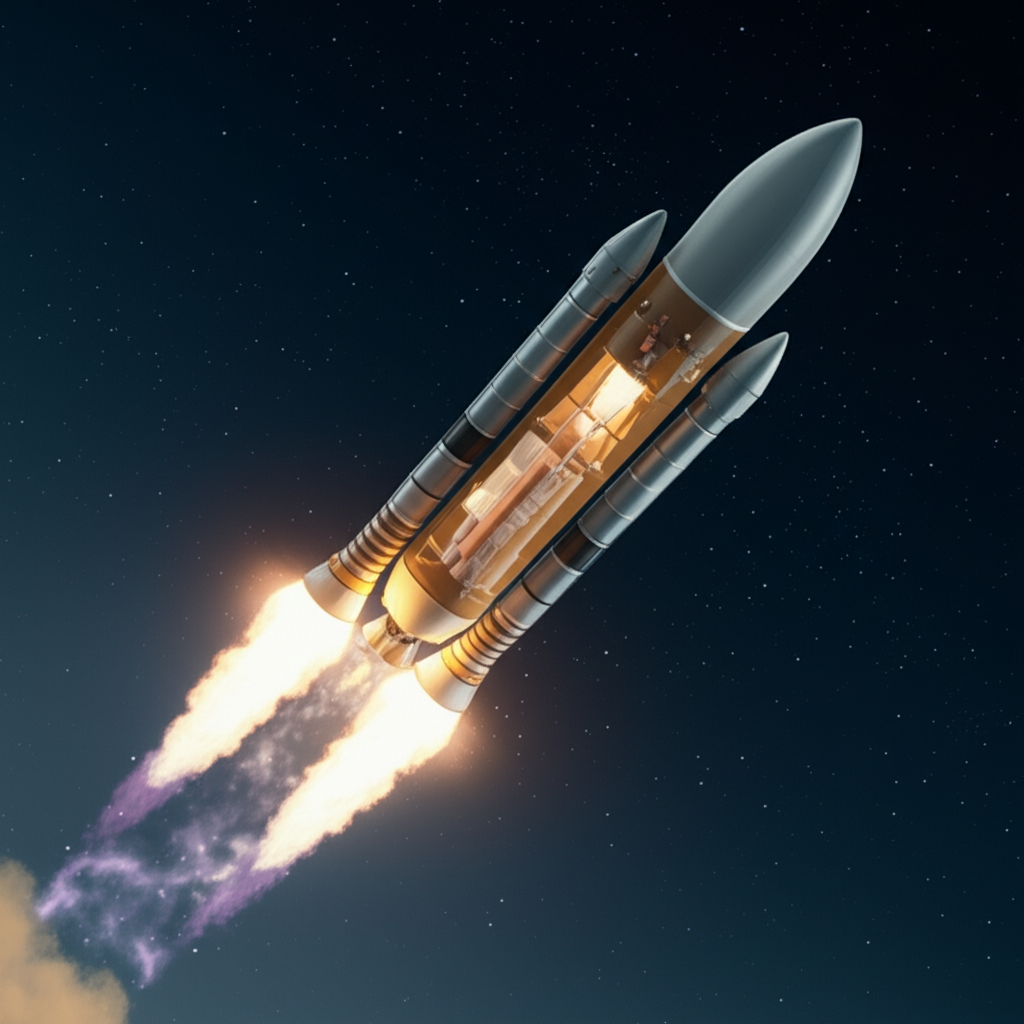
At its core, a rocket’s operation hinges directly on Isaac Newton’s Third Law of Motion: “For every action, there is an equal and opposite reaction.” Think of it like this: if you blow up a balloon and then release it, the air rushing out one end (the action) pushes the balloon in the opposite direction (the reaction). A rocket works on precisely the same principle, albeit on a far grander and more controlled scale. It expels high-velocity gas downwards, and in reaction, the rocket is pushed upwards.
Understanding How Rockets Generate Thrust
The “action” in a rocket comes from the rapid expulsion of gas. This gas is produced by burning propellants, which typically consist of a fuel and an oxidizer. These components can be liquid (like hydrogen and oxygen) or solid (like the composite materials found in fireworks or solid rocket boosters). Regardless of their state, their purpose is the same: to create a powerful, sustained chemical reaction.
Inside the rocket’s combustion chamber, the fuel and oxidizer are mixed and ignited. This creates an extremely hot, high-pressure gas. Picture an immense, continuous explosion contained within a very strong vessel. This incredible pressure is the key ingredient, constantly pushing against all the inner surfaces of the combustion chamber. However, there’s a crucial escape route: the nozzle.
The Anatomy of Propulsion: Key Components
To understand how this propulsion is achieved effectively, we need to look at the rocket’s main components related to thrust:
1. Propellant Tanks: These hold the fuel and oxidizer, kept separate until they are needed.
2. Pumps & Injectors: For liquid-fueled rockets, powerful pumps force the propellants into the combustion chamber through injectors that ensure proper mixing.
3. Combustion Chamber: This is where the magic happens – the controlled explosion that generates the hot, high-pressure gas.
4. Nozzle: This is arguably the most critical component for directing and amplifying the thrust.
How the Nozzle Amplifies Force
The nozzle is not just a hole; it’s a precisely engineered bell-shaped conduit crucial for efficient propulsion. Let’s revisit our balloon analogy. If you just pop a balloon, the air escapes in all directions, and the thrust is minimal. But if you restrict the air to a small opening, it creates a more powerful, directed push. The rocket nozzle takes this concept to the extreme.
As the superheated, high-pressure gas from the combustion chamber enters the narrow throat of the nozzle, it begins to accelerate. Then, as it expands into the wider bell section of the nozzle, two critical things happen:
1. Acceleration: The gas accelerates dramatically, often reaching supersonic speeds.
2. Direction: The nozzle directs this high-velocity gas in a singular, focused stream, maximizing the downward push.
By converting the thermal energy and pressure of the burning gases into kinetic energy in a precisely directed way, the nozzle maximizes the force exerted on the rocket itself, pushing it upwards and into space. The faster the exhaust gases are expelled, and the greater their mass, the more thrust the rocket generates.
The Continuous Battle Against Gravity
A rocket isn’t just pushed upwards once; it needs continuous thrust to overcome Earth’s immense gravitational pull and the drag of its atmosphere. This is why rockets burn their propellants for an extended period, often minutes or even many minutes, depending on their mission. Overcoming gravity requires a great deal of energy, and the constant expulsion of exhaust gases provides this sustained force.
Modern rockets often employ multiple stages, where sections of the rocket detach once their fuel is depleted. This shedding of mass makes the remaining rocket lighter, allowing it to accelerate more efficiently with the same amount of thrust, or requiring less thrust for continued acceleration. This clever engineering enhancement builds upon the core principle of action-reaction, making space travel more feasible.
Guiding the Ascent: Staying on Course
Beyond just pushing upwards, rockets also need to steer. This is achieved through various mechanisms, such as gimbaled engines that can swivel slightly to change the direction of the exhaust, or smaller thrusters that fire to adjust orientation. Inertial guidance systems and GPS on board continuously monitor the rocket’s position and trajectory, making micro-adjustments to ensure it reaches its precise destination. Even these complex control systems are ultimately directing specific applications of Newton’s Third Law to maneuver the craft.
In essence, while the sight of a rocket launch might appear to be a symphony of advanced technology and a modern marvel, the underlying physics remains elegantly simple. It’s a powerful demonstration of pushing matter one way to be propelled in the other, a testament to the efficient application of fundamental natural laws. From igniting propellants to channeling scorching gases through a precisely shaped nozzle, the entire endeavor of space flight is built upon this stunning simplicity, allowing us to reach for the stars.
0 Comments