
- What is Dark Matter? The Invisible Architect
- The Tangible Evidence for an Intangible Force
- Galactic Rotation Curves: A Cosmic Conundrum
- Gravitational Lensing: Bending Light, Revealing Mass
- The Cosmic Microwave Background: Echoes of the Early Universe
- The Quest to Discover Dark Matter's True Nature
- Direct Detection Experiments: Looking for WIMPs
- Indirect Detection: Hunting for Annihilation Byproducts
- Collider Experiments: Creating Dark Matter
- Future Prospects and The Unfolding Universe
Unveiling the Universe’s Greatest Mystery: Dark Matter
The cosmos, in its awe-inspiring vastness and intricate beauty, holds countless secrets, but perhaps none is more profound or puzzling than dark matter. This enigmatic substance is not just a scientific curiosity; it represents a fundamental missing piece in our understanding of the universe, an invisible architect that sculpts galaxies and dictates the very structure of the cosmos. Despite constituting an astonishing 85% of all matter, dark matter remains stubbornly elusive, interacting with the ordinary matter we know only through the pull of gravity. Its presence is inferred through a compelling array of astronomical observations, yet its true nature continues to baffle physicists and astronomers alike, prompting an urgent quest for scientific breakthroughs that promise stunning revelations about the universe we inhabit.
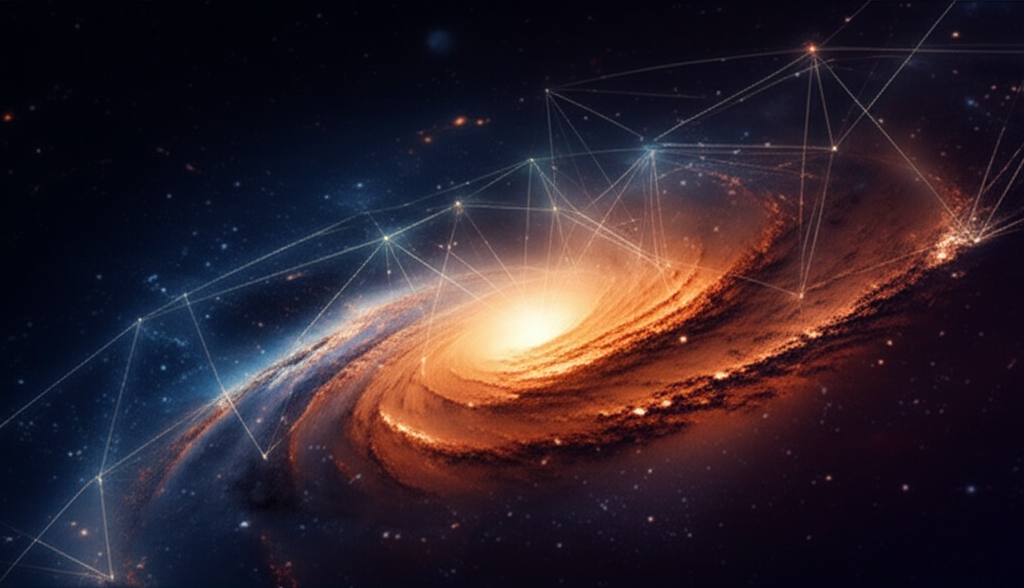
What is Dark Matter? The Invisible Architect
Distinguishing dark matter from ordinary matter is crucial for comprehending its significance. Unlike the baryonic matter that makes up stars, planets, and ourselves – which interacts electromagnetically and emits or reflects light – dark matter does not. It is invisible, utterly transparent to light, radio waves, and all other forms of electromagnetic radiation. This fundamental lack of interaction with light is precisely why it earned the moniker “dark.” Instead, its existence is primarily evidenced by its gravitational influence on visible matter and the large-scale structure of the universe. It is not made of protons, neutrons, or electrons, nor is it antimatter. It represents an entirely new, unknown component of reality, a silent, pervasive force guiding the cosmic dance from the shadows.
The Tangible Evidence for an Intangible Force
The concept of dark matter didn’t emerge from pure speculation; rather, it was necessitated by glaring inconsistencies between theoretical predictions and observational reality. Over decades, a wealth of independent astrophysical evidence has converged, all pointing to the inescapable conclusion that there is far more matter in the universe than we can see.
Galactic Rotation Curves: A Cosmic Conundrum
One of the earliest and most compelling pieces of evidence for dark matter came from observing the rotation of galaxies. In the 1970s, pioneering astronomer Vera Rubin and her colleagues discovered that stars at the outer edges of spiral galaxies were orbiting their galactic centers far too quickly. If a galaxy’s mass consisted only of its visible stars and gas, the stars at the periphery should be moving slower, eventually flinging off into intergalactic space. However, they observed that these outer stars moved at speeds comparable to those closer to the center, implying that there must be a massive halo of unseen matter extending far beyond the visible boundaries of the galaxy, providing the extra gravitational pull to keep everything intact. This invisible halo is what we now call dark matter.
Gravitational Lensing: Bending Light, Revealing Mass
Einstein’s theory of general relativity predicts that massive objects bend the fabric of spacetime, causing light to be deflected as it passes by. This phenomenon, known as gravitational lensing, allows astronomers to “weigh” distant objects simply by observing how much they distort the light from background galaxies. When applied to galaxy clusters, observations consistently show stronger lensing effects than can be explained by the visible matter alone. The amount of light bending indicates that galaxy clusters contain five to six times more mass than can be accounted for by their stars and hot gas. This excess mass is attributed to dark matter forming vast, invisible scaffolds within these cosmic superstructures.
The Cosmic Microwave Background: Echoes of the Early Universe
Further evidence for dark matter is etched into the cosmic microwave background (CMB), the faint afterglow of the Big Bang. The subtle temperature fluctuations in the CMB provide a snapshot of the early universe, allowing cosmologists to infer its composition. The patterns in these fluctuations are exquisitely sensitive to the universe’s matter density. Models that successfully reproduce the observed CMB anisotropies require a significant component of non-baryonic dark matter to explain how the initial fluctuations could have grown into the large-scale structures we observe today, like galaxies and galaxy clusters. Without dark matter, the universe would have remained too smooth to form any substantial structures in the allocated time.
The Quest to Discover Dark Matter’s True Nature
Identifying dark matter is one of the most significant challenges in modern physics, involving a multi-pronged approach combining direct detection, indirect detection, and collider experiments.
Direct Detection Experiments: Looking for WIMPs
The most prominent candidates for dark matter are hypothetical particles known as WIMPs (Weakly Interacting Massive Particles). As their name suggests, WIMPs would interact very feebly with ordinary matter, primarily through the weak nuclear force and gravity. Direct detection experiments aim to catch these rare interactions. Laboratories, often located deep underground to shield them from cosmic rays, employ ultra-sensitive detectors – typically large tanks of super-cooled liquids like xenon or germanium. Scientists hope to observe a brief flash of light or a tiny pulse of energy if a WIMP happens to collide with an atomic nucleus inside the detector. While experiments like XENONnT and LUX-ZEPLIN have pushed the sensitivity limits dramatically, a definitive WIMP detection remains elusive.
Indirect Detection: Hunting for Annihilation Byproducts
Another strategy involves searching for the byproducts of dark matter particles annihilating or decaying. If dark matter particles were to collide with each other, they might produce standard model particles like gamma rays, neutrinos, or antimatter (positrons). Space-based telescopes and ground-based observatories, such as the Fermi Gamma-ray Space Telescope, the IceCube Neutrino Observatory, and the Alpha Magnetic Spectrometer on the International Space Station, are constantly looking for unusual excesses of these particles emanating from dense regions of dark matter, like the galactic center or dwarf galaxies.
Collider Experiments: Creating Dark Matter
Particle accelerators like the Large Hadron Collider (LHC) at CERN offer a third avenue: creating dark matter particles in controlled laboratory conditions. By smashing particles together at incredibly high energies, physicists aim to produce new, heavy particles that could be dark matter. The signature of such an event would be “missing energy” – if a dark matter particle were created, it would pass undetected through the particle detectors, resulting in an imbalance of energy and momentum in the collision products. While the LHC has discovered the Higgs boson and other new particles, a dark matter signature has yet to be confirmed.
Future Prospects and The Unfolding Universe
The search for dark matter is an enduring testament to human curiosity and scientific ingenuity. As technology advances and theoretical models evolve, the prospects for finally unraveling this cosmic enigma are brighter than ever. Next-generation direct detection experiments will boast even greater sensitivity, while new astrophysical observatories, both on Earth and in space, will offer unprecedented views of the universe, potentially revealing new clues. The exploration of alternative dark matter candidates, such as axions or sterile neutrinos, is also gaining momentum, diversifying the search strategy.
Unlocking the secrets of dark matter promises not just new particles, but fundamentally new physics – potentially extending beyond the Standard Model that currently describes the known fundamental forces and particles. Such a discovery would revolutionize our understanding of gravity, quantum mechanics, and the origins of the universe itself, leading to truly stunning revelations that redefine our place in the cosmos. The invisible hand that shapes the galaxies beckons, promising that the greatest cosmic mysteries are yet to be fully revealed.
0 Comments