- The Standard Rule: Solids are Denser than Liquids
- Why Water is Different: The Hydrogen Bond Phenomenon
- The Curious Case of Crystallization
- Density and Buoyancy: The Mechanics of Floating
- The Profound Importance of Water's Anomaly
- An Amazing Secret, Unveiled
Why does ice float? It’s a question that observers of nature and curious minds have pondered for centuries. While it might seem like a simple observation, the fact that a solid form of a substance floats in its own liquid is, in fact, an incredible scientific anomaly with profound implications for life on Earth. Most substances, when they transition from a liquid to a solid state, become denser and therefore sink. Think about solid metal sinking in molten metal, or congealed fat settling at the bottom of cooling soup. Water, however, defies this conventional rule, revealing a secret etched into its very molecular structure.
The Standard Rule: Solids are Denser than Liquids
Before we dive into water’s peculiar behavior, let’s establish the common rule. For nearly every substance known, solidification involves molecules packing more tightly together. As a liquid cools, its molecules lose kinetic energy, slow down, and move closer. When they reach their freezing point, they often arrange themselves into a rigid, crystalline structure. This structure is typically more compact than the disorderly liquid state, resulting in a higher density. A higher density means more mass packed into the same volume, so the solid form sinks when placed in the liquid. This is the expected, logical outcome based on typical molecular behavior.
Why Water is Different: The Hydrogen Bond Phenomenon
The secret behind ice’s buoyancy lies deep within the fascinating world of water molecules themselves. A single water molecule (H₂O) consists of one oxygen atom covalently bonded to two hydrogen atoms. Due to oxygen’s higher electronegativity, it pulls the shared electrons closer to itself, giving the oxygen atom a slight negative charge and the hydrogen atoms slight positive charges. This creates a polar molecule, where one end is slightly positive and the other slightly negative.
These slight charges are what allow water molecules to form special, albeit weak, attractions called hydrogen bonds. In liquid water, these hydrogen bonds are constantly forming, breaking, and reforming as the molecules tumble and slide past one another. The molecules are relatively close together, but without a fixed, rigid arrangement.
The Curious Case of Crystallization
As liquid water cools and approaches its freezing point (0°C or 32°F), the kinetic energy of the water molecules decreases. This reduction in energy allows the hydrogen bonds to become more stable and influential. Instead of the chaotic, ever-shifting network of liquid water, the molecules begin to arrange themselves into a more ordered, crystalline structure.
This specific crystal structure, known as ice Iₕ (hexagonal ice), is crucial. Each oxygen atom centrally bonds to two hydrogen atoms, and also forms hydrogen bonds with two hydrogen atoms from neighboring water molecules. This creates a fixed, open, hexagonal lattice. Critically, this ordered arrangement forces the water molecules further apart than they are in their liquid state. Picture a perfectly designed scaffold with lots of empty space within its framework; this is akin to how ice forms.
This open, spacious structure means that for a given volume, ice contains fewer water molecules than an equivalent volume of liquid water just above freezing. Fewer molecules in the same space translates directly to less mass. And less mass for the same volume means lower density.
Density and Buoyancy: The Mechanics of Floating
The concept of density is fundamental here. Density is defined as mass per unit volume (D = m/V). If ice has less mass packed into the same volume compared to liquid water, then ice is less dense than liquid water.
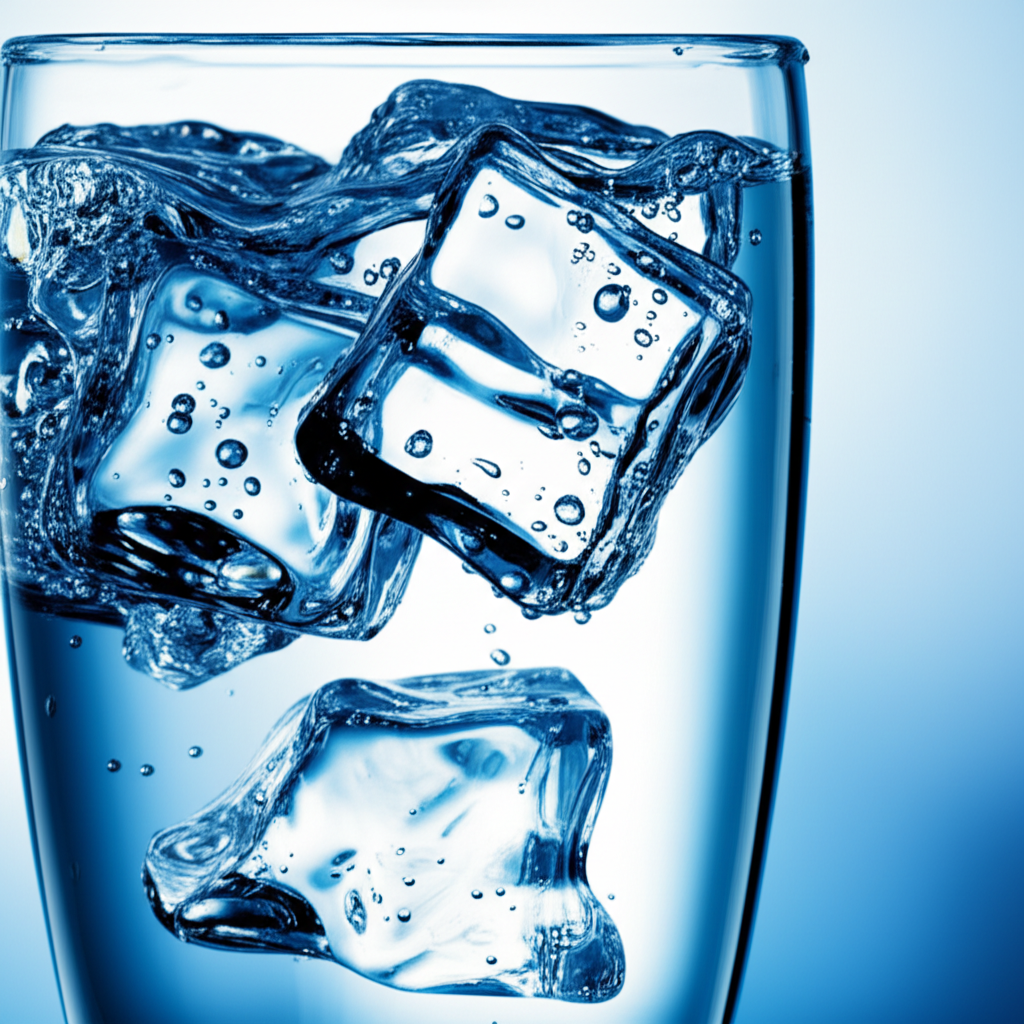
This difference in density is precisely why ice floats. According to Archimedes’ principle, an object floats if its density is less than the density of the fluid it displaces. Since ice is about 9% less dense than liquid water, approximately 90% of an iceberg or an ice cube will be submerged, with the remaining 10% visible above the surface.
The Profound Importance of Water’s Anomaly
The fact that ice floats is not just a scientific curiosity; it is a fundamental property of water that has incredibly far-reaching consequences for life on Earth.
Imagine a world where ice sank.
Life in Aquatic Environments: When winter arrives, the surface of lakes and oceans would freeze. But instead of floating, the ice would sink to the bottom. More ice would form on the surface, sink, and eventually, entire bodies of water, from small ponds to vast oceans, would freeze solid from the bottom up. This would obliterate most aquatic life, as there would be no unfrozen water for fish, plants, and microorganisms to survive in.
Climate Regulation: Floating ice acts as an insulator. The layer of ice on the surface of water bodies prevents the deeper water from freezing, allowing aquatic ecosystems to persist through harsh winters. Polar ice caps and glaciers also play a critical role in regulating Earth’s climate by reflecting solar radiation back into space, helping to keep our planet cool. If these massive ice formations sank, the entire oceanic circulation and global weather patterns would be drastically different, likely leading to a much warmer and less habitable planet.
* Geological Processes: The expansion of water as it freezes also contributes to geological processes like frost wedging, where water seeps into cracks in rocks, freezes, expands, and breaks the rock apart. While not directly linked to floating, it’s another consequence of water’s unique density change.
An Amazing Secret, Unveiled
The seemingly simple act of an ice cube bobbing in your drink is a testament to one of nature’s most extraordinary “tricks.” The peculiar hydrogen bonds between water molecules dictate a unique crystalline structure in its solid form, making it less dense than its liquid counterpart. This isn’t just a quirk; it’s a vital characteristic that determines the very habitability of our planet. From supporting intricate underwater ecosystems to shaping global climate, the amazing secret of why ice floats is truly a cornerstone of life as we know it.
0 Comments