- The Anatomy of Light: Refraction and Reflection
- The Dance of Light and Water: Forming the Arc
- The Primary Rainbow: Understanding Its Structure
- Beyond the Primary: Exploring Other Rainbow Phenomena
- The Myth of the Pot of Gold: Why Rainbows Are Personal
- Conclusion
The Ultimate Guide to Understanding Rainbows Through Physics
The breathtaking beauty of a rainbow is a universal marvel, a fleeting arc of vibrant colors painted across the sky after a rain shower. While its aesthetic appeal is undeniable, the true wonder of a rainbow lies in the intricate dance of light and water, a phenomenon perfectly explained by the principles of physics. Far from being a mystical apparition, a rainbow is a spectacular optical illusion, a personalized show designed by nature for each individual observer. Understanding the science behind these stunning arcs deepens our appreciation for one of Earth’s most enchanting natural displays.
The Anatomy of Light: Refraction and Reflection
To truly grasp how rainbows form, we must first delve into the fundamental properties of light. Sunlight, which appears white to the naked eye, is actually a composite of all the colors of the visible spectrum. This fact was famously demonstrated by Isaac Newton, who used a prism to split white light into its constituent colors – red, orange, yellow, green, blue, indigo, and violet (VIBGYOR).
When light travels from one medium to another (like from air to water), its speed changes, causing it to bend. This bending of light is known as refraction. Different wavelengths of light (which correspond to different colors) bend at slightly different angles. Red light, with the longest wavelength, bends the least, while violet light, with the shortest wavelength, bends the most. This differential bending is called dispersion.
The second critical physical process is reflection. When light strikes a surface, some of it bounces back. In the context of rainbows, light enters a water droplet, reflects off its inner back surface, and then exits. These two phenomena – refraction and reflection – are the primary architects of the rainbow.
The Dance of Light and Water: Forming the Arc
A rainbow requires two essential ingredients: sunlight and countless tiny water droplets suspended in the air. For an observer to see a rainbow, the sun must be behind them, and the rain or mist must be in front. Each water droplet acts like a tiny prism, playing a crucial role in creating the color spectrum.
Here’s a step-by-step breakdown of how light interacts with a single water droplet to contribute to a rainbow:
1. First Refraction: A ray of sunlight enters a spherical water droplet. As it passes from the less dense air into the denser water, it slows down and bends. Because different colors refract at slightly different angles, the white light begins to split into its individual spectral components.
2. Internal Reflection: Once inside the droplet, the light travels to the opposite side of the internal surface. Here, instead of exiting the droplet, much of the light reflects off the back surface. This total internal reflection is critical for sending the light back towards the observer.
3. Second Refraction (Dispersion): The reflected light then travels back to the front of the droplet. As it exits the water and re-enters the air, it refracts again, bending further and increasing the separation of the colors. This second refraction is where the dispersion becomes most evident, spreading the colors into a distinct band.
The key to seeing a rainbow is not just one droplet, but millions of them. Each droplet refracts, reflects, and disperses the sunlight, sending a specific color to the observer’s eye at a particular angle.
The Primary Rainbow: Understanding Its Structure
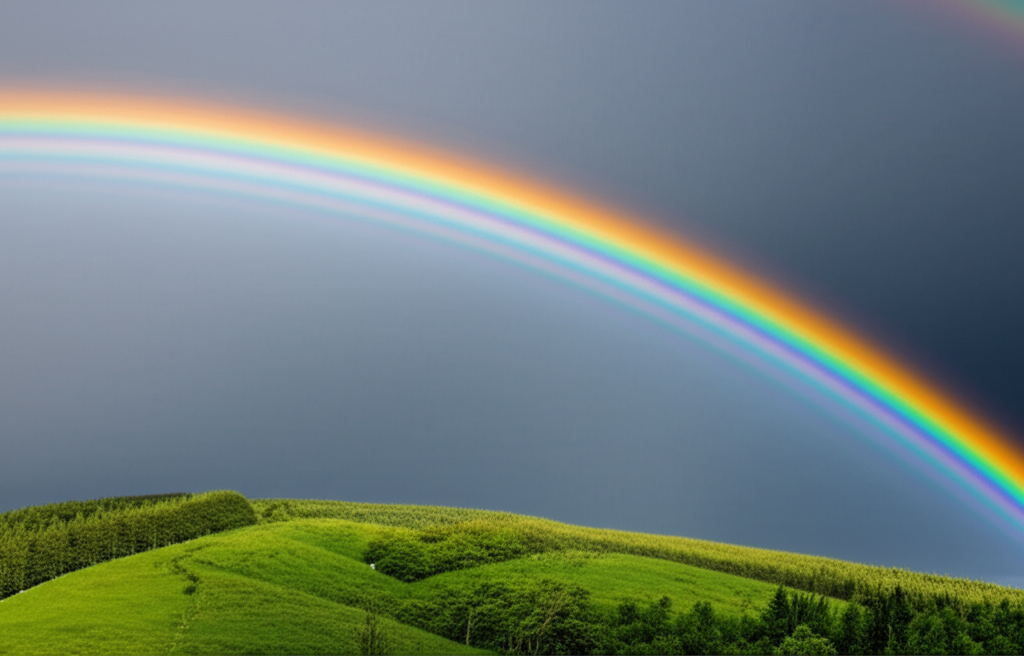
The most common rainbow we see is called the primary rainbow. For this rainbow, sunlight undergoes one internal reflection within the water droplets. The geometry of light, water droplets, and the observer’s eye dictates that the most intense light for a primary rainbow is seen at an angle of approximately 42 degrees relative to the anti-solar point (the point directly opposite the sun from the observer’s perspective).
What does this mean for the colors? Because violet light bends more than red light, the violet light emerges slightly “lower” (at a smaller angle) from the droplets, and red light emerges slightly “higher” (at a larger angle). When you look at a primary rainbow, you see red on the outermost edge and violet on the innermost edge. The arc shape arises because this 42-degree angle of concentrated light forms a cone, and when intersected by the ground, it appears as an arc. Since the sun needs to be behind you to see a rainbow, you’ll always see its arc with colors from red to violet from top to bottom.
Beyond the Primary: Exploring Other Rainbow Phenomena
While the primary rainbow is the most familiar, nature offers a variety of other rainbow phenomena, each explained by slightly different optical paths:
The Secondary Rainbow: Occasionally, you might spot a fainter, wider rainbow arc above the primary one. This is the secondary rainbow. It forms when sunlight undergoes two internal reflections within the water droplets, instead of one. The extra reflection causes the colors to be reversed compared to the primary rainbow, with violet on the outside and red on the inside. It also appears at a larger angle, around 50-53 degrees. Due to the extra reflection, more light is lost, making it fainter.
Supernumerary Bows: Sometimes, faint, narrow bands of pastel colors appear just inside the primary rainbow or outside the secondary. These are called supernumerary bows, and they are caused by wave interference effects within droplets of a very uniform size.
Twin Rainbows: While rare, a twin rainbow (not a double rainbow) signifies two primary rainbows splitting from a single base. This occurs when rainfall includes a mix of large and small raindrops, which refract light differently.
Moonbows (Lunar Rainbows): These are rainbows produced by moonlight rather than direct sunlight. Since moonlight is much fainter, moonbows often appear white to the naked eye, though photographic evidence reveals their colors.
Fogbows: Made by very tiny fog or cloud droplets, fogbows are broad, often colorless bows due to the small droplet size causing significant overlap of colors.
The Myth of the Pot of Gold: Why Rainbows Are Personal
The old Irish legend of a pot of gold at the end of a rainbow, while charming, highlights a fundamental truth: you can never reach the end of a rainbow. This is because a rainbow is not a physical object located at a specific point in space. It is an optical phenomenon, a visual effect whose position depends entirely on the observer’s position relative to the sun and the water droplets.
Every person sees their own unique rainbow. If you move, your rainbow moves with you. The specific droplets contributing to your rainbow are different from the droplets contributing to someone else’s rainbow, even if they are standing right next to you. The angle of 42 degrees (for the primary bow) is constant, but the specific cone of light that creates that angle for your eyes will always be unique to your* perspective.
Conclusion
Rainbows remain one of nature’s most captivating visual spectacles. By understanding the underlying physics of light, from its dispersion into a spectrum of colors to its intricate dance of refraction and reflection within water droplets, we gain a deeper appreciation for their ephemeral beauty. Each vibrant arc is a testament to the elegant laws orchestrating our natural world, transforming ordinary sunlight and rain into a personalized masterpiece of light and color. So, the next time you witness a rainbow, remember you’re not just seeing a pretty picture, but a complex scientific phenomenon designed just for you.
0 Comments