
- The Crucible of the Space Race
- Building Towards Apollo 11
- The Chosen Few: Armstrong, Aldrin, and Collins
- The Critical Descent to Tranquility Base
- A Small Step, A Giant Leap
- The Journey Home and Enduring Legacy
The first moon landing forever altered humanity’s perception of its place in the cosmos, marking an achievement so profound it resonates across generations. On July 20, 1969, a quarter of a million miles away from Earth, two men stepped out onto a celestial body, fulfilling an audacious dream that had captivated thinkers and scientists for centuries. This incredible story of human ingenuity, courage, and unwavering determination remains one of the greatest chapters in our collective history.
The Crucible of the Space Race
Before Apollo 11, the world was locked in the intense geopolitical rivalry known as the Cold War. A significant front in this ideological battle was the Space Race, primarily between the United States and the Soviet Union. The Soviets had taken an early lead with the launch of Sputnik in 1957, followed by Yuri Gagarin becoming the first man in space in 1961. These breakthroughs sent shockwaves through the U.S., prompting President John F. Kennedy to issue a monumental challenge: to land a man on the Moon and return him safely to Earth before the decade was out. This ambitious goal ignited an unprecedented national effort, mobilizing immense resources and the brightest minds to achieve what many considered impossible.
Building Towards Apollo 11
The journey to the Moon was not a direct one; it was a methodical, step-by-step progression through several preceding programs. Project Mercury demonstrated that humans could survive in space. Project Gemini then pushed the boundaries further, exploring spacewalks, orbital rendezvous, and extended missions, all crucial skills for a lunar voyage. Each mission provided invaluable data and experience, meticulously building the foundation for the more complex Apollo program. By the late 1960s, a series of uncrewed and crewed Apollo missions tested the Saturn V rocket – the most powerful ever built – the command module, and the lunar module, steadily paving the way for the ultimate expedition.
The Chosen Few: Armstrong, Aldrin, and Collins
The crew selected for Apollo 11 represented the pinnacle of astronaut experience and temperament. Neil Armstrong, the mission commander, was known for his calm demeanor under pressure and his exceptional piloting skills. Edwin “Buzz” Aldrin Jr., the lunar module pilot, possessed a doctorate from MIT and an keen understanding of orbital mechanics. Michael Collins, the command module pilot, was the vital link, responsible for piloting the spacecraft in lunar orbit while his colleagues descended. Their diverse skills and unwavering professionalism were essential for navigating the complex and perilous journey ahead.
The Critical Descent to Tranquility Base
On July 16, 1969, the mighty Saturn V rocket launched Apollo 11 from Kennedy Space Center, carrying the hopes and dreams of a nation – and indeed, the world. After a three-day journey, the spacecraft entered lunar orbit. On July 20, the Lunar Module “Eagle,” with Armstrong and Aldrin inside, separated from the Command Module “Columbia,” where Collins remained.
The descent to the lunar surface was fraught with tension. A series of alarms blared in the cockpit, indicating computer overload. Ground control, after quick assessment, gave the “Go” to proceed. As the Eagle neared the designated landing site, Armstrong realized the autopilot was guiding them toward a boulder field, forcing him to take manual control. With fuel rapidly depleting, Armstrong skillfully maneuvered the lander, searching for a safe spot. With literally seconds of fuel remaining, he guided the Eagle to a soft touchdown on the Sea of Tranquility. “Houston, Tranquility Base here,” Armstrong radioed, “The Eagle has landed.” A wave of relief and euphoria swept across the globe.
A Small Step, A Giant Leap
Several hours later, Armstrong opened the hatch and descended the ladder. At 10:56 PM EDT, he placed his left foot onto the dusty lunar surface, uttering the immortal words: “That’s one small step for a man, one giant leap for mankind.” His single step was viewed live by an estimated 600 million people worldwide, a moment of profound unity and shared awe.
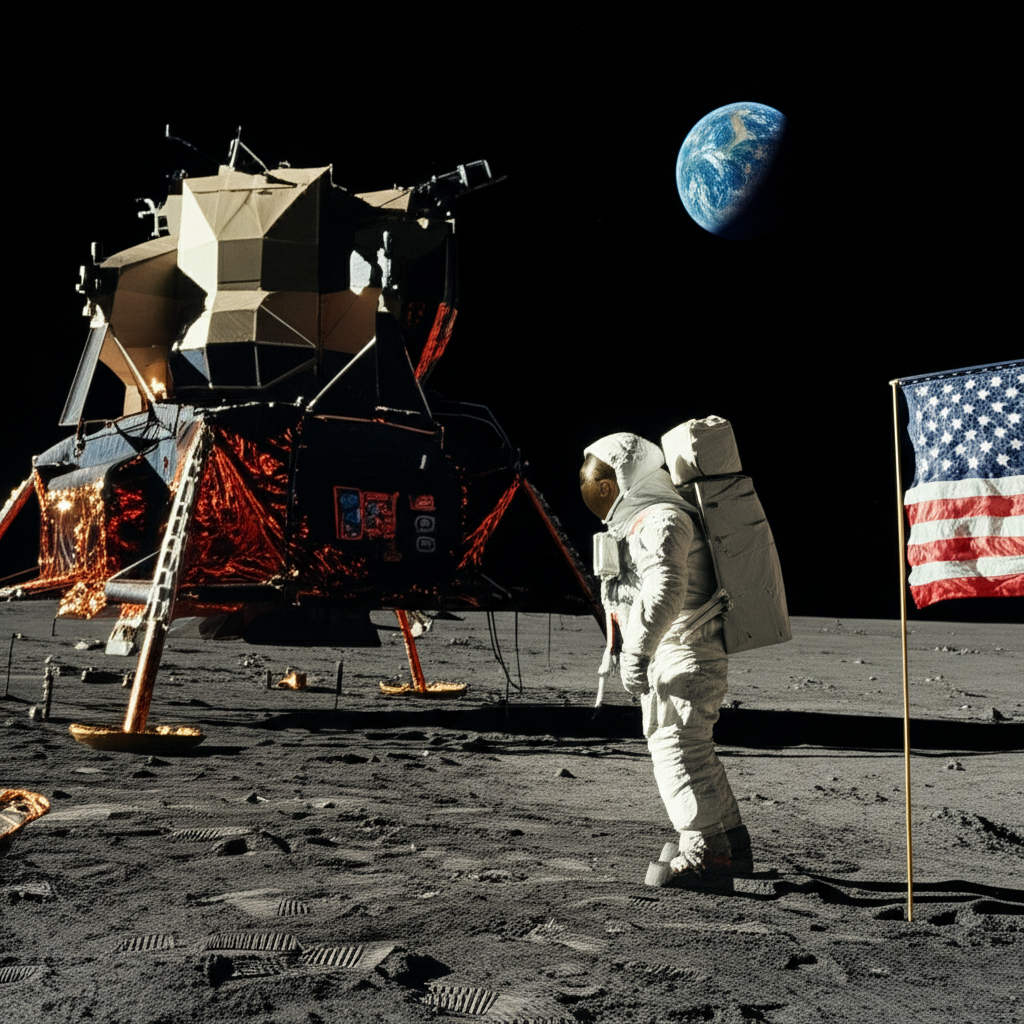
Nineteen minutes later, Aldrin joined him. For about two and a half hours, they explored the immediate vicinity of their landing site, collected over 21 kilograms of lunar rocks and soil samples, conducted scientific experiments, and planted the American flag. The images sent back to Earth – the stark, barren landscape, the footprints in the dust, the reflection of the Earth in Aldrin’s visor – became iconic symbols of human achievement. They also spoke with President Nixon via a historic phone call, further cementing the global significance of their feat.
The Journey Home and Enduring Legacy
After their historic moonwalk, Armstrong and Aldrin re-entered the Eagle, blasted off from the Moon, and successfully redocked with Collins in the Columbia. The trio then began their return journey to Earth, splashing down safely in the Pacific Ocean on July 24, 1969. While the immediate concern upon their return was a brief period of quarantine to ensure no lunar pathogens had been brought back, their reintegration into society marked the beginning of their lives as global heroes.
The first moon landing was far more than a scientific or geopolitical triumph; it was a profound testament to the human spirit. It demonstrated the boundless potential of collective effort, pushing the boundaries of what was thought possible. The technologies developed for the Apollo program spun off into countless innovations that benefit us today, from advanced computer chips to medical imaging. More importantly, it inspired generations to look skyward with a renewed sense of wonder and possibility, reminding us that with enough courage and ingenuity, truly anything is achievable. The legacy of Apollo 11 continues to fuel our ambitions for future space exploration, forever etched as the moment humanity reached for the stars and touched the Moon.
0 Comments