
- The Dawn of Light Detection
- From Simple Patches to The Pit Eye
- The Pinhole Principle: A Glimpse of Resolution
- Introducing The Lens: Sharpening The World
- The Diversity of Vision: Compound and Camera Eyes
- The Compound Eye: A Mosaic of Vision
- The Camera-Type Eye: Convergent Evolution's Marvel
- The Unending Adaptations of Sight
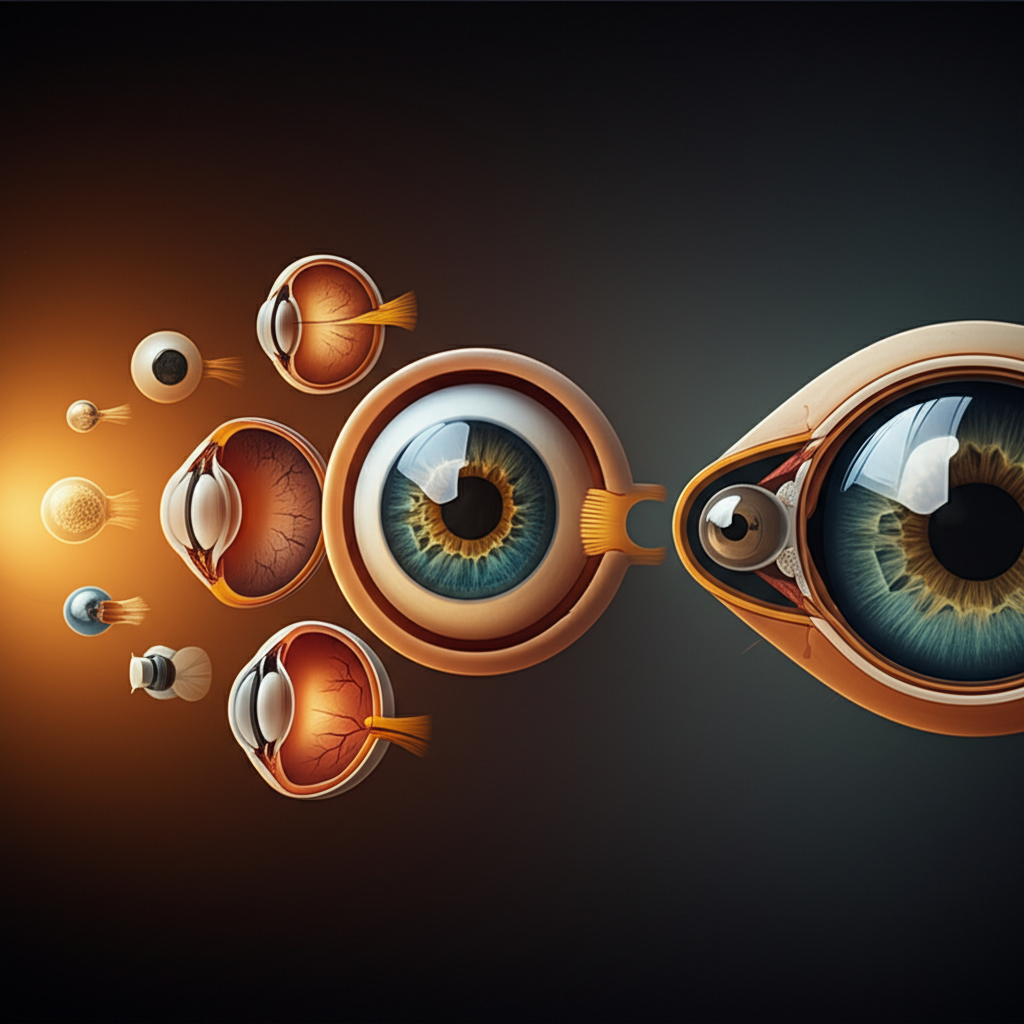
The journey of sight, from its most rudimentary beginnings to the sophisticated organs we possess today, is one of the most captivating narratives in the history of life on Earth. It’s a testament to the relentless power of natural selection, a story spanning hundreds of millions of years, transforming simple sensitivity to light into the breathtaking ability to perceive and interpret a complex visual world. This stunning evolution of the eye showcases incremental improvements accumulating over vast periods, leading to an astonishing array of visual systems perfectly tuned to their environments.
The Dawn of Light Detection
Life on Earth began in a dimly lit, watery world where distinction between light and shadow was a significant advantage. The earliest forms of “sight” weren’t about seeing images, but merely detecting the presence or absence of light. Microbes and early multicellular organisms developed simple photoreceptor cells – specialized cells containing light-sensitive pigments. These cells functioned like basic on/off switches, allowing organisms to differentiate day from night, or sense shadows cast by potential predators. This ability, known as phototaxis, enabled primitive life to navigate towards sunlight for photosynthesis or away from harmful UV radiation, laying the foundational stone for all further visual development.
From Simple Patches to The Pit Eye
The next crucial step involved grouping these photoreceptors into concentrated patches. Imagine a flatworm’s decision-making process: a simple patch of light-sensitive cells might tell it “it’s bright here” or “it’s dark there.” However, with the emergence of pigment cells surrounding these photoreceptors, a nascent form of directional vision began to develop. These pigment cells blocked light from certain angles, effectively creating a crude “eyelid” for individual photoreceptors.
This evolutionary path led to the fascinating innovation of the “pit eye” or “eyecup.” Here, the patch of photoreceptors began to invaginate, forming a shallow depression. This cup-like structure provided an even better sense of direction. Light coming from one angle would hit more photoreceptors than light coming from another, allowing the organism to discern not just light versus dark, but also where the light was coming from. Organisms like the flatworm Planaria still possess pit eyes today, demonstrating the enduring utility of this early visual upgrade.
The Pinhole Principle: A Glimpse of Resolution
As the pit eye deepened and its opening narrowed, it inadvertently stumbled upon a principle that would eventually lead to image formation: the pinhole camera effect. A sufficiently deep pit with a small aperture allows only a narrow beam of light from any given point in the environment to strike the photoreceptive cells at the back of the pit. This filters out scattered light, bringing the incoming light rays into a sharper, albeit dim, focus.
This rudimentary imaging capability was famously realized in the eyes of the Nautilus, a living fossil cephalopod. Its eyes are essentially simple pinhole cameras, perfectly demonstrating how a clear, though low-resolution, image can be formed without a lens. While effective, the trade-off was significant: a small opening meant very little light entered, resulting in poor vision in dim conditions.
Introducing The Lens: Sharpening The World
To overcome the dimness issue of the pinhole eye without sacrificing resolution, a revolutionary innovation was needed: the lens. The evolution of a transparent, light-focusing structure in the eye was a game-changer. It allowed a wider aperture to gather more light, while still bending the light rays to converge sharply onto the photoreceptors, thus creating a bright and clear image.
The initial lenses likely began as simple gelatinous secretions or transparent epidermal cells overlying the eye pit. Over time, these cells became specialized, densely packed with proteins called crystallins, which are highly efficient at refracting light. This process allowed for the development of sophisticated, multi-layered lenses seen in many species today, capable of fine-tuning focus and correcting aberrations.
The Diversity of Vision: Compound and Camera Eyes
From this point, the evolution of the eye branched into incredible diversity, largely falling into two main categories:
The Compound Eye: A Mosaic of Vision
The compound eye, characteristic of arthropods like insects and crustaceans, evolved along a distinctly different path. Instead of a single lens, it consists of hundreds or even thousands of individual light-sensing units called ommatidia. Each ommatidium has its own lens and photoreceptor cells, pointing in a slightly different direction. Together, they form a mosaic-like image.
Compound eyes excel at detecting motion and possess an incredibly wide field of view. Their faceted structure allows for rapid processing of movement, crucial for catching prey or avoiding predators. While they typically offer lower spatial resolution compared to camera-type eyes, their sensitivity to flicker and movement is unparalleled.
The Camera-Type Eye: Convergent Evolution’s Marvel
Perhaps the most familiar and complex eye is the camera-type eye, found in vertebrates (like humans) and cephalopods (like octopuses and squids). This structure, which evolved independently in these two groups – a remarkable example of convergent evolution – features a single, spherical lens that projects an inverted image onto a light-sensitive retina.
The camera-type eye includes an iris to control light entry, muscles to adjust lens shape (in mammals) or position (in fish and cephalopods) for focusing, and a retina packed with millions of specialized photoreceptor cells (rods for dim light, cones for color and detail). The optic nerve then transmits these complex visual signals to the brain for interpretation. This design offers high resolution, excellent color perception, and depth perception – capabilities that have driven the evolutionary success of countless species.
The Unending Adaptations of Sight
The evolutionary journey of the eye didn’t stop with these major breakthroughs. It continued to diversify, adapting to every conceivable ecological niche. Deep-sea fish have enormous, often tubular eyes to capture the scant bioluminescent light. Birds of prey boast incredibly acute vision, capable of spotting a mouse from a mile high. Chameleons possess independently moving eyes, allowing them to survey two different scenes simultaneously. From snakes detecting infrared radiation to mantis shrimp with 12 distinct photoreceptors for color vision, the adaptations are endless and awe-inspiring.
In humans, our binocular, color-sensitive eyes offer depth perception and a rich visual experience, enabling complex interactions with our environment and the creation of culture. Yet, our eyes are not “perfect”; they carry the baggage of their evolutionary history, such as the blind spot where the optic nerve exits.
The evolution of the eye is truly a stunning testament to the power of gradual change. From a simple light-sensitive patch to the intricate camera-like organs that allow us to perceive the beauty and complexity of the world, this journey highlights how life continually reinvents itself, incrementally building marvels from the most basic components. It’s a vivid reminder that some of life’s most profound wonders began with a mere speck of light.
0 Comments