- The Fundamental Principle: Newton's Third Law
- How Thrust is Generated: The Role of Propellants
- Key Components: Beyond the Engine
- How Staging Boosts Efficiency: A Symphony in Motion
- The Simplicity Within the Complexity
How do rockets work? At first glance, the sight of a towering rocket, brimming with complex technology and immense power, might suggest an incredibly intricate mechanism beyond the grasp of the average person. Yet, beneath the layers of advanced engineering and digital precision lies a principle of stunning simplicity, rooted in the fundamental laws of physics. Understanding how these incredible machines defy gravity and propel humanity into space reveals a elegance that makes rocket science truly fascinating.
The Fundamental Principle: Newton’s Third Law
The core of rocket propulsion isn’t magic; it’s pure physics. Specifically, it’s an elegant application of Isaac Newton’s Third Law of Motion: “For every action, there is an equal and opposite reaction.” Imagine standing on a skateboard and throwing a heavy ball forward. As the ball goes forward (the action), you and the skateboard roll backward (the reaction). A rocket operates on precisely this same principle, but instead of throwing a ball, it expels a high-velocity stream of hot gas.
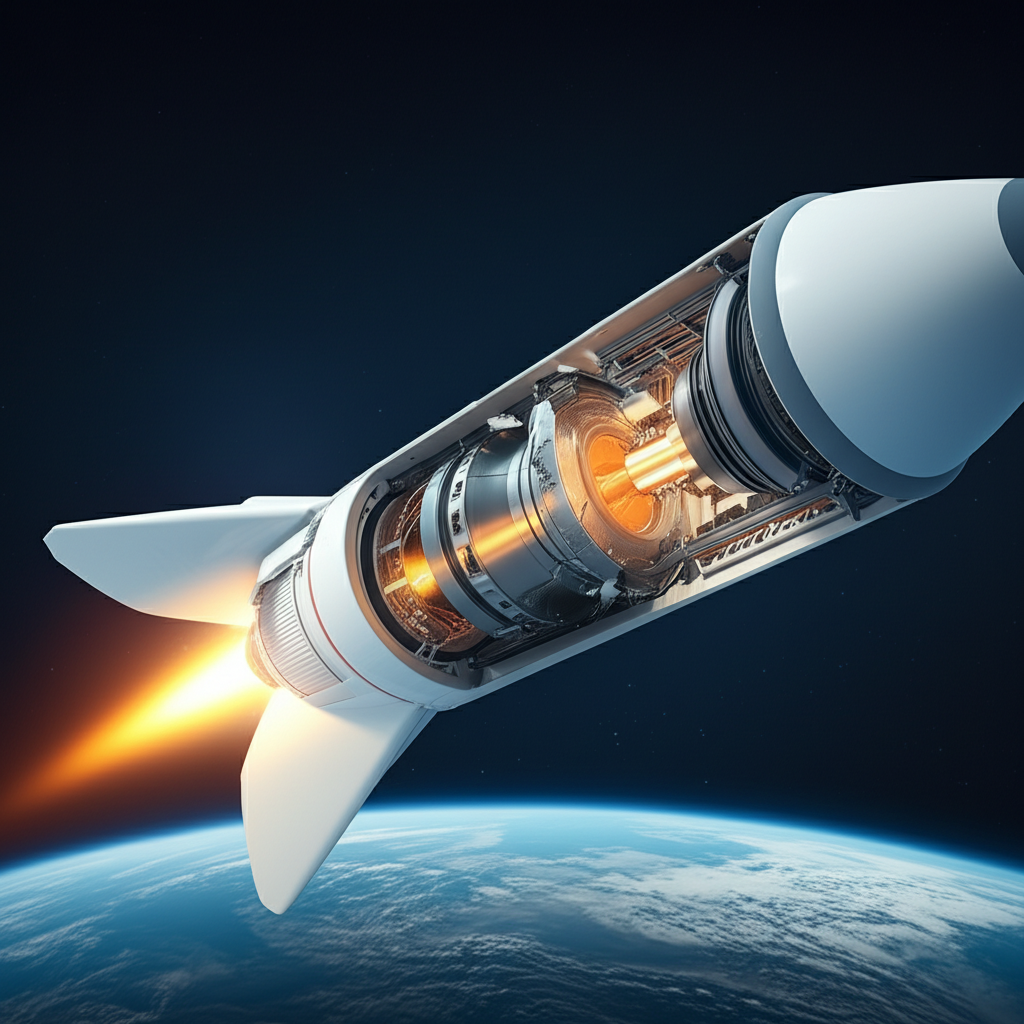
The rocket engine burns fuel and an oxidizer to create extremely hot gases. These gases are then directed out of a precisely shaped nozzle at tremendous speed. The action is the expulsion of these gases downwards (or backward relative to the rocket’s direction of travel). The reaction is an equal and opposite force that pushes the rocket upwards (or forward). This upward push is what we call thrust.
How Thrust is Generated: The Role of Propellants
The efficiency and power of a rocket largely depend on its propellants – the substances that are burned to produce the exhaust gases. Rocket propellants come in two primary forms:
1. Liquid Propellants: These consist of separate fuel (like kerosene or liquid hydrogen) and oxidizer (like liquid oxygen) stored in different tanks. They are pumped into a combustion chamber, mixed, and ignited. Liquid propellants offer excellent control; engines can be throttled up or down, shut off, and even restarted. This makes them ideal for precision maneuvers.
2. Solid Propellants: These are a mixture of fuel and oxidizer pre-mixed into a solid block, similar to gunpowder or fireworks. Once ignited, they burn rapidly until all the propellant is consumed. Solid rockets are simpler in design and very reliable, offering massive initial thrust. However, they cannot be easily throttled or shut off once ignited, making them less flexible for controlled flight.
Regardless of whether they are liquid or solid, the goal is the same: to create a high-pressure, high-temperature gas that can be rapidly expelled. The design of the combustion chamber and nozzle is crucial here. The chamber is where the magic of converting chemical energy into thermal energy happens. The nozzle then acts like a funnel, accelerating these hot gases to supersonic speeds, thus maximizing the reaction force and overall thrust.
Key Components: Beyond the Engine
While the engine is undoubtedly the heart of a rocket, a successful journey into space requires several other critical components working in harmony:
Propellant Tanks: Designed to safely store massive quantities of fuel and oxidizer, often at extreme temperatures (e.g., cryogenic liquid hydrogen and oxygen).
Structure: The rocket’s body, typically made of lightweight yet incredibly strong materials like aluminum alloys or carbon composites, must withstand immense stresses during launch and ascent.
Avionics and Guidance Systems: These are the brains of the rocket. Computers, sensors, gyroscopes, and accelerometers work together to monitor the rocket’s trajectory, attitude, and performance. This system constantly makes tiny adjustments to keep the rocket on its intended path, compensating for winds, gravitational forces, and other disturbances.
Payload Fairing: A protective nose cone that shields the delicate payload (satellites, space probes, crew capsules) from atmospheric drag and heating during the initial ascent through Earth’s atmosphere. It typically jettisons once the rocket is high enough.
Staging Mechanisms: Most large rockets are multi-stage vehicles. This is an ingenious design choice rooted in efficiency. As a rocket climbs, it expends its fuel and the empty tanks and engines become dead weight. By shedding these spent stages, the remaining rocket becomes lighter, requiring less thrust to accelerate further. This dramatically improves overall performance and allows for greater achievable speeds and altitudes.
How Staging Boosts Efficiency: A Symphony in Motion
The launch of a multi-stage rocket is a carefully choreographed event:
1. First Stage Ignition & Liftoff: Large engines ignite, providing the massive initial thrust needed to overcome Earth’s gravity and atmospheric drag.
2. Ascent: As the first stage burns through its propellant, the rocket rapidly gains altitude and speed.
3. Stage Separation: Once the first stage runs out of fuel or reaches a predetermined velocity, it separates and falls back to Earth (often burning up in the atmosphere or being recovered for reuse).
4. Second Stage Ignition: The smaller second stage engines ignite, continuing the acceleration of the now lighter rocket. This stage typically carries the rocket into orbit or sets it on a trajectory for deep space.
5. Payload Deployment: Once the desired orbital altitude or trajectory is reached, the payload fairing opens, and the satellite, spacecraft, or crew capsule is released.
This hierarchical approach to propulsion allows rockets to achieve speeds and altitudes that would be impossible for a single-stage vehicle of the same size. It’s an elegant solution to the problem of carrying fuel to burn fuel.
The Simplicity Within the Complexity
While the engineering challenges of building rockets are undeniably immense—requiring mastery of thermodynamics, fluid dynamics, materials science, and computer control—the underlying principle remains beautifully simple. It’s about violently pushing matter in one direction to move in the opposite direction. The complexity comes from how* engineers achieve this with incredible precision, power, and reliability, optimizing every atom of fuel and every ounce of thrust to send payloads safely and accurately to their destinations.
From the first rudimentary firecrackers to the mighty Saturn V and Falcon Heavy, the journey of rocketry is a testament to human ingenuity in harnessing basic physical laws. It reminds us that even the most awe-inspiring feats of science and engineering often have their roots in readily understandable concepts, proving that sometimes, the most stunning advancements spring from the most profound simplicity.
0 Comments