
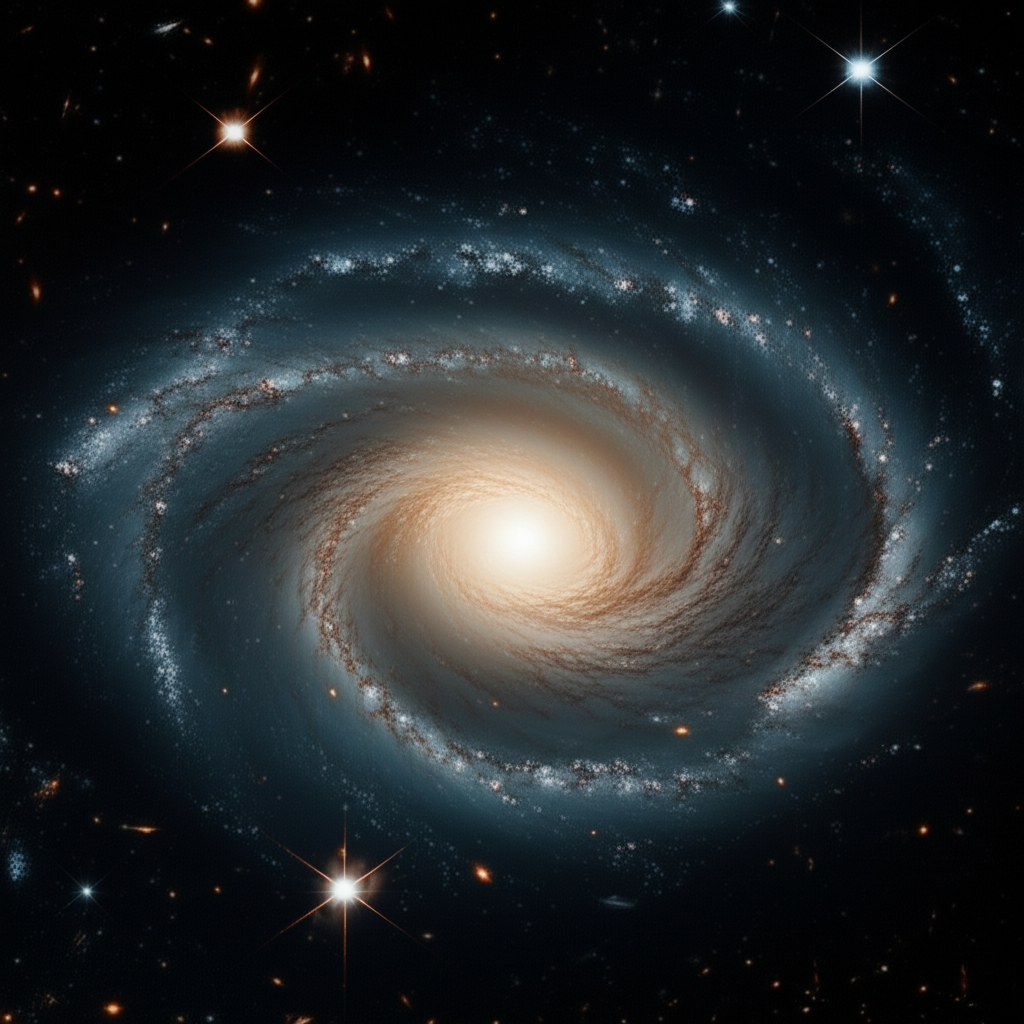
- Unveiling the Universe's Hidden Component
- The Compelling Evidence for Dark Matter
- The Hunt for Dark Matter Candidates
- The Global Search for Direct Detection
- The Indomitable Spirit of Inquiry
The universe is an intricate tapestry woven from visible matter, energy, and forces we understand relatively well. Yet, an overwhelming majority of its mass remains cloaked in an impenetrable veil of mystery: dark matter. This elusive substance, which we cannot directly observe, touch, or interact with ordinary matter except through gravity, holds the key to unlocking some of the cosmos’ most profound secrets. Scientists have spent decades piecing together its enigmatic existence through indirect observations, leading to a sprawling scientific quest that promises to revolutionize our understanding of the universe’s fundamental composition and evolution.
Unveiling the Universe’s Hidden Component
At its core, dark matter is precisely what its name suggests: “dark” because it emits no light or energy, making it invisible to telescopes, and “matter” because it possesses mass and exerts gravitational pull. This unseen entity is estimated to make up about 27% of the universe’s total mass-energy content, dwarfing the mere 5% attributed to the ordinary, baryonic matter that forms stars, planets, and ourselves. The remaining 68% is dark energy, an even more mysterious force accelerating the universe’s expansion. Our existence, therefore, is but a fleeting flicker in a cosmos largely dominated by the unseen.
The concept of dark matter first emerged in the 1930s when Swiss astronomer Fritz Zwicky observed that galaxies within the Coma Cluster were moving too fast to be held together solely by the gravitational pull of their visible matter. He hypothesized a significant amount of “dunkle Materie” (dark matter) must be present. Decades later, Vera Rubin’s meticulous studies of galaxy rotation curves in the 1970s provided compelling confirmation: the outer regions of spiral galaxies were rotating at speeds that defied the observable mass, indicating a vast, invisible halo of matter extending far beyond their visible edges.
The Compelling Evidence for Dark Matter
While we still haven’t directly detected dark matter, the cumulative weight of observational evidence for its existence is overwhelming and comes from multiple independent lines of inquiry:
Galactic Rotation Curves: As Zwicky and Rubin discovered, galaxies rotate in a way that suggests they contain far more mass than can be accounted for by the stars, gas, and dust we can see. Without a halo of invisible dark matter, galaxies would simply fly apart.
Gravitational Lensing: Massive objects, including galaxy clusters, are known to bend the fabric of spacetime, a phenomenon predicted by Einstein’s theory of relativity. This bending acts like a cosmic lens, distorting the light from background objects. Observations of gravitational lensing around galaxy clusters reveal a mass distribution that far exceeds the visible matter, pointing directly to substantial amounts of dark matter.
The Cosmic Microwave Background (CMB): This ancient light, a relic from the early universe, provides a snapshot of the cosmos just 380,000 years after the Big Bang. Precise measurements of tiny temperature fluctuations in the CMB reveal the conditions necessary for the large-scale structure of the universe to form. These patterns are consistent only if dark matter was present in significant quantities, acting as a gravitational scaffold for ordinary matter to clump together and form galaxies and clusters.
Structure Formation: Dark matter is crucial for understanding how galaxies and galaxy clusters formed. In the early universe, ordinary matter was too hot and energetic to coalesce efficiently into large structures on its own. Dark matter, being non-interactive and “cold” (moving slowly), provided the gravitational seeds around which ordinary matter could accumulate and eventually form the cosmic web we observe today. Without dark matter, the universe would be a much more uniform and less structured place.
The Hunt for Dark Matter Candidates
Given the robust evidence for dark matter, scientists are actively pursuing various hypotheses regarding its composition. The leading candidates are exotic, non-baryonic particles that interact weakly, if at all, with ordinary matter and light:
Weakly Interacting Massive Particles (WIMPs): For decades, WIMPs were the hypothetical frontrunners. These particles are predicted to be much heavier than protons and to interact with ordinary matter only through gravity and the weak nuclear force. Despite extensive searches, including experiments like XENONnT and LUX-ZEPLIN, no definitive WIMP signal has been detected, leading some to explore other avenues.
Axions: These extremely light particles are proposed as a solution to a problem in quantum chromodynamics (QCD), the theory describing the strong nuclear force. If they exist, axions would be far less massive than WIMPs but could still contribute significantly to the universe’s dark matter budget. Experiments like ADMX are actively searching for these elusive particles.
Sterile Neutrinos: Unlike the “active” neutrinos we know, which interact via the weak force, sterile neutrinos would only interact gravitationally. They could be a potential dark matter candidate if they possess a small mass.
Primordial Black Holes: While largely ruled out for the majority of dark matter, some theories suggest that tiny, primordial black holes, formed shortly after the Big Bang, could constitute a fraction of the dark matter.
The Global Search for Direct Detection
The quest to identify dark matter particles is a global endeavor involving a variety of cutting-edge experiments. Direct detection experiments, often located deep underground to shield them from cosmic rays, aim to observe the rare interaction of a dark matter particle with an atomic nucleus in a highly purified detector. Indirect detection experiments search for the annihilation or decay products of dark matter particles, such as gamma rays or neutrinos, from dense regions of space like the galactic center or dwarf galaxies. Finally, particle accelerators like the Large Hadron Collider (LHC) at CERN attempt to produce dark matter particles in high-energy collisions, though this has yet to yield definitive results.
The stakes are incredibly high. A direct detection of a dark matter particle would not only solve one of the greatest mysteries in cosmology but also usher in a new era of particle physics, potentially revealing entirely new forces or dimensions. It would reshape our understanding of quantum mechanics, relativity, and the fundamental building blocks of existence itself.
The Indomitable Spirit of Inquiry
Despite the challenges and the lack of a definitive answer so far, the scientific community remains resolute. New theoretical models are constantly being developed, and more sensitive experiments are being designed, pushing the boundaries of technology and human ingenuity. The journey to unveil dark matter’s true nature is an enduring testament to humanity’s insatiable curiosity and our relentless pursuit of knowledge. While the ultimate dark matter secrets remain largely hidden, each new experiment and observation brings us closer to painting a complete picture of the cosmos, promising revelations that will undoubtedly redefine our place within it.
0 Comments