
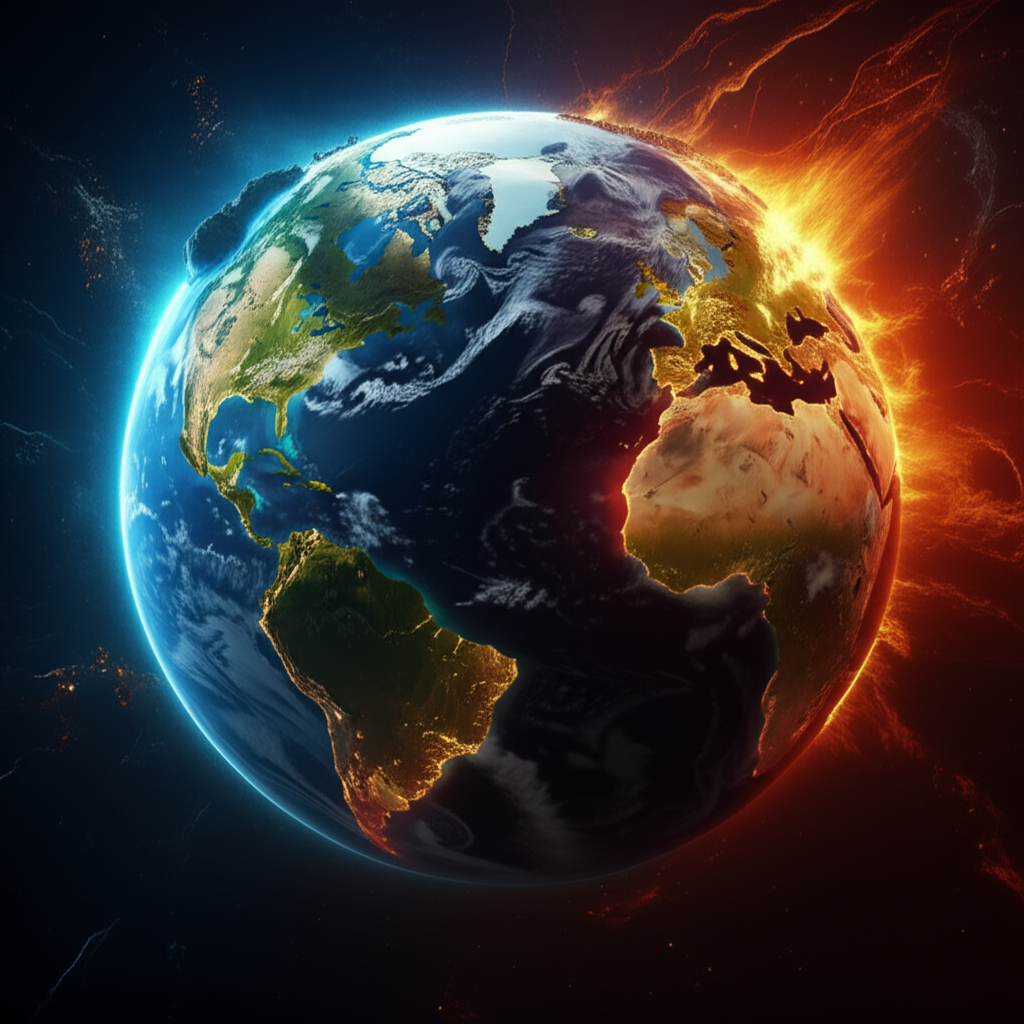
- The Earth's Fiery Cradle: Setting the Stage for Continents
- How Plate Tectonics Orchestrates Continental Formation
- From Scattered Scraps to Grand Landmasses: The Accretion Process
- The Supercontinent Saga: A Cycle of Assembly and Rupture
- Witnessing the Evidence: Proving the Continental Drift
- The Ongoing Dance: Continents in Motion Today
How the majestic landmasses we call continents came to be is a story far more dramatic and dynamic than static maps suggest—a stunning true tale spanning billions of years, driven by the fiery heart of our planet. From a molten, uninhabitable sphere to the vibrant, diverse world we know, Earth’s continents have undergone an extraordinary journey of formation, collision, and relentless reshaping. Understanding this process unveils the fundamental mechanisms that govern our planet’s very existence.
The Earth’s Fiery Cradle: Setting the Stage for Continents
In its infancy, Earth was a turbulent, molten rock, bombarded by asteroids and radiating intense heat. As it slowly cooled, a thin skin of solid rock began to form on its surface—the Earth’s first crust. Initially, much of this was oceanic crust, basaltic in composition, dense, and relatively thin. But the conditions were ripe for something grander. Water, outgassed from volcanoes and delivered by comets, accumulated to form the early oceans, creating a vital interface with the fledgling crust.
Beneath this initial crust, immense convective currents churned in the semi-molten mantle, slowly but powerfully dragging and tearing at the surface. This fundamental process, known as plate tectonics, is the unseen orchestrator behind continental formation. The Earth’s lithosphere, its rigid outer layer comprising the crust and uppermost mantle, is not a single, unbroken shell but is fragmented into numerous colossal plates. These plates ceaselessly move—colliding, pulling apart, and sliding past one another—at speeds comparable to the growth of a fingernail, but with geological consequences beyond imagination.
How Plate Tectonics Orchestrates Continental Formation
The formation of buoyant continental crust, which is thicker and less dense than oceanic crust, is a complex tale of differentiation and accumulation, largely driven by subduction. When an oceanic plate, laden with water-rich sediments, is forced beneath another plate (either oceanic or continental) into the mantle, it begins to melt. However, not everything melts uniformly. The lighter, more silica-rich components tend to melt first, rising as magma through the overlying plate to form volcanic arcs. Over eons, the repeated eruption and intrusion of this differentiated magma creates new, lighter, and more silicic crust—protocontinents or island arcs.
These island arcs, akin to modern-day Japan or the Aleutian Islands, slowly grow. With continued subduction, they may eventually collide with larger landmasses or other arcs, accreting new material and forming more extensive continental crust. This “accretion” effectively stitches smaller pieces of crust together, adding them to the margins of existing continents, much like adding new fabric to a growing quilt. This process is evident in mountain ranges like the North American Cordillera, which incorporates many terrains that originally formed far out in the Pacific Ocean before being “welded” onto the continent.
From Scattered Scraps to Grand Landmasses: The Accretion Process
The growth of continents isn’t just about volcanoes; it’s also about a geological dance of assembly. As plates move, microcontinents—smaller, isolated blocks of continental crust—and entire island arcs can be transported across vast oceans. When they encounter the edge of a larger continent at a convergent plate boundary, they don’t necessarily subduct. Instead, their buoyancy often prevents them from sinking, causing them to “dock” or “accrete” onto the existing landmass. This process adds new material to the continental margin, widening and thickening the continent over geological time.
The most spectacular display of continental construction occurs when two large continental plates collide. Because continental crust is too buoyant to subduct significantly, these confrontations result in immense compressional forces that buckle, fold, and uplift vast swathes of rock, creating towering mountain ranges. The Himalayas, the world’s highest mountains, are a prime example, formed by the ongoing collision between the Indian and Eurasian plates. This monumental clash continues to sculpt the Earth’s surface, demonstrating the incredible power of plate tectonics.
The Supercontinent Saga: A Cycle of Assembly and Rupture
The history of Earth’s continents isn’t just one of growth but also a cyclical pattern of assembly and dispersal known as the supercontinent cycle. Over hundreds of millions of years, continents drift, collide to form a single, enormous supercontinent (like Pangaea, which formed about 335 million years ago), only to later rift apart and drift away again. Evidence suggests that at least three such supercontinents—Columbia (or Nuna), Rodinia, and Pangaea—have formed and broken up over Earth’s history.
This cycle profoundly impacts global climate, ocean currents, and biological evolution. When continents are assembled into a supercontinent, landmasses are concentrated, influencing atmospheric circulation patterns and creating vast arid interiors. When they rift apart, new ocean basins form, altering ocean currents and promoting biodiversity through increased coastal shelf environments. Each iteration of this cycle leaves its indelible mark on the geological record, providing clues to Earth’s ancient past.
Witnessing the Evidence: Proving the Continental Drift
The remarkable theory of continental drift, first proposed by Alfred Wegener in the early 20th century, faced initial skepticism. However, decades of accumulating evidence have firmly established the validity of plate tectonics as the mechanism behind it. Matching fossil distributions across now-separate continents, the jigsaw-puzzle fit of continental margins, identical rock formations and mountain ranges found on different continents, and paleomagnetic data showing the wandering of Earth’s magnetic poles all provided compelling geological clues.
Modern technologies like GPS confirm that continents are indeed still moving today, albeit imperceptibly to our senses. Scientists can precisely measure the tiny shifts and drifts of different landmasses year by year, providing real-time validation of this grand, slow-motion ballet that has shaped our planet.
The Ongoing Dance: Continents in Motion Today
The story of continental formation is far from over. The continents continue their stately dance across the globe. Africa is slowly splitting along the East African Rift Valley, destined to create a new ocean basin over tens of millions of years. Australia is inexorably moving northwards towards Asia, and the Pacific Ocean is gradually shrinking as its oceanic plates are consumed beneath the surrounding continents.
The land beneath our feet is not static but a constantly evolving tapestry woven by the immense forces within the Earth. Each mountain range, each earthquake, each volcanic eruption is a testament to the dynamic nature of our planet and the stunning, true story of how continents formed, continue to evolve, and will forever reshape the face of Earth.
0 Comments