
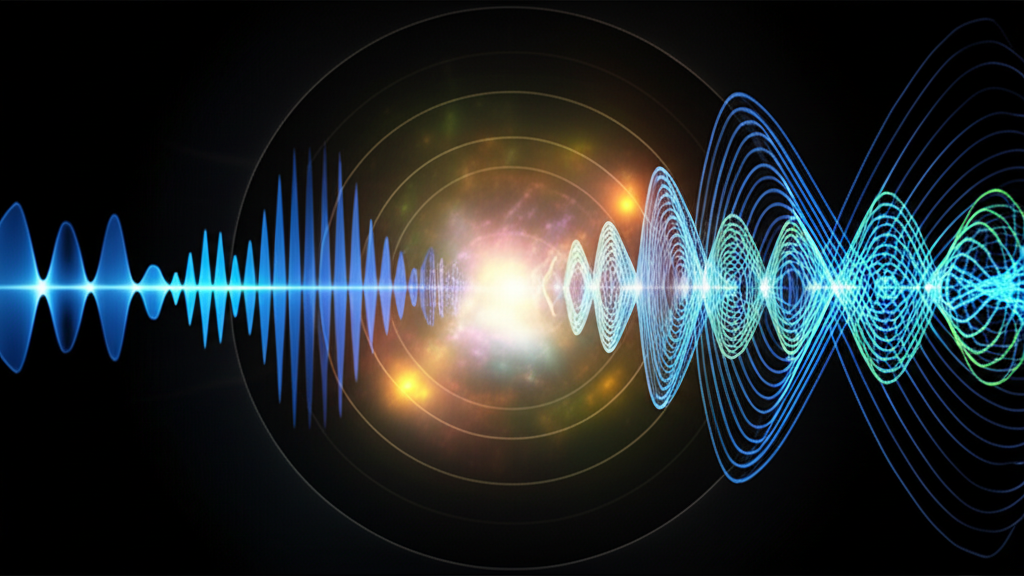
The baffling wave-particle duality stands as one of the most perplexing yet fundamental concepts in quantum mechanics. It challenges our everyday intuition and classical understanding of reality, suggesting that the very fabric of existence at the subatomic level behaves in ways that are both counter-intuitive and profoundly insightful. Far from being a mere abstract theoretical construct, this duality underpins much of modern physics and has revealed truths about the universe that continue to inspire awe and fuel scientific inquiry.
For centuries, scientists debated the nature of light. Isaac Newton championed a particle theory, envisioning light as tiny corpuscles. However, experiments by Christiaan Huygens and later Thomas Young’s famous double-slit experiment demonstrated light’s wave-like properties, exhibiting interference patterns characteristic of waves. James Clerk Maxwell’s electromagnetic theory solidified light’s identity as an electromagnetic wave traveling through space. The particle theory seemed relegated to history.
Then, at the turn of the 20th century, a new series of observations began to unravel this neat picture. Max Planck introduced the idea that energy is quantized, meaning it comes in discrete packets. Albert Einstein then famously explained the photoelectric effect – where light striking a metal surface ejects electrons – by proposing that light itself consists of individual energy packets, or “quanta,” which he later called photons. These photons behaved distinctly like particles. How could light be both a wave and a particle? This was the initial puzzle.
What Exactly Does Duality Mean?
In essence, wave-particle duality posits that every particle or quantum entity may be described as either a particle or a wave. It is not that it is sometimes one and sometimes the other, but rather that it possesses properties of both simultaneously, manifesting as one or the other depending on how it is measured or observed.
The classic demonstration of this phenomenon is the double-slit experiment for both light and matter. When a beam of light is shone through two narrow slits, it creates an interference pattern on a screen behind it – a clear sign of wave-like behavior. The waves superpose, canceling out in some places and reinforcing in others. However, if detectors are placed at the slits to determine which slit each photon passes through, the interference pattern disappears, and the photons behave like distinct particles, passing through one slit or the other, resulting in two distinct bands. The act of observation seems to “collapse” the wave function into a particle state.
Remarkably, in 1924, Louis de Broglie hypothesized that this duality wasn’t limited to light; all matter should also exhibit wave-like properties. While imperceptible for macroscopic objects due to their extremely short wavelengths, this was experimentally confirmed for electrons in 1927 by Davisson and Germer. Electrons, previously thought of solely as tiny particles, were shown to produce interference patterns, behaving like waves. This meant that protons, neutrons, atoms, and even molecules also possess wave characteristics.
The Profound Implications of Wave-Particle Duality
The implications of this duality are vast and fundamentally reshape our understanding of the universe. It necessitates a probabilistic rather than deterministic view of reality at the quantum scale, where particles exist in a superposition of states until measured.
1. Redefining Reality: The observer’s role becomes crucial. Before measurement, a particle’s properties (like its position or momentum) are not fixed but exist as a range of probabilities, described by a wave function. The act of measurement forces the wave function to “collapse,” yielding a definite outcome. This suggests that reality as we know it is not entirely independent of observation, a mind-bending concept that continues to provoke philosophical debate.
2. Technological Marvels: Far from being an abstract curiosity, wave-particle duality is the bedrock of many modern technologies. Electron microscopes, for instance, exploit the wave nature of electrons to achieve much higher resolutions than optical microscopes, allowing us to visualize structures as small as individual atoms. Lasers rely on photons (particles of light) interacting with electrons in specific quantum ways. The emergent field of quantum computing leverages principles like superposition (a direct consequence of wave-like probability) to perform calculations far beyond the capabilities of classical computers.
3. Heisenberg’s Uncertainty Principle: Directly linked to wave-particle duality, Werner Heisenberg’s Uncertainty Principle states that one cannot simultaneously know with perfect precision both the position and the momentum of a particle. If we try to pinpoint a particle’s position (treating it as a localized particle), its wave properties become more spread out, making its momentum uncertain, and vice versa. This isn’t a limitation of our measuring instruments but a fundamental property of nature.
4. A Unified Field of Physics: Wave-particle duality bridges the classical divide between energy and matter. It shows that at the most fundamental level, there’s a deep interconnectedness, blurring the lines that once seemed absolute. This concept is a cornerstone of quantum field theory, where particles are understood as excitations of underlying quantum fields.
Beyond the Baffling: Continued Exploration
While the wave-particle duality remains profoundly counter-intuitive from a classical perspective, its consistent experimental verification solidifies its status as a cornerstone of quantum mechanics. It has forced physicists to abandon the comfortable certainties of classical physics and embrace a world governed by probabilities, observations, and an inherent fuzziness at its core.
The journey to comprehending wave-particle duality has not ended. Scientists continue to push the boundaries, performing experiments on larger and more complex molecules to observe their wave-like properties, aiming to understand the transition from the quantum world to the classical world we experience daily. The insights revealed by this baffling phenomenon are not just theoretical curiosities; they are foundational truths that have reshaped our understanding of the cosmos and continue to propel scientific and technological advancement into an ever more fascinating future.
0 Comments