
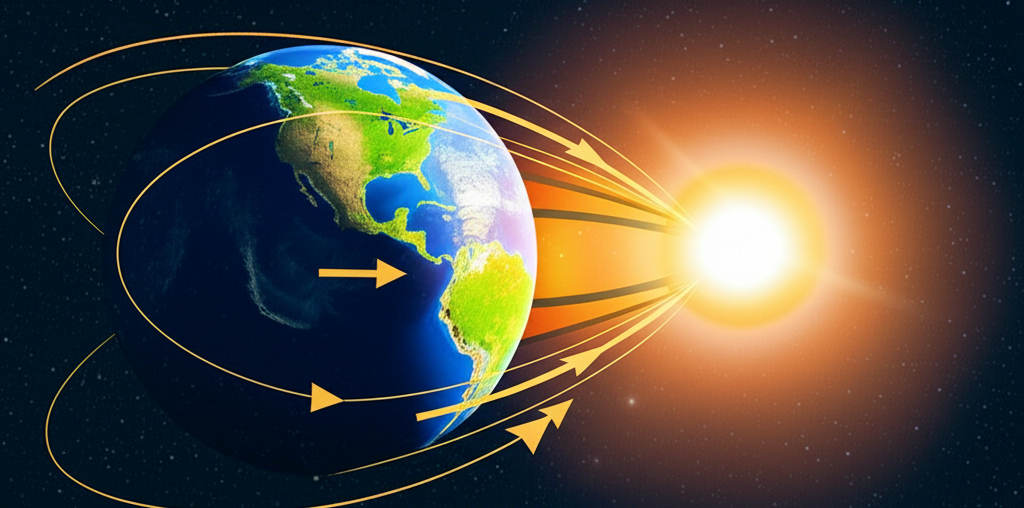
- Debunking the Distance Myth: It's Not About How Close We Are
- The Real Game Changer: Earth's Axial Tilt
- Why the Tilt Matters: Decoding Sunlight's Angle and Duration
- The Solstices and Equinoxes: Milestones in Earth's Journey
- A Continuous Cycle, A Constant Tilt
Why do seasons change? It’s a question that has puzzled humanity for millennia, inspiring myths, scientific inquiry, and countless poems celebrating the annual shift. From the vibrant rebirth of spring to the sun-drenched days of summer, the crisp hues of autumn, and the quiet slumber of winter, these cyclical transformations are fundamental to life on Earth. Yet, the precise reasons behind this predictable dance often get muddled in popular understanding. Many people mistakenly believe that our planet’s varying distance from the sun dictates whether we experience warmth or cold. However, the true explanation, while seemingly counterintuitive, is elegantly simple and revolves around a specific celestial characteristic: Earth’s axial tilt.
Debunking the Distance Myth: It’s Not About How Close We Are
Before diving into the actual mechanics, let’s address the most common misconception head-on. The idea that Earth is closer to the sun in summer and farther away in winter seems logical at first glance. If you live in the Northern Hemisphere, you might notice that our planet is actually closest to the sun (a point called perihelion) in early January, right in the middle of winter! Conversely, Earth is farthest from the sun (aphelion) in early July, during the Northern Hemisphere’s summer.
This fact alone should tell us that distance isn’t the primary driver of temperature changes. Furthermore, if distance were the key, then the entire planet would experience the same season at the same time. But we know this isn’t true: when it’s summer in Canada, it’s winter in Australia. This stark contrast points to a localized rather than universal cause, steering us away from the orbit’s slight eccentricity as the main culprit. While Earth’s elliptical orbit does cause a minor variation in incoming solar radiation, its effect on seasonal temperatures is negligible compared to the true hero of our story: the tilt.
The Real Game Changer: Earth’s Axial Tilt
The fundamental reason for the change in seasons is that Earth is tilted on its axis relative to its orbital plane around the sun. Imagine a spinning top that isn’t perfectly upright but leans slightly. Earth does the same, maintaining a constant tilt of approximately 23.5 degrees. This tilt doesn’t change as Earth orbits the sun; instead, our planet’s axis always points towards the same spot in space, roughly towards Polaris, the North Star.
It’s this consistent tilt, combined with Earth’s annual journey around the sun, that brings about the cycle of seasons. As Earth makes its year-long revolution, different parts of our planet are exposed to varying amounts of direct sunlight, and for differing durations.
Why the Tilt Matters: Decoding Sunlight’s Angle and Duration
The 23.5-degree tilt profoundly impacts two critical factors that determine temperature: the angle at which sunlight strikes the Earth’s surface and the length of daylight hours.
1. Directness of Sunlight (Solar Angle):
When a hemisphere is tilted towards the sun, the sun’s rays hit that part of the Earth more directly. Think about holding a flashlight directly over a spot versus shining it at an angle. Direct light concentrates its energy over a smaller area, making it more intense and warming the surface more effectively. This translates to summer. Conversely, when a hemisphere is tilted away from the sun, the sun’s rays strike it at a more oblique or glancing angle. This spreads the same amount of solar energy over a larger area, reducing its intensity and leading to cooler temperatures—this is winter.
2. Length of Daylight Hours:
The tilt also dictates how long the sun remains above the horizon each day. When a hemisphere is tilted towards the sun, locations within that hemisphere experience longer days and shorter nights. More hours of daylight mean more time for the sun to heat the ground, contributing significantly to warmer summer temperatures. In contrast, when a hemisphere is tilted away from the sun, it experiences shorter days and longer nights. Fewer hours of sunlight mean less opportunity for heating, resulting in colder winter temperatures. This effect is most dramatically seen at the poles, where summer brings continuous daylight and winter plunges them into months of darkness.
The Solstices and Equinoxes: Milestones in Earth’s Journey
As Earth travels around the sun, four key points mark the transitions between seasons:
Summer Solstice (around June 21st in the Northern Hemisphere, December 21st in the Southern): This is when one hemisphere is tilted most directly towards the sun, receiving maximum direct sunlight and experiencing its longest day.
Winter Solstice (around December 21st in the Northern Hemisphere, June 21st in the Southern): At this point, one hemisphere is tilted farthest away from the sun, receiving the most indirect sunlight and enduring its shortest day.
* Vernal (Spring) and Autumnal (Fall) Equinoxes (around March 20th and September 22nd, respectively): During these times, Earth’s tilt is neither towards nor away from the sun. The sun is directly over the equator, resulting in roughly equal day and night length for nearly all locations on Earth. These are transitional periods, mediating between the extremes of summer and winter.
It’s important to remember that the seasons don’t change instantaneously on these dates, but rather transition gradually over weeks, as our planet continues its slow, steady journey around its star.
A Continuous Cycle, A Constant Tilt
The elegance of the seasonal change lies in its consistency. Earth’s tilt remains fixed in space, maintaining its 23.5-degree lean relative to its orbit. It doesn’t wobble significantly on a yearly basis (though there is a very slow, long-term wobble called precession over thousands of years). It’s this steadfast lean combined with the continuous orbit around the sun that ensures the predictable cycle of spring, summer, autumn, and winter, year after year.
From the lush growth spurred by summer’s warmth to the dormancy that protects life through winter, the changing seasons are a testament to the elegant physics governing our planet. Understanding this cosmic dance not only satisfies our curiosity but also deepens our appreciation for the intricate natural world we inhibit, shaping everything from weather patterns and crop cycles to animal migrations and human cultures across the globe. The seasons aren’t just a backdrop to our lives; they are a fundamental part of Earth’s identity, effortlessly explained by a simple, persistent lean.
0 Comments