Why Dinosaurs Vanished: Unraveling the Tragic Mystery
Why is it that creatures who dominated Earth for over 160 million years seemingly disappeared overnight? The sudden and dramatic demise of the dinosaurs, approximately 66 million years ago at the end of the Cretaceous period, remains one of the most compelling and tragic mysteries in Earth’s history. For decades, scientists have pieced together clues from rocks, fossils, and geological formations, leading us closer to understanding not just the how, but the profound why behind this cataclysmic event that reshaped the entire planet and paved the way for the rise of mammals, including ourselves.
The Reign Before Ruin: Life in the Late Cretaceous
Before their fateful end, dinosaurs were the undisputed behemoths of the Mesozoic Era. From the towering long-necked sauropods to the ferocious Tyrannosaurus Rex and the agile Velociraptors, diverse species thrived across lush continents. Pterosaurs soared through the skies, and marine reptiles like mosasaurs ruled the oceans. The Earth was a different place – warmer, with higher sea levels and vast forests. Life was complex, interconnected, and seemingly stable, giving little indication of the impending catastrophe that would utterly transform its trajectory. The sheer scale and longevity of their reign make their abrupt disappearance all the more astonishing.
The Cataclysmic Impact: An Asteroid’s Deadly Kiss
For much of the 20th century, the extinction of the dinosaurs was a puzzle with many speculative answers, often involving slow environmental changes. However, a groundbreaking discovery in 1980 by physicist Luis Alvarez and his son, geologist Walter Alvarez, revolutionized our understanding. They found an unusually high concentration of iridium – a rare element on Earth but common in asteroids – in a geological layer dating precisely to the time of the dinosaur extinction. This iridium layer, found globally, strongly suggested an extraterrestrial impact.
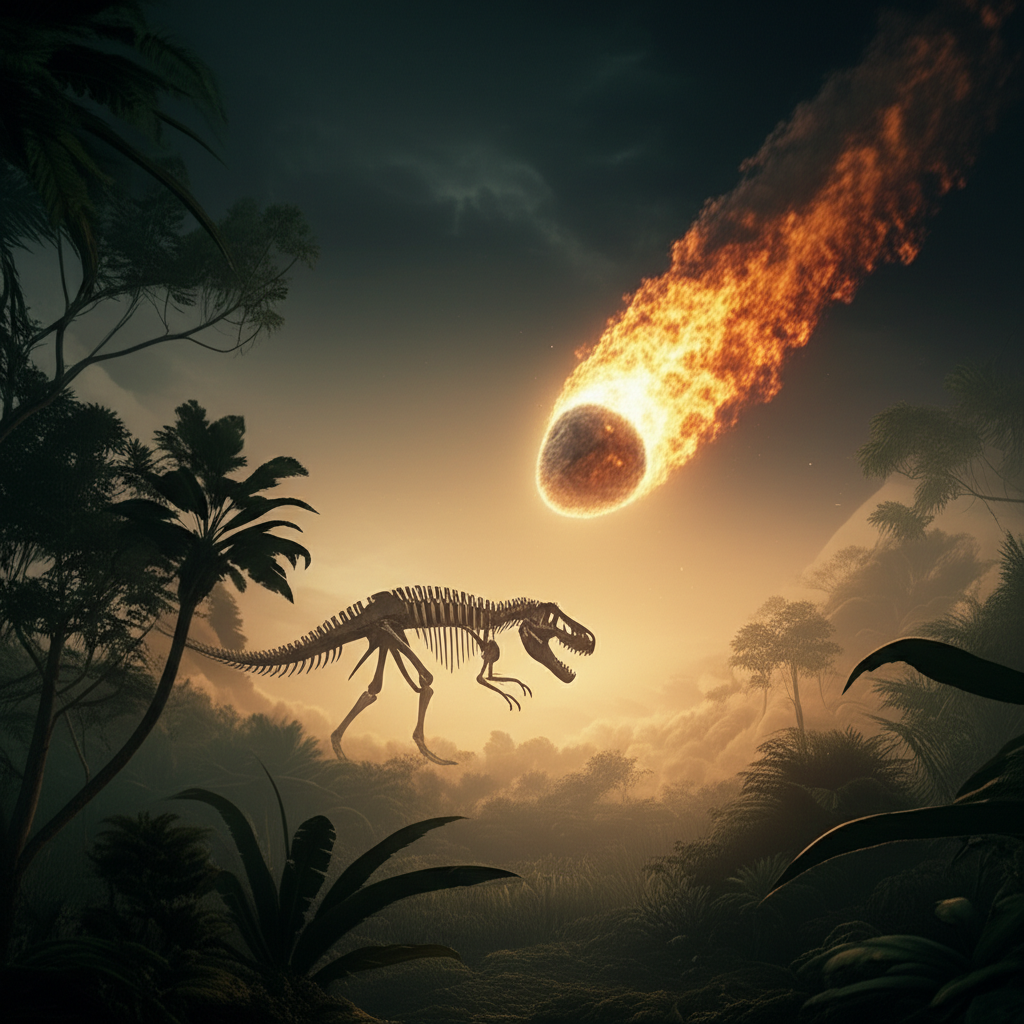
Further research eventually led to the identification of the Chicxulub crater, a massive 180-kilometer-wide impact structure buried beneath the Yucatán Peninsula in Mexico. Scientists now widely agree that a colossal asteroid, perhaps 10 to 15 kilometers in diameter, slammed into Earth with unimaginable force.
The immediate aftermath was apocalyptic. Gigantic tsunamis swept across coastlines, earthquakes rocked continents, and superheated debris rained down globally, igniting massive wildfires that scorched vast expanses of vegetation. But the real killer blow came later. The impact ejected trillions of tons of dust, ash, and sulfates into the atmosphere, creating a dense, opaque cloud that enveloped the planet. This global shroud blocked out sunlight, plunging the Earth into a prolonged period of “impact winter.” Photosynthesis ground to a halt, causing a collapse of the food chain from the bottom up. Herbivorous dinosaurs starved, followed by the carnivores dependent on them. Acid rain, caused by sulfur released into the atmosphere, further devastated ecosystems.
The Volcanic Counterpoint: The Deccan Traps Eruptions
While the asteroid impact is the prime suspect, some scientists argue that it wasn’t the sole perpetrator. Another significant geological event occurred around the same time: the colossal eruptions of the Deccan Traps in what is now India. For hundreds of thousands of years leading up to, and continuing after, the asteroid impact, immense volumes of lava poured out, creating vast flood basalt plains.
These eruptions released enormous quantities of greenhouse gases like carbon dioxide, potentially leading to long-term global warming. However, they also spewed sulfur dioxide and other aerosols into the atmosphere, which can have an initial cooling effect, followed by acid rain. It’s plausible that this prolonged volcanic activity had already stressed global ecosystems, altering climates, acidifying oceans, and disrupting food webs, making life on Earth more vulnerable to the final asteroid blow. Some theories suggest the asteroid impact might have even triggered an increase in the intensity of the Deccan Traps eruptions, creating a deadly one-two punch.
Why Some Species Survived: A Coincidence or Adaptation?
Given the scale of destruction, a natural question arises: why did some species survive while the mighty dinosaurs perished? The extinction event was undeniably catastrophic, wiping out about 75% of all plant and animal species on Earth. However, it wasn’t a complete annihilation.
Survivors often shared certain characteristics:
Smaller Size: Smaller animals generally require less food and can adapt to resource scarcity more easily.
Generalist Diets: Omnivores and scavengers had a better chance than highly specialized herbivores or carnivores.
Aquatic or Burrowing Lifestyles: Animals living in water or underground were somewhat insulated from the immediate heat, fires, and atmospheric dust.
Seed-Eating: Many plants survived as seeds, which could lie dormant and sprout once conditions improved, providing food for seed-eating animals.
Mammals, birds, and many amphibians, reptiles (like snakes, lizards, and turtles), and fish managed to weather the storm. Mammals, in particular, were often small, nocturnal, and capable of burrowing, allowing them to scavenge for food and avoid the worst of the surface devastation during the impact winter. This select survival laid the groundwork for an entirely new chapter in Earth’s biodiversity.
A Perfect Storm of Catastrophe
Ultimately, the vanishing of the dinosaurs was likely not due to a single cause but rather a “perfect storm” of catastrophic events. The asteroid impact delivered the decisive blow, triggering an ecological collapse on an unprecedented scale. However, the existing environmental stresses from massive volcanism may have weakened ecosystems, making them more susceptible to the impact’s ravages. The interplay between these immense geological forces created an environment so hostile that the dominant life forms of the era simply couldn’t adapt or survive.
The tragic mystery of the dinosaurs’ disappearance continues to captivate and inform us. It stands as a stark reminder of Earth’s dynamic nature and the fragility of even the most dominant species in the face of truly global catastrophes. Their extinction wasn’t just an end; it was a violent beginning, clearing the stage for the evolution and diversification of new life, leading directly to the world we know today.
0 Comments