
- Setting the Stage: A Race to the Heavens
- Apollo 11 Takes Flight
- The Eagle Has Landed: A Moment Etched in Time
- One Small Step, One Giant Leap for Mankind
- The Enduring Legacy of Apollo 11
The year was 1969, a time of unprecedented global tension and technological ambition. Amidst the swirling currents of the Cold War, the rivalry between the United States and the Soviet Union had transcended terrestrial boundaries, launching both superpowers into an exhilarating and perilous Space Race. For nearly a decade, the world had watched in awe as rockets soared, satellites orbited, and brave astronauts ventured further into the cosmos. Yet, one ultimate prize remained tantalizingly out of reach: the Moon. It was a goal declared by President John F. Kennedy in 1961, a seemingly impossible dream that captured the imaginations of millions and galvanized an entire nation. What followed was not just a mission, but a saga of human ingenuity, courage, and perseverance that would culminate in one of the most astonishing achievements in our history: one small step for a man, one giant leap for mankind.
Setting the Stage: A Race to the Heavens
The journey to the Moon did not begin with Apollo 11, but with a foundational series of missions designed to prove human capability in space. The Mercury program put the first Americans into orbit, demonstrating that astronauts could survive the rigors of spaceflight. This was followed by the Gemini program, which pioneered crucial techniques like spacewalks and rendezvous and docking, skills absolutely essential for a lunar mission. Each success, however, was underscored by immense risks and heartbreaking setbacks, none more poignant than the Apollo 1 fire in 1967, which tragically claimed the lives of astronauts Gus Grissom, Ed White, and Roger Chaffee during a launchpad test. This devastating event served as a stark reminder of the perils involved, but also reinforced a fierce determination to improve safety and honor their sacrifice by pushing forward. The will to land a human on the Moon before the decade was out became an unyielding national priority, propelling thousands of engineers, scientists, and technicians to work tirelessly towards a common, audacious goal.
Apollo 11 Takes Flight
After years of meticulous planning, countless tests, and several successful precursor Apollo missions that perfected lunar orbit and reentry procedures, the stage was set for the ultimate attempt. On July 16, 1969, at precisely 9:32 AM EDT, the mighty Saturn V rocket, a colossal feat of engineering standing 363 feet tall, ignited its engines at Launch Complex 39A at Kennedy Space Center. Aboard the Apollo 11 mission were three exceptionally skilled astronauts: Commander Neil Armstrong, Lunar Module Pilot Buzz Aldrin, and Command Module Pilot Michael Collins. With a thunderous roar that shook the very ground, the rocket slowly ascended, carrying humanity’s hopes and dreams towards the heavens.
The journey to the Moon was a carefully orchestrated ballet of propulsion, navigation, and human resilience. Following a multi-day translunar coast, the spacecraft entered lunar orbit. It was here that the mission’s complexity truly shone. Collins remained aboard the Columbia command module, circling the Moon in lonely vigil, while Armstrong and Aldrin prepared to descend in the Lunar Module (LM), famously christened “Eagle.”
The Eagle Has Landed: A Moment Etched in Time
On July 20, 1969, as the Eagle began its powered descent towards the lunar surface, tension gripped mission control in Houston and billions of viewers worldwide. The module’s onboard computer, overwhelmed by data due to a minor oversight, triggered several “1202” and “1201” alarm codes. Inside the claustrophobic confines of the Eagle, Armstrong and Aldrin, though undoubtedly concerned, maintained remarkable composure. Guidance officer Steve Bales famously gave the “go” for continuing the descent, trusting in the system and his team’s assessment that the alarms were not critical.
As the LM approached the designated landing site in the Sea of Tranquility, Armstrong realized they were overshooting their planned landing zone, heading towards a boulder-strewn crater. With only seconds of fuel remaining, he took manual control, skillfully piloting the Eagle past the hazardous terrain. The craft skimmed the surface, kicking up dust, before Armstrong expertly guided it to a smoother spot. At 4:17 PM EDT, with barely 30 seconds of fuel left, a light flashed on the control panel. “Contact light!” Aldrin called out. Armstrong, ever calm, transmitted the historic message: “Houston, Tranquility Base here. The Eagle has landed.” The exultation in mission control was palpable, a burst of cheers and applause that resonated with the collective relief and triumph of the entire planet.
One Small Step, One Giant Leap for Mankind
A few hours later, after thorough checks and preparations, Neil Armstrong opened the Eagle’s hatch. Slowly descending the ladder, he carefully placed his left boot onto the dusty lunar surface. At 10:56 PM EDT, his voice crackled across the void, transmitting words that would forever echo through history: “That’s one small step for a man, one giant leap for mankind.”
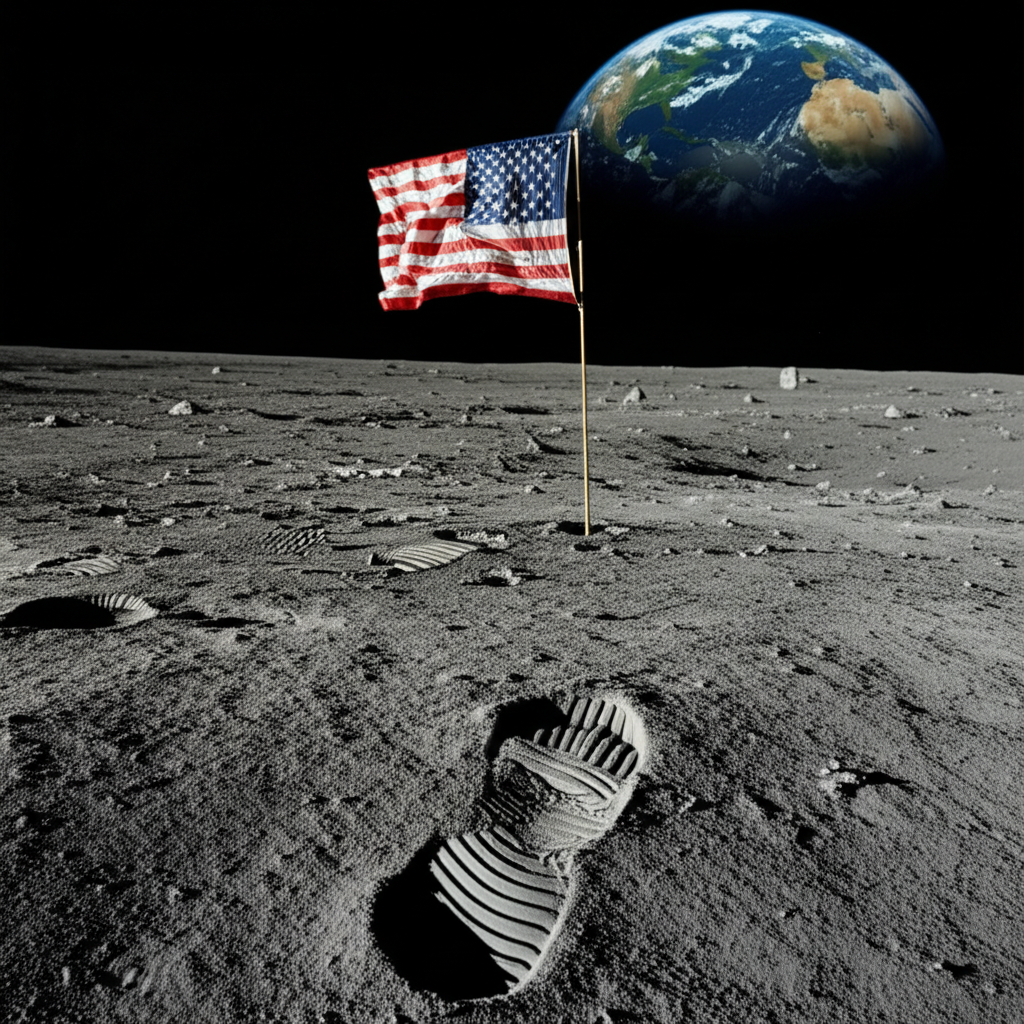
Minutes later, Buzz Aldrin joined him, describing the landscape as “magnificent desolation.” For over two and a half hours, the two astronauts explored their alien surroundings. They planted the American flag, conducted scientific experiments, collected precious lunar rock and soil samples – over 47 pounds in total – and deployed a passive seismometer and a laser ranging retroreflector. Photographs captured the indelible images of humanity’s presence on another world, a testament to collective ambition and individual bravery. The sheer unreality of two men walking on the Moon, a celestial body that had for millennia been a distant, unreachable orb, was almost overwhelming.
The Enduring Legacy of Apollo 11
The impact of the moon landing extended far beyond the realm of space exploration. It was a catalyst for unprecedented technological advancement, pushing the boundaries of computing, materials science, telecommunications, and medicine. The development of miniaturized computers, sophisticated life support systems, and advanced communication networks for the Apollo program eventually found their way into everyday life, benefiting generations.
Beyond the scientific and technological breakthroughs, Apollo 11 provided an incredible psychological boost during a turbulent decade. It united billions of people in a shared moment of wonder and achievement, demonstrating humanity’s capacity for extraordinary feats when united by a common purpose. It inspired legions of scientists, engineers, and dreamers, proving that seemingly impossible goals could be achieved through perseverance and innovation.
The lunar samples brought back by Apollo 11 and subsequent missions revolutionized our understanding of the Moon’s origin, composition, and geological history. This fundamental research continues to inform new theories about planetary formation and the conditions for life in the solar system. Today, as humanity looks towards returning to the Moon with the Artemis program and eventually venturing to Mars, the spirit of Apollo 11 remains a guiding light, a powerful reminder of what is possible when we dare to dream big and reach for the stars. The moon landing was not merely a destination reached, but a new horizon glimpsed, forever changing our perception of humanity’s place in the cosmos and igniting an insatiable desire to explore the unknown.
0 Comments