- Early Quests for Earth's Age: From Myth to Measurement
- Radioactive Dating: The Unlocking Key
- Confirming The Age: Evidence from Meteorites and Lunar Samples
- What 4.54 Billion Years Really Means: A Deep-Time Calendar
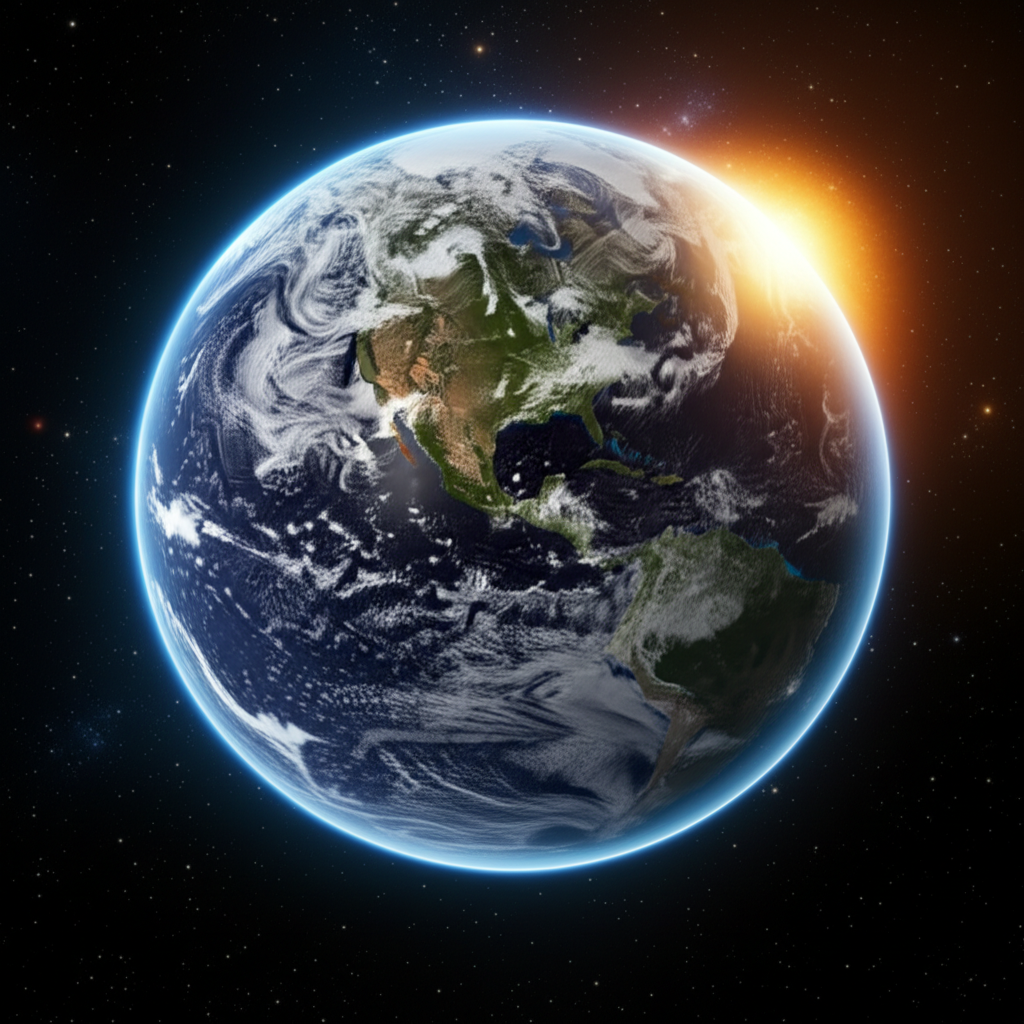
The vastness of time is a concept that often eludes our immediate grasp. For humans, a lifetime seems long, a millennium ancient, but these periods are mere blips on the unimaginable timeline of our planet. For centuries, humanity pondered the age of Earth, looking to myths, religious texts, and early scientific observations for answers. Today, thanks to groundbreaking scientific advancements, we have a remarkably precise figure: Earth is approximately 4.54 billion years old. This incredible span isn’t just a number; it tells the epic saga of cosmic dust coalescing into a vibrant, living world, constantly evolving through cataclysmic events and slow, persistent change.
Early Quests for Earth’s Age: From Myth to Measurement
Before the advent of modern geology and physics, estimations of Earth’s age varied wildly. Many ancient cultures had creation myths suggesting a relatively young Earth, often just a few thousand years old. In the 17th century, Archbishop James Ussher famously calculated Earth’s creation to have occurred on Sunday, October 23, 4004 BC, based on a literal interpretation of the Bible.
However, scientific inquiry began to challenge these notions. Geologists like James Hutton and Charles Lyell observed geological processes – erosion, sedimentation, volcanic activity – and realized that these required immense spans of time to form the landscapes we see. Lyell’s principle of uniformitarianism, stating that “the present is the key to the past,” suggested that geological changes happen gradually over eons. Lord Kelvin, a brilliant physicist in the 19th century, attempted to calculate Earth’s age based on its cooling rate, arriving at an estimate of 20 to 400 million years. While a significant step forward, his calculations were flawed because he didn’t account for a critical factor: radioactivity.
Radioactive Dating: The Unlocking Key
The true breakthrough in determining Earth’s age came with the discovery of radioactivity in the early 20th century. Scientists like Ernest Rutherford and Bertram Boltwood realized that certain unstable isotopes of elements decay into stable ones at a constant, predictable rate – a concept known as a half-life. This process is unaffected by temperature, pressure, or chemical environment, making it a perfect geological clock.
Radiometric dating works by measuring the ratio of parent radioactive isotopes (like Uranium-238) to their stable daughter products (like Lead-206) in a rock sample. The longer the rock has existed, the more parent isotopes would have decayed into daughter isotopes. This method revolutionised geochronology, allowing scientists to pinpoint the age of rocks with incredible accuracy. Geologists primarily use uranium-lead dating, potassium-argon dating, and rubidium-strontium dating, depending on the age range and type of rock.
Confirming The Age: Evidence from Meteorites and Lunar Samples
While radiometric dating allowed for the aging of Earth’s crustal rocks, the problem was that Earth is a geologically active planet. Processes like plate tectonics, erosion, and volcanism constantly recycle and reshape the surface, meaning very few pristine, ancient rocks from the planet’s infancy survive. The oldest known terrestrial rocks are around 4.03 billion years old (the Acasta Gneiss in Canada), with individual zircon crystals reaching 4.4 billion years, suggesting parts of the crust were solid relatively early.
To find the true age of the solar system, and by extension, Earth, scientists turned to celestial bodies less affected by geological processes: meteorites and lunar samples. Meteorites are fragments of asteroids that represent primeval material from the solar nebula that formed our solar system. When these meteorites are radiometrically dated, they consistently yield ages around 4.54 billion years. Similarly, rock samples brought back from the Moon by the Apollo missions, representing unaltered primordial crust, also dated to approximately 4.5 billion years. The consistency of these dates across multiple samples from different celestial bodies provides compelling evidence for the 4.54 billion-year age of Earth and the entire solar system.
What 4.54 Billion Years Really Means: A Deep-Time Calendar
To truly grasp the magnitude of 4.54 billion years, it helps to put it into perspective. If you compress Earth’s entire history into a single 24-hour day:
Midnight: Earth forms (4.54 billion years ago).
Around 4 AM: The first simple life appears (around 3.8 billion years ago).
Around 1 PM: Photosynthesis evolves, filling the atmosphere with oxygen (around 2.5 billion years ago).
Around 8:30 PM: Multicellular life emerges (around 600 million years ago).
Around 9:30 PM: Dinosaurs roam the Earth (around 250 million years ago).
Around 11:39 PM: Dinosaurs go extinct (66 million years ago).
11:59:58 PM: Modern humans appear (around 300,000 years ago).
The last fraction of a second: All of recorded human history.
This “deep-time calendar” vividly illustrates how long the planet existed before complex life, how recently humanity arrived, and how vast geological processes truly are. From the formation of supercontinents to the waxing and waning of ice ages, Earth has undergone unimaginable transformations, each event contributing to the planet we inhabit today.
The understanding of our planet’s immense age profoundly impacts our view of geology, evolution, and our place in the cosmos. It underscores the incredible resilience and transformative power of natural forces over billions of years, revealing Earth not as a static backdrop, but as a dynamic, living entity with a story far grander than we can often conceive.
0 Comments