
- The Profound Mystery of Quantum Entanglement
- Understanding Entanglement: The Basics
- The Birth of "Spooky Action at a Distance"
- Proving Entanglement: The Role of Bell's Theorem
- The Future Unlocked: Entanglement's Applications
- The Enduring Enigma
The Profound Mystery of Quantum Entanglement
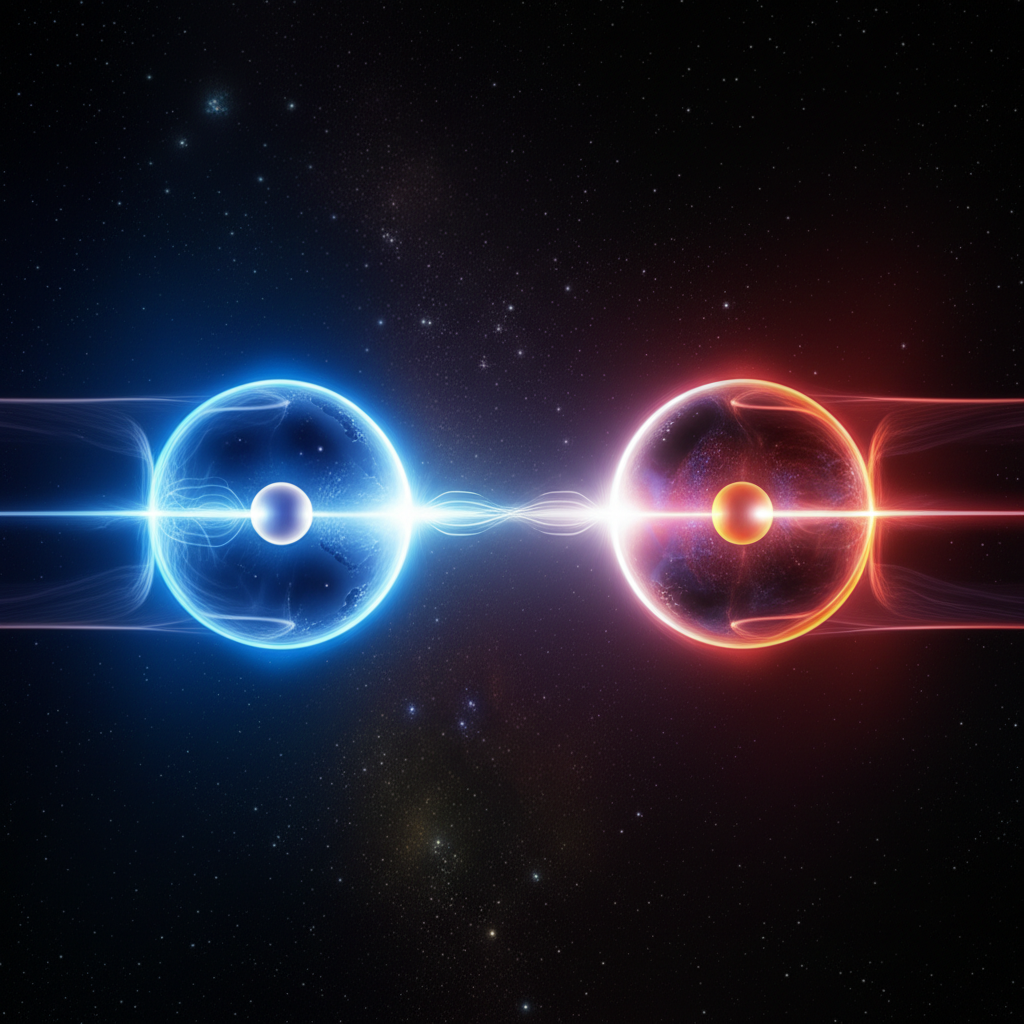
The universe, in its vastness and complexity, holds many secrets, but few are as perplexing and mind-bending as quantum entanglement. This peculiar phenomenon, first highlighted by Albert Einstein as “spooky action at a distance,” describes a deep and instantaneous connection between two or more quantum particles, regardless of how far apart they are. Imagine two coins, separated by light-years, where flipping one instantly determines the outcome of the other, even before information could possibly travel between them. This is the essence of entanglement, a concept that challenges our classical understanding of reality and local causality, pushing the boundaries of what we thought was possible. It’s a cornerstone of quantum mechanics, yet its true nature remains one of the most profound mysteries in physics.
Understanding Entanglement: The Basics
At its heart, quantum entanglement means that the quantum states of two or more particles become intrinsically linked. If you measure a property of one entangled particle – say, its spin or polarization – you instantly know the corresponding property of the other, even if they are light-years apart. Before measurement, these particles exist in a superposition of states, meaning they simultaneously possess all possible states until observed. It’s only when one particle is measured that its state “collapses” to a definite value, and instantaneously, its entangled partner also collapses into its correlated state. There’s no time delay, no signal traveling between them. They simply are linked.
This isn’t like two perfectly synchronized clocks that were set at the same time and run independently. Instead, it’s as if their gears are still somehow meshed, no matter the distance. The correlation is not about pre-existing hidden properties; experiments have overwhelmingly shown that the particles “decide” their state only at the moment of measurement, influenced by the shared entangled state.
The Birth of “Spooky Action at a Distance”
The term “spooky action at a distance” originated in 1935 when Albert Einstein, along with Boris Podolsky and Nathan Rosen, devised what became known as the EPR paradox. They proposed a thought experiment designed to expose what they saw as an incompleteness in quantum mechanics. Einstein, a staunch proponent of local realism – the idea that objects only influence their immediate surroundings (locality) and that physical properties exist independently of measurement (realism) – found quantum entanglement deeply disturbing. He believed there must be “hidden variables” or some underlying classical mechanism that explained the instantaneous correlation, rather than true non-local influence.
For Einstein, the idea that a measurement on one particle could instantaneously influence another far away contradicted the speed limit of light, a fundamental principle of his theory of relativity. If information could travel faster than light, it would break causality, potentially allowing effects to precede their causes. The EPR paper argued that quantum mechanics was incomplete if it couldn’t provide a full description of reality without invoking such “spooky” connections.
Proving Entanglement: The Role of Bell’s Theorem
Despite Einstein’s strong objections, his challenge inadvertently paved the way for experimental proof of entanglement. For decades, the EPR paradox remained a philosophical debate until Northern Irish physicist John Stewart Bell entered the scene in the 1960s. Bell devised a theoretical test, now known as Bell’s Theorem, which showed that if a system adhered to local realism (Einstein’s view), there would be certain limits to the correlations that could be observed between particles. However, if quantum mechanics was correct and entanglement truly existed without hidden local variables, then these correlations could exceed Bell’s upper limits.
Experiments designed to test Bell’s inequalities began in the 1970s, culminating in the groundbreaking work of Alain Aspect and his team in the early 1980s. Their experiments involved entangled photons, demonstrating correlations that consistently violated Bell’s inequalities. This was a monumental moment: it provided strong evidence that entanglement is a real phenomenon and that the universe operates in a non-local, quantum mechanical way that cannot be explained by classical physics or local hidden variables. Subsequent, more rigorous experiments in recent years have closed various “loopholes,” further solidifying the experimental validation of entanglement.
The Future Unlocked: Entanglement’s Applications
Far from being just a theoretical oddity, quantum entanglement is poised to revolutionize technology. Its unique properties are at the heart of several emerging fields:
Quantum Computing: Entangled particles, or qubits, can process information in ways classical bits cannot. While a classical bit is either 0 or 1, a qubit can be 0, 1, or both simultaneously through superposition. Entanglement allows these qubits to work together, vastly increasing computational power for specific tasks. This could lead to breakthroughs in medicine, materials science, cryptography, and artificial intelligence.
Quantum Cryptography (QKD): Quantum Key Distribution uses entangled particles to create unhackable communication channels. Any attempt by an eavesdropper to measure the entangled particles instantly changes their state, alerting the communicating parties to the interception. This provides an unparalleled level of security.
Quantum Teleportation: While not teleportation of matter in the sci-fi sense, quantum teleportation involves moving the state of a quantum particle from one location to another using entanglement. This technology is crucial for building quantum networks and the quantum internet, serving as a fundamental protocol for transferring quantum information.
Enhanced Sensing and Metrology: Entanglement can be used to create extremely precise sensors, potentially improving everything from medical imaging to gravitational wave detectors.
The Enduring Enigma
Despite the experimental validation and the profound technological prospects, entanglement remains a deep mystery. We can observe it, measure it, and even harness it, but we still don’t fully understand how it works or why the universe is structured in such a non-local way. Is there truly instantaneous action at a distance, or is our understanding of space and time incomplete at the quantum level? Does entanglement hint at a deeper, more fundamental reality where particles are never truly separate?
The implications are staggering. It challenges our intuitive understanding of cause and effect, suggesting a universe where separateness might be an illusion at its most fundamental scale. Scientists continue to explore whether entanglement could be a gateway to uncovering new physics, perhaps even bridging the gap between quantum mechanics and general relativity. As we delve deeper into this “spooky” connection, quantum entanglement continues to reveal the profound, counter-intuitive, and wonderfully strange nature of our universe, promising both technological marvels and an endless frontier of fundamental discovery.
0 Comments